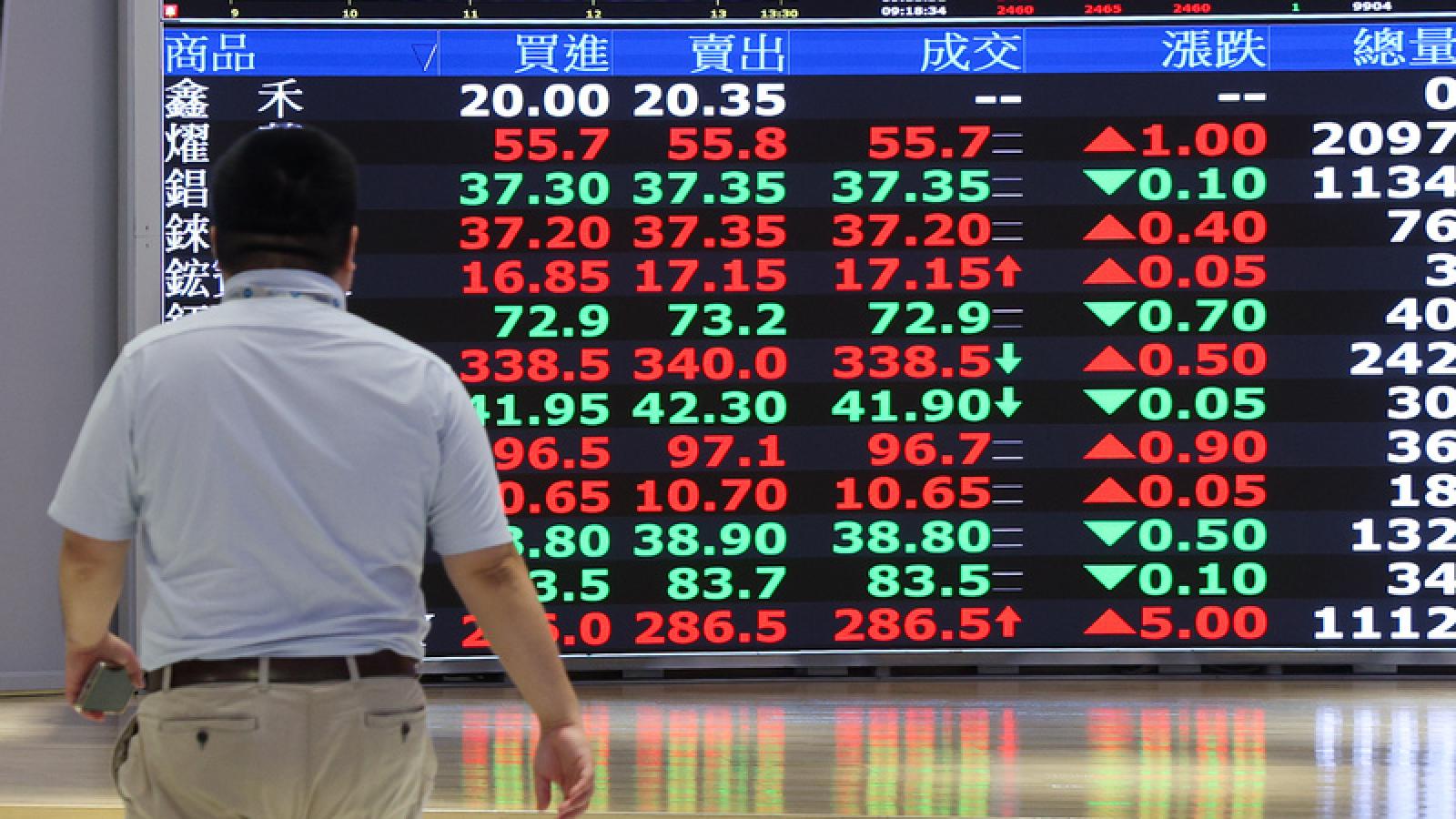
August marks a crucial period when listed and OTC companies in Taiwan are密集ly releasing their semi-annual reports. Hsieh Jin-He, chairman of CommonWealth Magazine, posted on Facebook that Taiwan's economic growth rate in the first half of 2024 reached 13.72%, the largest increase in half a century. This economic performance not only surpasses that of China and South Korea but also demonstrates Taiwan's successful transformation in foreign trade, shifting significantly toward the U.S. and New Southbound markets.
Taiwan's economic growth rate of 13.72% has set a half-century record, far exceeding China and South Korea. Hsieh stated that if this first-half performance were a midterm exam, Taiwan has scored 'more than 100 points.' Data shows that Taiwan's GDP growth was 14.55% in Q1 and 12.92% in Q2, averaging 13.72% for the first half— the highest growth in 50 years. In contrast, China, which once frequently achieved double-digit growth, recorded only 5% in Q1 and 4.3% in Q2. Fixed asset investment in China declined by 5.7% year-on-year in Q2, and real estate investment dropped by 18%, indicating mounting pressure from bubble adjustments.
South Korea, although benefiting from strong HBM (High Bandwidth Memory) demand that has put SK Hynix and Samsung in the global spotlight, posted growth rates of 3.8% in Q1 and 3.7% in Q2—still significantly behind Taiwan. However, Hsieh cautioned that due to HBM demand, Taiwan imported $46.591 billion from South Korea in the first half (up 66.6% year-on-year), while exports to South Korea amounted to only $16.109 billion, resulting in a trade deficit of $30.481 billion—making South Korea Taiwan's largest trade deficit partner. Hsieh criticized that while South Korea benefits greatly from Taiwan, political figures like Lee Jae-myung have adopted hostile attitudes toward Taiwan. He emphasized that Taiwan holds leverage and should not remain passive, urging government departments to develop counter-strategies based on export structures.
Regarding global trade dynamics, Hsieh analyzed that many remain nostalgic for ECFA and cross-strait trade or even a shared market, but such a scenario is 'irreversible.' The current focus, he stressed, is investment in the United States. Taiwan's export share to China and Hong Kong has dropped from 43.9% in 2020 to 23.8% in the first half of 2024. Export value reached $99.142 billion (up 25.2% year-on-year), with the trade surplus shrinking to $39.585 billion. In contrast, Taiwan's export share to the U.S. rose from 11.7% in 2020 to 32%. Exports to the U.S. totaled $133.312 billion (up 69% year-on-year), generating a trade surplus of $104 billion. Additionally, the New Southbound Policy has proven effective, with exports reaching $86.361 billion (up 55.4% year-on-year) and a surplus of $36.89 billion. ASEAN markets, especially Singapore, are playing an increasingly important role.
Hsieh emphasized that while many have long claimed Taiwan's economy depends on China, 'in reality, China depends more on Taiwan.' In the first half of 2024, electronic components—primarily semiconductors—exported from Taiwan to China amounted to $68.029 billion, accounting for 68.6% of total exports to China. Adding information and communications technology (ICT) products, which account for 11.7%, the combined share exceeds 80%, leaving traditional industries at just 12%. Although many traditional industries have been crushed by China's internal competition, China still heavily relies on Taiwan's semiconductors. For years, many have painted Taiwan's economy in a negative light, but 'the numbers speak for themselves,' Hsieh concluded, calling this a remarkably strong performance.
FACT BOX
- Source: PR Times
- Category: Survey