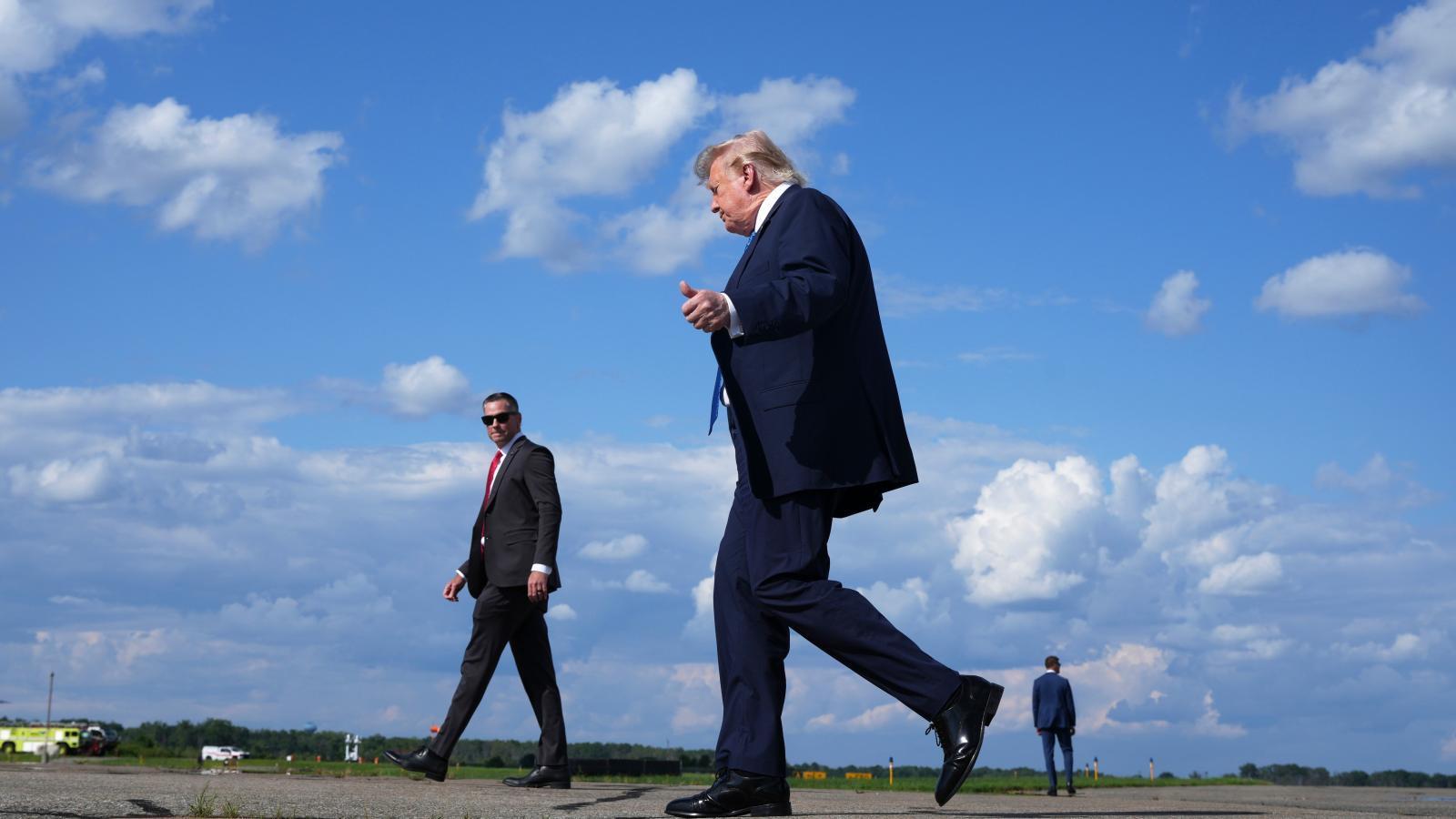
U.S. President Trump confirmed in a recent interview that Washington has shifted its strategy toward Iran to 'low keying it,' favoring economic pressure over launching a new round of large-scale military attacks to force Tehran to concede. Meanwhile, Iranian officials have loudly ruled out the possibility of direct dialogue with the United States, again accusing Washington of violating the interim agreement, leaving negotiations over the resumption of navigation through the Strait of Hormuz in deadlock.
According to U.S. news website Axios, Trump revealed in a phone interview on the 9th that the U.S. is closely monitoring Iran's extreme inflation and financial exhaustion. Trump stated, 'We're just semi-negotiating with them right now. We're just watching Iran's soaring inflation and the fact that they have no money at all.'
Trump emphasized that Iran's economy is in dire condition, even unable to pay military salaries, and that the U.S. naval blockade is further exacerbating Tehran's plight. Despite the postponement of the scheduled announcement of a Strait of Hormuz resumption agreement between Iran and Oman last week, Trump did not issue new military threats, saying only, 'Everything will be resolved. Things always get resolved. It's like a chess game.'
Trump added that with international oil prices falling back to just over $75 per barrel, the impact on American consumers has eased, giving the U.S. sufficient strategic patience.
Iranian Foreign Minister Rules Out U.S.-Iran Talks
While Trump softens his stance, Tehran's position on negotiations with the U.S. has hardened. Bloomberg and AFP report that Iranian Foreign Minister Abbas Araghchi issued a televised statement on the 9th, clearly denying the possibility of direct U.S.-Iran talks.
Araghchi pointed out that the U.S. has repeatedly violated the Memorandum of Understanding (MoU) signed in June, stating, 'As long as the United States continues to violate the MoU and fails to compensate for its breaches, there can be no resumption of negotiations between the two sides.' Araghchi clarified that Tehran is not directly negotiating with Washington, with all messages conveyed only through third-party mediators like Oman, though he acknowledged that discussions with Oman on navigation arrangements are 'approaching the final stage.'
The Strait of Hormuz, through which one-fifth of the world's oil and natural gas shipments pass, has seen nearly complete shipping disruption since the U.S. and Israel launched a surprise attack on Iran on February 28. Although the U.S., Iran, and Oman had nearly reached a consensus on channel management, hardliners in Iran subsequently presented new conditions, causing the agreement to falter. According to U.S. and mediator officials, a fierce internal power struggle is unfolding within the Iranian regime:
The pragmatic faction led by Iranian President Masoud Pezeshkian fears total economic collapse and advocates quickly reaching an agreement with the U.S. to lift the blockade. In contrast, the hardline faction led by Islamic Revolutionary Guard Corps (IRGC) General Ahmad Vahidi and Supreme National Security Council Secretary Mohammad Bagher Zolghadr remains firmly opposed to compromise. On the 9th, the office of Iran's Supreme Leader Ayatollah Mojtaba Khamenei confirmed that Khamenei had met with President Pezeshkian to receive a detailed report on the 'battle situation and economic difficulties.'
On Saturday (8th), Zolghadr presented six stringent conditions for reopening the strait, demanding that the U.S. permanently cease hostilities against Iran and its allies in Lebanon, Gaza, Yemen, and Iraq, fully withdraw troops, lift maritime blockades and sanctions, release frozen assets, and compensate for war damages (the interim agreement mentioned a $300 billion reconstruction fund). On the 9th, the Revolutionary Guard declared that 'the strait is a battlefield, not an ordinary waterway' until all conditions are met.
Houthis Attack Saudi Refinery
As U.S.-Iran talks stall, geopolitical tensions in the Middle East have escalated again. Iran-backed Yemeni Houthi militants (Houthis) claimed on the 9th to have attacked Saudi Aramco's oil refinery in Jizan, Saudi Arabia; Saudi authorities confirmed a fire but stated it had been extinguished. Additionally, the Houthis have imposed a parallel blockade on Saudi ports and launched attacks in Yemen's Mokha port, killing at least 11 people.
U.S. Vice President JD Vance emphasized in a Fox News interview on the 8th that Washington is comprehensively employing diplomatic, economic, and military tools, stating, 'This isn't over. We're in the middle of the game.' U.S. officials also revealed that although U.S.-Iran talks are stalled, about 8 million barrels of crude oil are still being shipped out of the Persian Gulf each night via the southern Strait of Hormuz route under U.S. military coordination and escort. Washington will continue its dual-track strategy of 'semi-negotiation' and 'maximum economic pressure' to wait for Tehran to soften its stance under internal pressure.
FACT BOX
- Source: PR Times
- Category: News
- Organizations: Saudi Aramco / Axios / Bloomberg