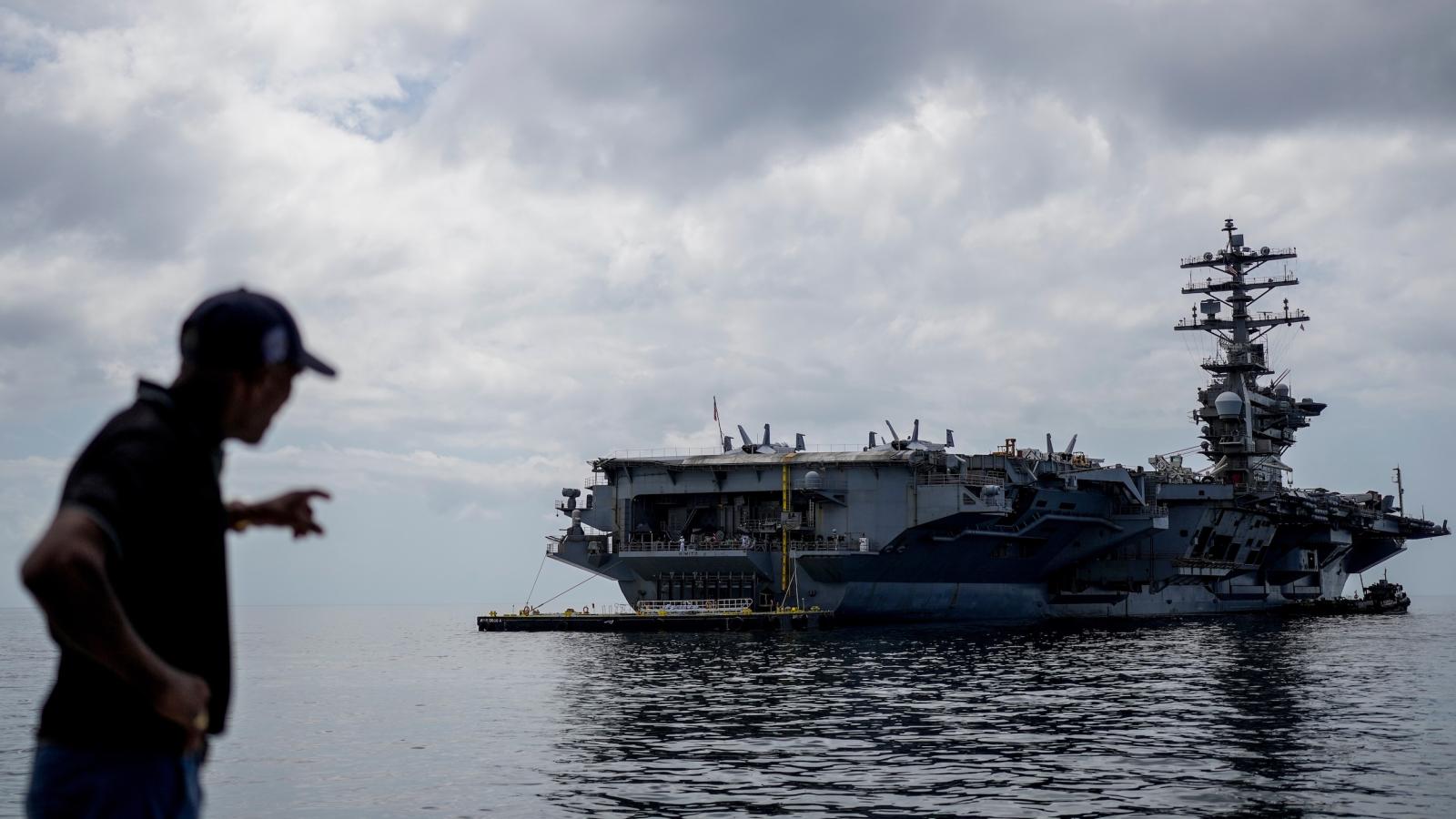
In the geopolitical contest across the Indo-Pacific, a persistent shadow over U.S. military strategic planning is the vulnerability of aircraft carriers. This narrative stems from China’s ongoing development of its 'Anti-Access/Area Denial' (A2/AD) strategy, particularly long-range ballistic missiles known as 'carrier killers.' This concern was most vividly illustrated when U.S. Secretary of Defense Pete Hegseth admitted, 'In every war game simulating conflict with the PLA, we lose.' He further questioned on a podcast: 'What would it look like if 15 hypersonic missiles could destroy our 10 aircraft carriers within 20 minutes of conflict onset?'
Interestingly, while China actively develops tactics targeting U.S. carriers, it is simultaneously building its own aircraft carriers. Beijing’s obsession with these maritime giants is not only symbolic of military modernization but also a declaration of its ambition to become a global naval power. From the Liaoning, built from scrap metal retrieved from Ukraine, to the Fujian—displacing 80,000 tons and equipped with electromagnetic catapults (carrying J-15, J-35, and KJ-600 early warning aircraft)—and the Sichuan, believed to be a drone carrier (equipped with the stealth GJ-11 'Sharp Sword' UAV), to the highly likely first Chinese nuclear-powered carrier, the Type 004, currently under construction. This rapid expansion hides a deep strategic contradiction: while China emphasizes the obsolescence and vulnerability of large warships through anti-ship missiles, it continues to build equally vulnerable high-value targets.
A recent report by the Washington-based think tank 'Center for Strategic and International Studies' (CSIS), titled 'Flipping the Script: How to Hold China’s New Carriers at Risk,' highlights how the risk of being hunted—once primarily a U.S. concern—is rapidly shifting to the PLA. China aims to add six more carriers by 2035, bringing its total to a staggering nine. These carriers are expected to deploy east of Taiwan during a cross-strait conflict, blocking reinforcements and enforcing a blockade, while extending China’s strike reach beyond the First Island Chain to advance its interests in the South China Sea and beyond. CSIS researchers argue that the U.S. military should shift from a defensive to an offensive posture in carrier operations, treating Chinese carrier strike groups as the highest-priority asymmetric targets—a move not just in military technology, but in reclaiming psychological deterrence.
China’s Naval Rise and Vulnerability
The CSIS report notes that for every $1 China invests in hypersonic missile development, it could theoretically destroy $10,858 worth of U.S. naval assets. However, this logic applies equally to the PLA. When Chinese carriers attempt to break through the Miyako Strait or Bashi Strait into the Pacific, they lose the tight protection of land-based air defense and coastal surveillance networks. Without combat experience or a mature anti-submarine warfare (ASW) system, these expensive strategic platforms become ideal targets for U.S. and allied 'kill chains.'
The PLA has indeed integrated space-based sensing, AI computation, and long-range precision firepower to keep U.S. forces at bay near Chinese shores. However, to counter carrier strike groups that are highly mobile and equipped with layered defenses in open waters, this 'kill web' requires continuous tracking and real-time data links from space to the deep sea. Disrupting or severing these sensor nodes would significantly degrade the effectiveness of China’s kill web.
To counter the PLA’s carrier capabilities, CSIS proposes five key tactics:
Tactic 1: Submarine Underwater Ambush
Underwater warfare is considered the PLA Navy’s 'Achilles’ heel' by CSIS. Reflecting on the 1982 Falklands War, the sinking of Argentina’s General Belgrano by a British nuclear-powered submarine caused the remainder of the Argentine Navy to retreat to port. The PLA’s overall ASW capability still lags far behind that of the U.S.-Japan alliance. The U.S. Virginia-class nuclear-powered attack submarines (SSNs) can conduct deep-water surveillance and hunting, while Japan’s Taigei-class and South Korea’s Dosan Ahn Changho-class conventional submarines, equipped with Air-Independent Propulsion (AIP), can serve as silent ambushers in shallow waters or narrow straits.
In terms of weaponry, the MK-48 heavyweight torpedo, costing $4.142 million per unit, is considered the top choice for sinking Chinese carriers. Detonating beneath the hull and generating a massive pressure wave, it could break the Fujian’s keel. To counter escort vessels in Chinese carrier groups, the U.S. is developing the low-cost 'RAPTOR' torpedo, aiming to exhaust enemy defenses through saturation attacks. If the U.S. and its allies set up ambush zones at key First Island Chain chokepoints, Chinese carriers would face devastating threats from the moment they leave port.
Tactic 2: Land-Based Anti-Ship Strikes
To counter the PLA’s long-range firepower, the U.S. military is working to transform the First Island Chain into an 'unsinkable fortress' composed of countless defensive nodes. This involves structural transformation of the U.S. Marine Littoral Regiments (MLR) and Army Multi-Domain Task Forces (MDTF). Core weapons include the highly mobile Marine Corps Expeditionary Ship Interdiction System (NMESIS) and the Army’s 'Typhon' tactical system.
CSIS highlights that the strength of these forces lies in dispersion and concealment. When missile systems are mounted on unmanned chassis, they can be rapidly deployed across the First Island Chain. The U.S. Precision Strike Missile (PrSM) has already proven capable of hitting moving maritime targets. Deploying even a small number of land-based missiles at the Miyako, Bashi, and Balintang Straits could effectively trap Chinese carriers within the First Island Chain.
For the Chinese Navy, this is an extremely difficult tactic to counter. Aircraft carriers are highly visible and mobility-constrained targets, while mobile land-based missile launchers are extremely difficult to detect and lock onto via satellite. This geographically advantageous asymmetric setup allows the U.S. to force China into investing massive resources into an almost impossible 'island seizure' campaign, effectively slowing PLA force projection.
Tactic 3: Long-Range Air Strikes
CSIS notes that in high-intensity modern warfare, completely sinking an enemy vessel isn’t always necessary. 'Mission kill'—damaging the flight deck, disrupting communications, or destroying fuel stores to render the carrier combat-ineffective—can be more strategically valuable.
U.S. air strikes center on B-1B and B-52 bombers, capable of launching Long-Range Anti-Ship Missiles (LRASM) from outside PLA air defense zones. LRASM features high autonomy and stealth, able to identify the most valuable targets within enemy fleets. Meanwhile, F-35 fighters can act as advanced sensor nodes, providing precise mid-course guidance for missiles. Even if U.S. communication satellites are jammed by the PLA, this tactic remains robust.
Tactic 4: Electronic Jamming
In non-kinetic warfare, cyber-electromagnetic attacks will be a nightmare for the PLA. Chinese carriers heavily rely on land-based data links and the BeiDou navigation system. Through electromagnetic jamming and cyber attacks, the carrier’s radar screens could be flooded with false targets, and carrier-based aircraft might fail to establish navigation links. Successfully disrupting the air traffic control system would render the carrier a defenseless hulk. CSIS believes this tactic is highly effective for managing escalation, potentially forcing the enemy’s most powerful assets to withdraw without triggering full-scale war.
Tactic 5: Drone Swarms
CSIS points out that the biggest lesson from the Ukraine war for modern naval warfare is asymmetric combat: Ukraine, with almost no navy, has severely damaged Russia’s Black Sea Fleet and forced its retreat using drones. This asymmetric approach is rapidly being adopted in the Indo-Pacific. The CSIS report specifically highlights Taiwan’s indigenously developed 'Fenjin Mofish' (Manta) unmanned surface vessel. This drone can launch swarm attacks, posing a major tactical burden on Chinese carriers.
Additionally, the U.S. military is developing tactics to deploy large numbers of small drones and suicide drones from mother ships. PLA carriers may be forced to remain docked for extended periods due to underwater threats. If carriers are immobilized by severed supply lines or ports blocked by drone-laid mines, their strategic deterrent value collapses entirely. This low-cost blockade strategy allows U.S. allies like Taiwan and the Philippines to threaten China’s powerful carriers without building large warships.
Building the '300+300' Hybrid Fleet
While CSIS proposes numerous asymmetric tactics against Chinese carriers, the U.S. shipbuilding industry has indeed severely declined. For example, the U.S. builds only 1.2 Virginia-class submarines per year, far below the target of two per year. Therefore, the report recommends that the U.S. Navy abandon the traditional '350 manned vessels' framework and transition to a '300+300' hybrid fleet—300 manned combat vessels and 300 unmanned platforms. To drive this transformation, the U.S. military has allocated
FACT BOX
- Source: PR Times
- Category: Survey