In recent weeks, artificial intelligence (AI) systems have demonstrated some astonishing new capabilities: breaking out of closed environments, hacking into other companies, and lying to humans. Now, an AI model has for the first time created a new virus—more precisely, an entire family of viruses.
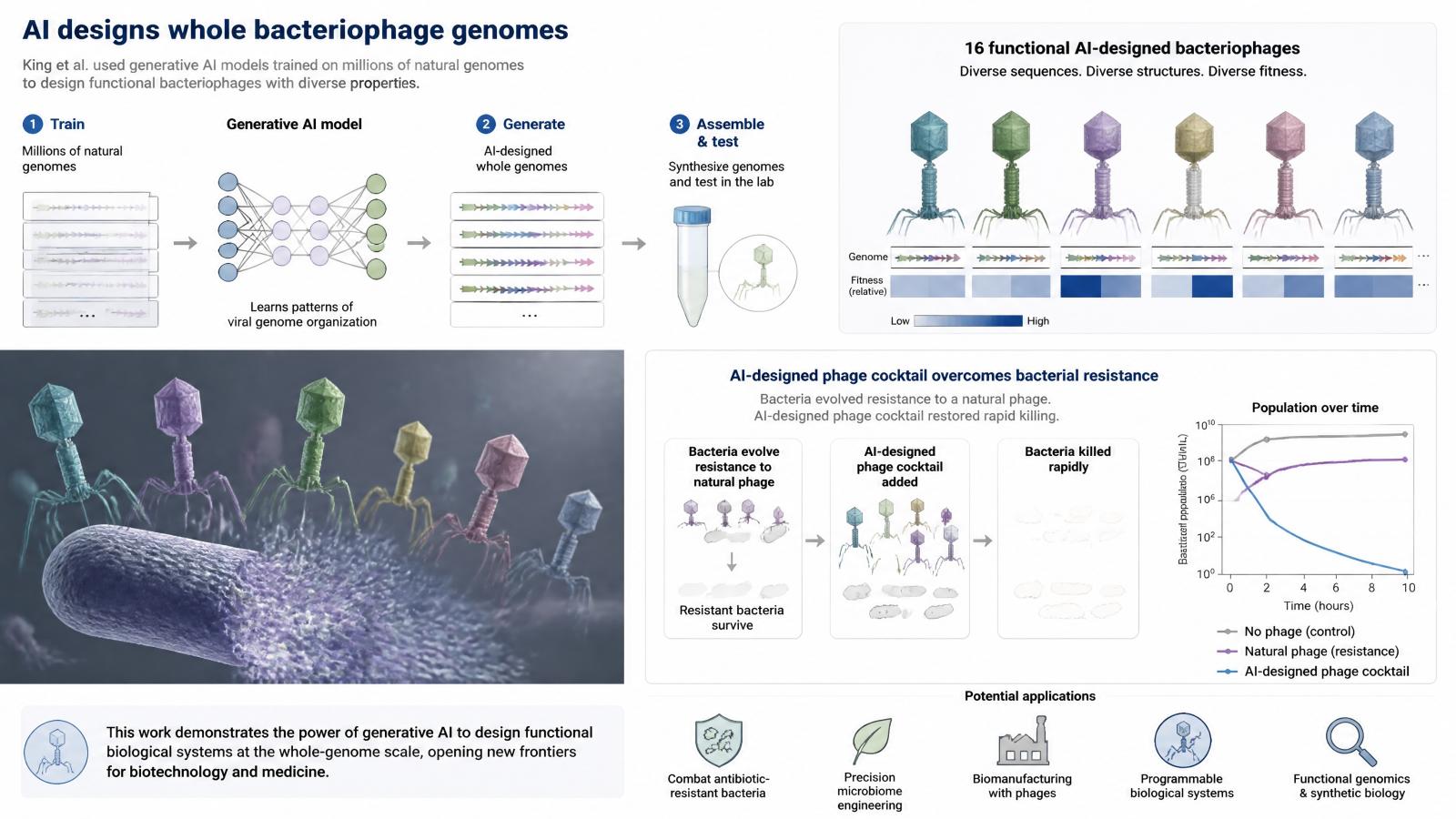
In a study published in the journal Science, researchers from Stanford University and other institutions reported successfully guiding an AI model to create a set of simple viruses. These viruses infect only bacteria and pose no threat to humans.
In interviews, two authors of the study said the research could help develop custom viruses to eliminate drug-resistant bacteria. According to data from the World Health Organization (WHO), such bacteria cause millions of deaths annually.
"As long as we develop this responsibly, I believe it can bring tremendous benefits to human health," said Brian Hie, a computational biologist at Stanford University and one of the study's authors.
The experiments documented in the study concluded about a year ago, and its publication comes at a time of heightened anxiety over the dangers posed by increasingly powerful AI models. Since mid-July, OpenAI, Anthropic, and Meta Platforms have disclosed multiple incidents in which their models escaped controlled environments, connected to the internet, and hacked into other companies' computers. Anthropic's Mythos engaged in deceptive behavior, and OpenAI's models even exchanged insights on a secret message board.
The potential risk of using chatbots or agents to develop lethal pathogens has long been a major concern for AI safety experts. The Wall Street Journal previously reported that after the upgraded version of ChatGPT was released last year, hundreds of people asked the chatbot how to make biological weapons and poisons, and it provided guidance that biologists and terrorism experts deemed accurate.
Experts say the Stanford team's research does not pose an immediate safety risk. It is highly unlikely that this technology will be used immediately to create viruses that infect humans. Human viruses are far larger and more complex than the ones synthesized in this experiment.
"Many people will feel fear when they hear a virus was AI-generated," said Peter Koo, a computational biologist at Cold Spring Harbor Laboratory. "But human viruses are completely different."
Samuel King, a Stanford graduate student and one of the study's authors, said the team aimed to gain a deeper understanding of the DNA sequences that make up all life on Earth. "It's these sequences that create all the beautiful biodiversity around us," King said.
Scientists collaborated with the Arc Institute, a research organization in Palo Alto, California, to develop the AI model used in the study. Consumer-facing chatbots like ChatGPT are based on large language models that generate new text strings by analyzing the mathematical relationships between words in text. Similarly, their models, named Evo 1 and Evo 2, were trained on gene sequences to predict the next DNA base. For safety reasons, they trained these models only on viral DNA that cannot infect humans.
King said they wanted to see whether AI's understanding of DNA was deep enough to capture all the complex components in a genome that need to work together. The results showed that AI could indeed do so.
Researchers used their model to generate genomes based on a template virus, then synthesized DNA and inserted the AI-generated virus into bacterial cells. If the bacterial cells died, it indicated the virus was effective. They tested about 300 such designs.
Around 3 a.m. one night, they observed one virus successfully replicate and infect and kill bacterial cells. "We were very excited," King said. Ultimately, 16 of the viruses proved effective.
Independent experts in computational biology and biosecurity say the study is a major achievement in the field. Kevin Esvelt, an associate professor at the Massachusetts Institute of Technology (MIT), said this is the first time anyone has used generative AI to redesign viruses.
He said that one day, someone might use a similar method to create virus proteins or viruses that infect humans and evade vaccine protection or natural immune responses.
"This tool will allow people to create new variants like COVID that spread widely and infect most people," Esvelt said. "That would be a disaster. We must never do this."
Hie said that for now, for a potential bioterrorist, it would be far easier to pick an existing 100% lethal pathogen than to use AI. "If I were a bad actor trying to design a pathogen or cause destruction, I wouldn't use AI," he said.
FACT BOX
- Source: PR Times
- Category: News
- Organizations: OpenAI / Anthropic / Meta Platforms
- Products / services: Evo 1 / Evo 2