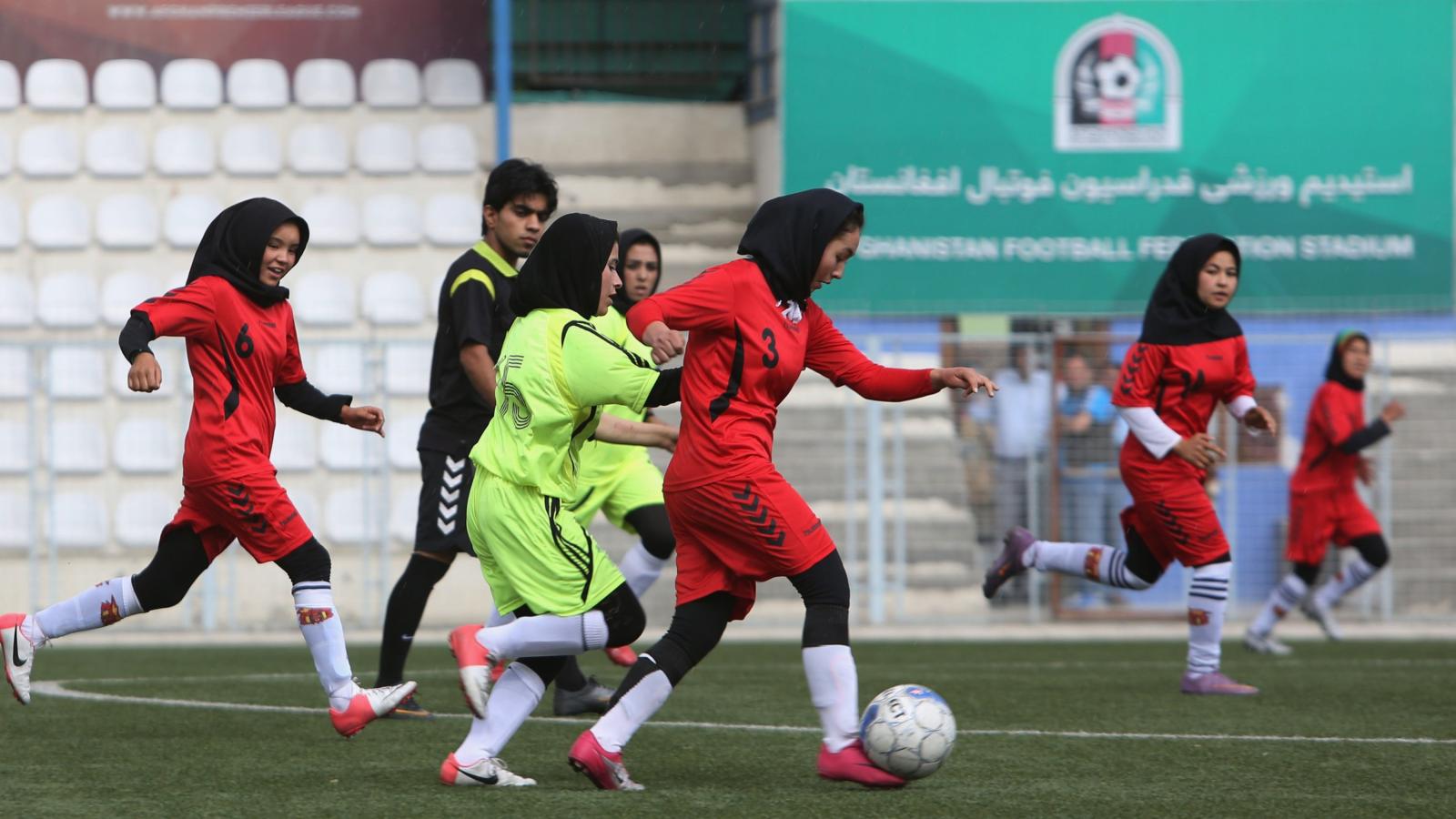
The locker room buzzed with activity as players prepared for the match. Some stretched, others retied their cleats, and teammates embraced. "Let’s be strong as always, because we represent Afghan women," said midfielder Fatima Haidari to her teammates on the 'Afghan Women United' team. Applause filled the room. The Afghan flag hung on the wall, and a patriotic song played. The players sang along, holding back tears. Before stepping onto the pitch, the coach led a final huddle, offering words of encouragement. For these women, the field is a place they’ve long been told doesn’t belong to them.
This 23-member team, made up of Afghan players now living overseas, has come to New Zealand for training and two unofficial friendlies against the Cook Islands. It’s their first reunion since FIFA’s April 2024 ruling that allows them to represent Afghanistan in official international competitions. Previously, representing Afghanistan required approval from the Afghanistan Football Federation, which became impossible after the Taliban regained power in August 2021. The Taliban has imposed sweeping restrictions on women and girls, including banning secondary and higher education, most employment, and organized sports.
The Afghan women’s national football team was founded in 2007 but was unable to continue playing. Players became targets of evacuation efforts and were resettled in countries like Australia, the UK, and Portugal. After years of advocacy, a refugee representative team—now known as 'Afghan Women United'—was formed. With FIFA’s new ruling, the team now has a pathway to compete in major international tournaments like the Olympics and World Cup. Reuniting in New Zealand, each player is thrilled to play together again. As asylum seekers scattered across different countries, they’ve struggled for five years to obtain travel documents, making full-team training impossible until now.
The day before the match, in an Auckland hotel, Manozh Noori wore a T-shirt and knee-length shorts, her hair cut short. She said relatives often criticized her for looking "too masculine." The 23-year-old, speaking to BBC’s Global Women, began to tremble when talking about her family. She paused, took a deep breath, looked away, and continued—tears unshed but emotion evident. Now living in Australia, Noori played football on the streets of Kabul with boys as a child. After seeing women’s football on TV, she secretly joined a local club and rose to the highest level in Afghanistan. Knowing her brother would disapprove, she wore a mask during matches to avoid being recognized. Over six years, she won league titles, national championships, and multiple individual awards. Eventually, her success could no longer be hidden. Around 2018, teammates convinced her to remove her mask during a TV interview. The segment aired with match highlights. She knew her brother would see it. "I was so scared," she recalled. "I kept thinking, 'He’ll see me, he’ll know.'" In desperation, she even tried cutting the power at home to stop her family from watching. But the news reached her brother, who erupted in anger. "He kept shouting," Noori said. "'You told me you were studying! You said you wanted to be a teacher, a doctor—what is this?'" She said he threatened to cut ties with the entire family if she didn’t stop playing. "My mother cried constantly. She told me, 'We depend on him. How will we survive without him?'" Noori briefly quit football but eventually returned. Another brother, living in Germany, sent money to support her dream.
After the Taliban regained power in 2021, Noori decided to flee Afghanistan. Before leaving, she buried her football medals and trophies in her family’s garden. More than four years later, they remain there. "One day, I’ll go back and dig them up," she said, briefly smiling. "Football helped me bring my mother and sister out of Afghanistan," she said. Two years after settling in Australia and establishing herself as a player, she successfully brought her mother and sister to Australia. Her sister was able to resume her education. While her brother opposed sports, he supported their education. "I hope my brother now knows I’m not a bad person," she said.
As Noori and her teammates prepared to face the Cook Islands in Auckland, many said football had been the force that carried them through Afghanistan’s most turbulent modern era. "If I weren’t a footballer, I’d still be in Afghanistan, one of millions of girls unable to study, speak, or choose their future," said Mursal Sadat, 24, now based in Australia. She works as a football coach, youth worker, and advocate for refugee, women’s, and human rights. In Afghanistan, she faced constant criticism and harassment, often told no one would marry a woman who played football. Now engaged to a man still in Afghanistan, she said her fiancé and his family support her work and her national team role. "They told me, 'You’re our family’s pride. We’re so lucky to have you.'"
The players stepped onto the pitch in Auckland’s rain to face the Cook Islands. They brought full energy and determination, undeterred by the weather—after all, they’d faced far harsher conditions. Defender Najma Arefi recalled that as a youth, women’s teams were always scheduled for the worst training times, forcing her to train in temperatures above 45°C. Still, she persisted. At 22, she helped her team from Herat win the national championship. That victory, she said, changed local perceptions of women’s sports. "Our billboards were everywhere in Herat," she recalled. "Everyone was proud. More families began letting their daughters play football."
After the Taliban takeover, she arrived in the UK and now lives in Doncaster, northern England. She describes herself as outgoing. She’s studying criminal justice, continues playing football, and can now make her own life choices. "Having this freedom is truly incredible," she said. Yet, she admits guilt and sorrow when thinking of Afghan women still deprived of freedom. "Millions of girls have no chance to study or chase dreams. I feel I must seize every opportunity," she said, tears streaming. She especially thanked Khalida Popal, founder of the Afghan women’s football team, for years of advocacy to gain FIFA recognition for the exiled team. Being recognized by FIFA "without needing Taliban approval" was a historic moment, she said. "This official status will be something I’m proud of for life."
When BBC asked Ahmadullah Wasiq, the Taliban’s sports director, about FIFA’s support for the women’s team, he declined to comment. However, he expressed hope that FIFA would revisit Afghanistan and resume support for local football development—support that FIFA has largely halted since the Taliban’s return. FIFA has previously stated that resuming support depends on women’s ability to participate in football again.
The two matches in Auckland didn’t go well. The Afghan team lost 0–1 in the first game. Three days later, despite their efforts, they lost 0–3 again. Yet, for these players, the significance of these matches far outweighed the losses. They returned to the pitch, proving to the world that even in exile, separated from family, and enduring years of uncertainty, Afghan women footballers have never chosen to disappear.
FACT BOX
- Source: PR Times
- Category: News