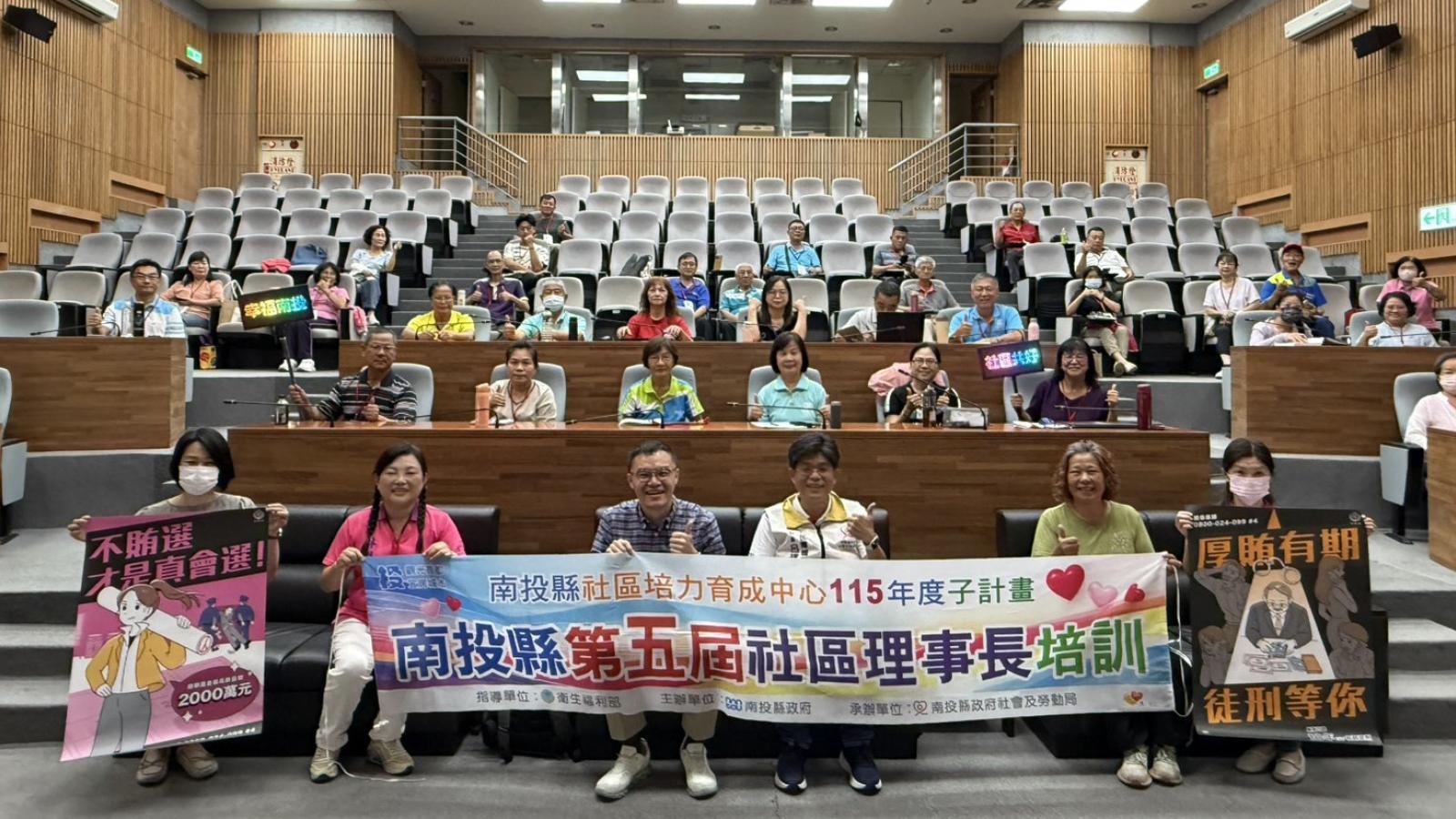
On the 12th, Nantou County Government held the second session of its '5th Nantou Community Chairperson Training' at the 7th-floor International Conference Hall, inviting Associate Professor Liang Kai-Lin from National Chi Nan University to lecture on 'Design Thinking and Community Program Ideation' and 'Consensus Decision-Making in Communities.' The training aimed to guide community chairpersons and staff across the county to start from residents' needs, learn program design and consensus-building techniques, and enhance community governance and leadership capabilities.
The County's Department of Social and Labor Affairs emphasized that community chairpersons are not only responsible for administrative tasks and event planning but also serve as key leaders in uniting residents, integrating resources, and driving community development. Facing diverse challenges such as aging populations, volunteer shortages, generational gaps, and low resident engagement, communities must move beyond asking 'what events to organize' and instead deeply understand 'what residents truly need' to maximize the impact of limited resources.
The morning session introduced 'Design Thinking,' guiding participants through steps such as empathizing with residents, defining problems, ideating solutions, prototyping, and testing and refining. This approach emphasizes understanding residents' lived experiences and needs before designing services, transforming residents from passive recipients into active partners in community development.
The afternoon focused on 'Consensus Decision-Making,' exploring how communities can move beyond voting to identify underlying concerns through meaningful dialogue when facing differing opinions. The session introduced practical tools such as the Five-Finger Method, Consensus Thermometer, small group discussions, feedback circles, and plan stacking to help community leaders incorporate diverse viewpoints into discussions and adjust proposals accordingly. Consensus decision-making does not replace voting but offers an alternative method tailored to different issues, enabling decisions that are more easily understood and supported by residents.
The County Government stated that through this series of trainings, community chairpersons are expected to evolve beyond 'event organizers' into leaders who listen to residents, integrate diverse opinions, and inspire collective action. By applying what they have learned in their communities, participants will gradually strengthen resident engagement and self-governance, collectively building more resilient and compassionate happy communities.
FACT BOX
- Source: PR Times
- Category: Event