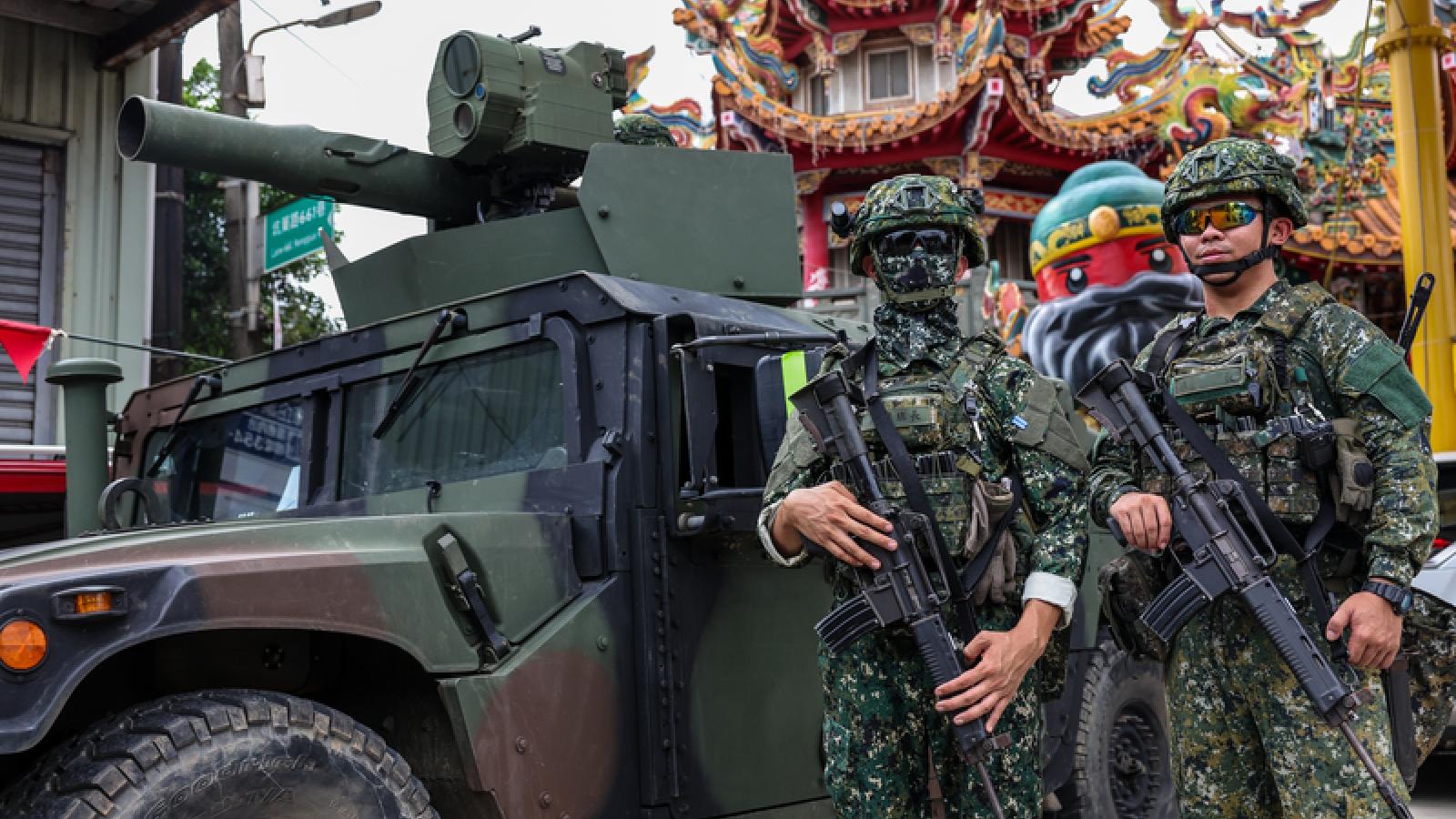
Before and after the Han Kuang exercise, media outlets extensively covered every detail: operational zones, scale of forces, weapon systems involved, transportation methods, and even remote islands like Kinmen, Matsu, Penghu, Green Island, and Orchid Island were all included. The exercise was meant to demonstrate Taiwan's determination for self-defense to the United States and to show the public that asymmetric warfare preparations are sufficient to resist the People's Liberation Army (PLA). But at the same time, is Taiwan also openly revealing its future countermeasures against the PLA to mainland China?
An 'English teacher' accompanied the drills throughout, and even the highly classified presidential evacuation plan, 'Operation Wan Jun,' was personally unveiled by Lai Qingde. Combat brigades conducted cross-zone reinforcements, airports and ports demonstrated rapid recovery after heavy damage, reinforcements were deployed to outer islands, missile units moved into position, river denial measures on the Tamsui River were conducted with live troops, network slowdowns (internet blackouts) were simulated, reserve forces were mobilized, and civilian facilities such as factories, temples, and schools were requisitioned to verify whole-of-society resilience.
To the untrained eye, it's a spectacle. To the expert, it's a revealing test. The exercise is over—kudos to the military for their hard work. But now that the show is done, it's time for the experts to step in.
From a preparedness perspective, we must seriously examine whether the exercise truly validates the 'Guoan Operational Plan' against real war threats. The purpose of military drills is to identify shortcomings and gaps. After the exercise ends, we must face these shortcomings honestly, conduct pragmatic reviews, adjust military development strategies in response to evolving threats, revise operational plans, and formulate next year's training agenda. This is the logical framework for building and preparing a military force.
Forty years ago, I was an instructor at the Army Command and Staff College of the Tri-Service University, teaching division-level tactics. Some student officers would submit tactical plans that were imaginative but completely detached from tactical principles, making mission accomplishment impossible. Yet, because they worked hard and appeared serious, I didn’t want to crush their morale. So I gave feedback: 'The concept is excellent, but the means are insufficient.' Some officers only read the first part and proudly thought, 'The teacher praised my concept!' But my real emphasis was on the second half: 'means are insufficient.' Without adequate means, even the best concept is meaningless—simply put, the mission cannot be achieved. The assignment effectively scored zero.
This year’s Han Kuang exercise has an excellent concept, but the means to support it are inadequate. Upon close inspection, while the exercise features numerous well-designed scenarios addressing current threats—deserving praise for 'excellent concept'—a deeper analysis reveals that many critical nodes and battlefield conditions were only partially or locally simulated, without exploring comprehensive responses if these scenarios occurred simultaneously.
For example, what happens if the north-south railway and highway systems are severed, making troop redeployment impossible? If a nationwide internet blackout lasts more than a day, can decentralized command still function effectively? How will the government manage public chaos and social unrest when civilians lose internet access? If ports and airports suffer severe damage and cannot resume operations quickly, is there a contingency plan? How will the government respond when infrastructure damage leads to water and power outages, immediately affecting civilian life? While it is necessary to conduct drills ensuring safe sea lanes under U.S. military escort—given Taiwan’s energy reserves last only two weeks—what if suppliers refuse to ship or are too afraid to sail?
Facing the PLA’s overwhelming combat power, the likelihood of substantive U.S. military intervention is extremely low (Trump has already made this clear). Taiwan’s battlefield environment is narrow and densely populated, with no separation between civilian life zones and combat zones. We do not wish for war, but if China truly launches an attack, it will be 'swift and decisive'—'the first battle is the decisive battle.' They will not engage in a war of attrition or a prolonged conflict. If Taiwan suffers comprehensive blockades and intense bombardment in a short time, national security leaders cannot simply set off fireworks and let green media and 'Bluebirds' conduct massive domestic propaganda campaigns. Many battlefield scenarios can be simulated through war games to yield substantial data, but the conclusion remains the same: 'means are insufficient' or 'means cannot support the concept.'
FACT BOX
- Source: PR Times
- Category: News