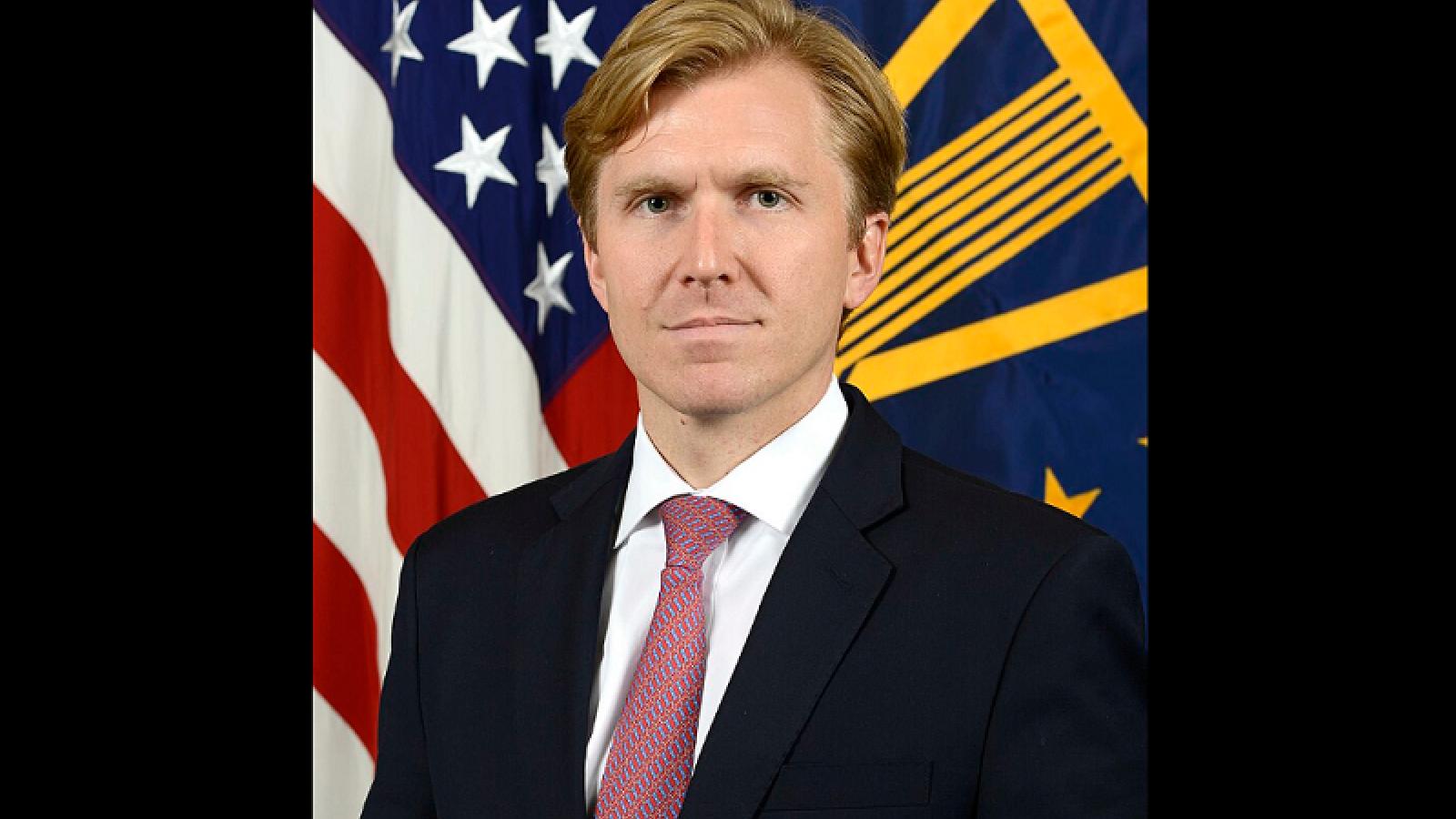
Elbridge Colby, the US Under Secretary of War for Policy (formerly the Department of Defense), recently began a Southeast Asia tour, scheduled to visit the Philippines, Indonesia, Thailand, and Cambodia. On the 10th, speaking at the Stratbase Institute in Manila, Colby emphasized, 'The United States will never disengage from Asia — quite the contrary. Our vital interests demand that we maintain a long-term presence here.' 'We are not leaving; in fact, we are putting down roots here to ensure a favorable balance of power in the most critical areas,' he stated.
The South China Morning Post noted that, with President Xi Jinping scheduled to visit the United States next month, Colby avoided directly naming China in his speech and did not mention Scarborough Shoal (known as Huangyan Island in China), a site of sovereignty disputes between China and the Philippines. Bonnie Glaser, of the German Marshall Fund in Washington, said, 'With the Trump-Xi summit just six weeks away, Colby likely wanted to avoid making comments about China that could undermine the fragile stability achieved in Busan and Beijing.'
Glaser also noted that Colby has long expressed interest in visiting Beijing, which may have influenced his approach, but added, 'Harsh criticism of China would anger Beijing; mild criticism would disappoint Manila.' However, Ken Moriyasu of the Hudson Institute said that although Colby did not mention China directly, 'almost everything he discussed is related to China.' He also stated bluntly, 'It would be a mistake for Washington to signal strategic softening toward Beijing ahead of the Trump-Xi summit.'
On August 10, 2026, US Department of Defense Policy Under Secretary Colby attended a forum in Manila. (Reuters)
According to a press release from the Department of War, the full text of Colby’s speech is as follows:
Thank you for that generous introduction.
This is my first official trip to Southeast Asia as Under Secretary of War for Policy. Starting here in Manila is deeply fitting. The Philippines is our oldest mutual defense treaty ally in Asia, and we share a deep and abiding historical connection in addition to our profound alignment of strategic interest.
From Manila, I will be traveling onward to Jakarta, Bangkok, and Phnom Penh. As in Manila, I intend to deliver a clear message that is at once both realistic and perhaps bracing but also reassuring: That America's interests are more engaged than ever in the Indo-Pacific, and that we at the Department of War are concentrated on ensuring those interests are stoutly defended. This means a strong and growing U.S. investment in the region. But it is also coupled with a newfound but common sense expectation of much greater effort and contribution by our allies and partners. Not in a hectoring or unbalanced way. To the contrary, in a spirit of partnership, not dependency; of realism, not idle cloud-castle abstraction; of respect, not patronization.
Our approach, as laid out in the Administration's National Security Strategy and National Defense Strategy and set out eloquently by Secretary Hegseth in his Shangri-La speeches this year and last, is straightforward. Our legacy foreign policy of the post-Cold War period was fundamentally out of date and ill-advised.
In the years following the collapse of the Soviet Union, American strategy was characterized by high-flown abstractions and comfortable illusions of permanent unipolarity. Washington's strategic approach became unmoored from the concrete realities of power, geography, economics, and limits. Our foreign policy became detached from clear-headed strategic rationality, and the results were demonstrably poor.
President Trump has reversed that failed course. Under Sec
FACT BOX
- Source: PR Times
- Category: News