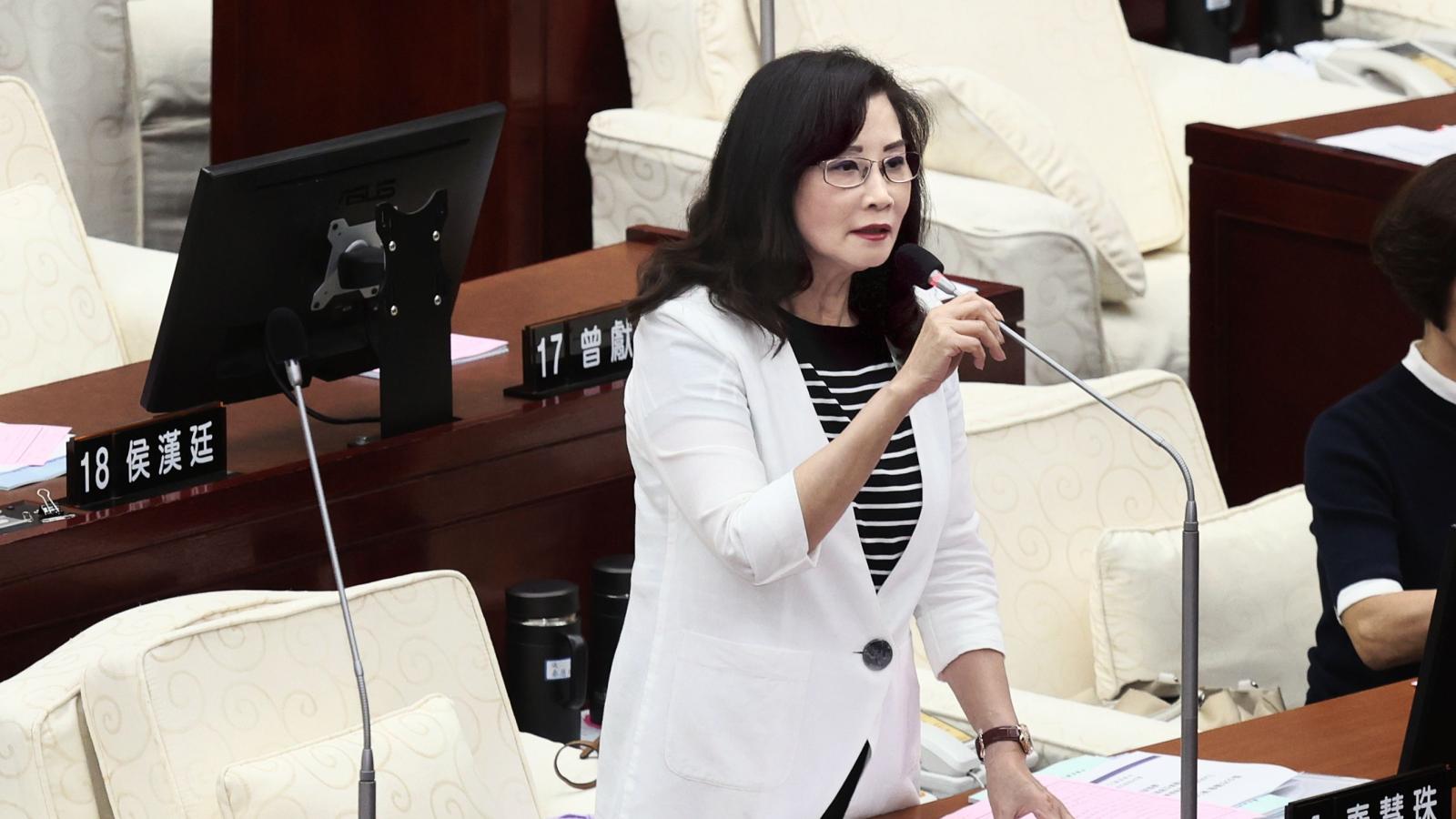
Amid ongoing partisan clashes in the Legislative Yuan, KMT Taipei City Councilor and former legislator Chin Hui-chu commented on Legislative President Han Kuo-yu's recent anger over budget negotiations, stating from her experience as a former legislator and party caucus leader: 'I have never seen a Legislative Yuan this chaotic in history.' She pointed out that the annual budget review has dragged into August without completion, and prolonged continuous sessions are abnormal. She also discussed the 2026 Taipei City Council election, revealing that KMT party workers told local village chiefs she 'does not support Chiang Wan-an,' which made her so angry she considered confronting the party headquarters directly.
Why did Han Kuo-yu get angry? Chin Hui-chu: Absent and Unrepresented
Chin Hui-chu appeared on the Feng Media program 'Xia Ban Han Ni Liao' and shared her past work experience with Han Kuo-yu and legislator Fu Kun-chi in the Legislative Yuan. She described how Han, after experiencing political ups and downs, has clearly changed in demeanor since returning as Legislative President. 'Han is no longer full of unexpected moves; he now truly looks like a neutral, disciplined, and serious Legislative President,' she said, noting his more composed performance.
However, she believes the current operation of the Legislative Yuan is indeed problematic. Chin recalled that during her time as a legislator, even without any party holding a majority, intense partisan conflicts were still resolved through negotiations. Budgets were passed through consecutive overnight voting sessions—'vote after vote, until the entire budget was approved'—typically completed by January each year. In contrast, this year’s budget remains unprocessed as of August, leading her to state: 'I have never seen a Legislative Yuan this chaotic in history.'
No one shows up to cross-party negotiations, and no authority is delegated? Chin Hui-chu: What are they all sitting there for?
Regarding Han Kuo-yu’s recent outburst, Chin Hui-chu believes he had good reason. She emphasized that cross-party negotiations should be attended by authorized representatives. If someone cannot attend, they should either reschedule or formally delegate authority. Chin recalled her role as director of the People First Party’s Legislative Caucus Office, where she handled negotiations firsthand. Back then, parties would confirm availability: 'If you’re not free, we reschedule; if you are, we meet.'
She noted that even closed-door negotiations could involve heated debates or arguments, but the key was resolving issues. The current situation—where responsible parties fail to attend and do not delegate authority—is something she said she has 'never seen before.'
Is Han Kuo-yu the 'weakest Legislative President'? Chin Hui-chu highlights KMT power dynamics
Chin Hui-chu pointed to another issue: the weakened coordination mechanism between the KMT central party, the Legislative President, and the party caucus. Reflecting on the KMT’s past governance, she recalled a relatively robust communication system among the central party, the president and vice president of the legislature, and the caucus, with the policy chief serving as a key liaison.
But she believes this system has weakened. Since the Legislative President must remain administratively neutral, Han Kuo-yu has limited influence over the KMT caucus. Chin even described Han as 'the weakest Legislative President in KMT history,' stating he currently 'has no power, no influence at all.'
Will Han Kuo-yu run in 2028? Chin Hui-chu: Run for president or keep depending on others
On whether Han might run for president again, Chin offered her assessment. She believes Han faces a 'two-choice' dilemma in his next political move. As a proportional-representation legislator, Han’s reappointment depends first on KMT nomination. Even if nominated, becoming president again requires sufficient intra-party support, which Han cannot control alone.
In contrast, running for president is a choice Han can make independently. Therefore, if the presidency is uncertain, Han must decide whether to retire or 'make a final push.' Chin bluntly stated: 'Han has only two options: run for president or continue depending on others.'
Exposed KMT party worker manipulation? Chin Hui-chu: 'Extremely angry'
Discussing her 2026 Taipei City Council race, Chin revealed internal KMT local organizational issues. In multi-seat elections, new candidates are often seen as weaker and thus receive 'rescue votes,' putting well-known, experienced incumbents at risk. For example, a household with six votes might allocate four to newcomers and only two to senior candidates, making 'us, neither new nor weak-looking, the most disadvantaged.'
Chin expressed further frustration, claiming KMT party workers individually approached village chiefs, urging full support for two specific candidates. When her supporters asked, 'What about Chin Hui-chu?' they were told she 'doesn’t support Chiang Wan-an.'
Chin emphasized that while they didn’t explicitly say 'don’t vote for Chin,' directing full support to others already impacted local sentiment. She said she was 'extremely angry' upon hearing this and initially wanted to confront the party headquarters, but decided against it to avoid worsening the situation.
Is re-election really at risk? Chin Hui-chu: Every election is extremely tough
Chin admitted that seniority doesn’t guarantee safety, especially in multi-seat races where 'abandoning the strong to save the weak' is the biggest threat. She also mentioned unfair responsibility district allocations—while others received 16–17 districts last election, she got only 12, some in pro-Green (DPP-leaning) areas. The party justified this by citing her support from the Huang Fuxing system, allowing fewer local resources.
Facing the 2026 race, Chin concluded: 'There’s no shortcut. You just have to do your best. Every election is extremely tough and difficult.' Even in an unfavorable environment, she said she must find a way to break through.
FACT BOX
- Source: PR Times
- Category: News