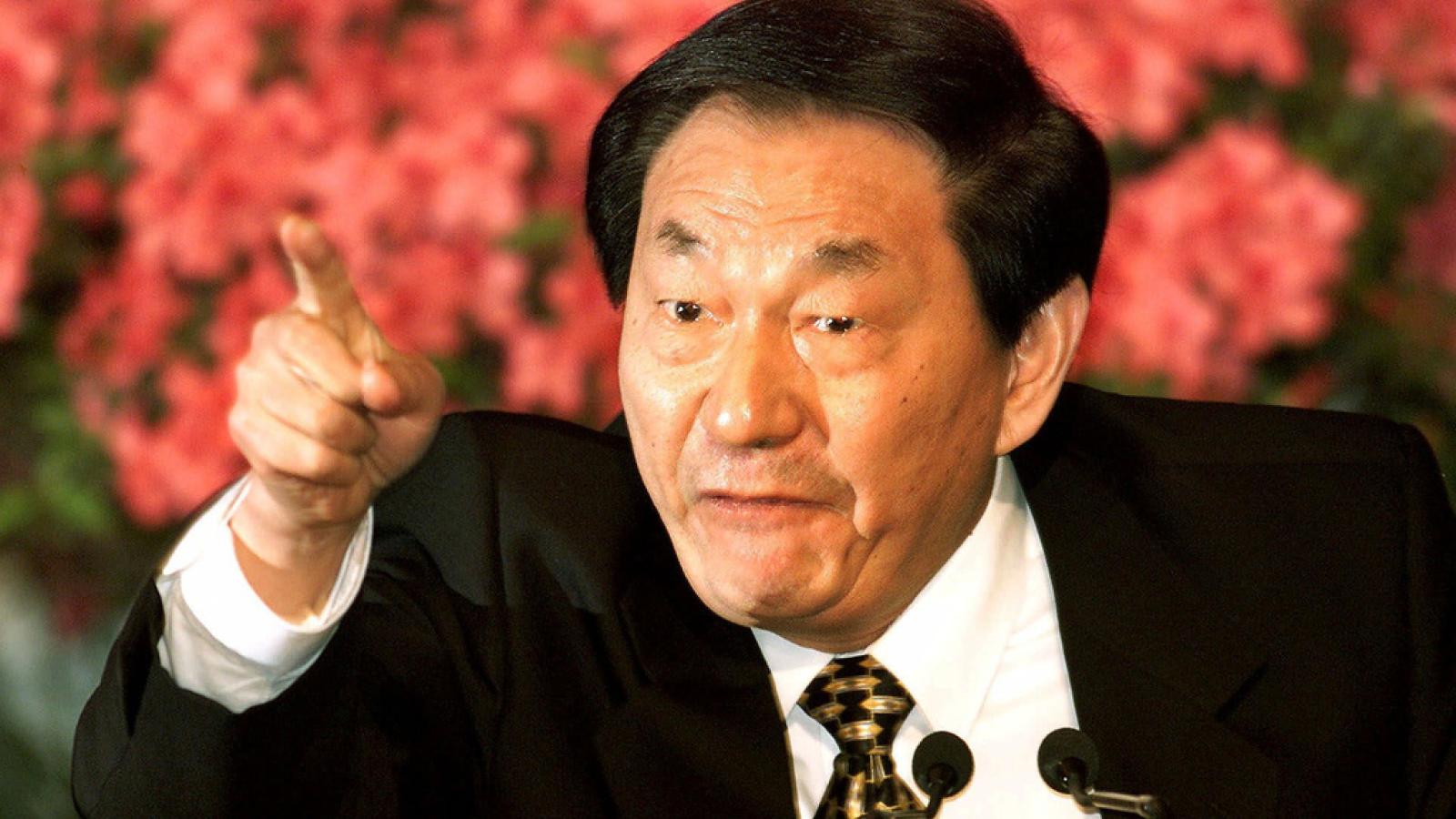
I conducted a street interview at noon, which was quite moving. I asked people from three generations—old, middle-aged, and young—and at the end of the article, a university student asked me: 'Did China lose a premier, or a path that was once taken but is now increasingly difficult to return to?' At that moment, I couldn't answer him. He was probably China's last reformist leader, who knows how long the next one will stay until the 21st Party Congress next year.
Former Chinese Premier Zhu Rongji passed away in Beijing on August 12, 2026, at 11:06 AM due to illness, at the age of 98. This technocrat, long referred to by the West as the 'Economic Tsar', who pushed forward state-owned enterprise reforms, the tax-sharing system, anti-corruption, and China's accession to the World Trade Organization (WTO), has quickly elicited reactions from various quarters.
From the personal condolences of multinational corporate leaders, the diplomatic posture of the Japanese embassy in China, to Chinese public nostalgia, and historical intersections with Taiwan, to the rare positive coverage by Western media, this farewell is not just a farewell to a former premier, but also reflects the vast contrast between China's reform and opening-up memories and current realities.
Why did the West give the 'Economic Tsar' a rare highly positive evaluation?
Zhu Rongji served as Premier of the State Council from 1998 to 2003, a crucial period when China accelerated its transition from a planned economy to a market economy and fully integrated into the global economic system. He promoted state-owned enterprise reforms, fiscal and financial reforms, handled the Asian financial crisis, and played a key role in China's accession to the WTO. These reforms were accompanied by large-scale state-owned enterprise restructuring, layoffs, and social shocks, so Zhu Rongji was never a figure without controversy in China.
But in the eyes of the West, another Zhu Rongji was even more prominent: he was the one willing to negotiate with the West, believing in globalization, believing in market forces, and also willing to explain China to the outside world in his own way.
As early as the beginning of Zhu Rongji's tenure as Premier, he received high attention from Western media. At that time, Western media even had terms like 'China's Gorbachev', 'Asia's Lucky Rider', and 'China's Economic Miracle Chief Architect'. The Zhu Rongji era was precisely one of the periods when China-West relations were closest and had the most imagination.
That was an era when the West believed that 'China's integration into the world' would change China and also change the world. Beijing's bid for the Olympics, accession to the WTO, attracting foreign investment, and integrating into the global supply chain; Wall Street believed in the Chinese market, American companies believed in Chinese consumers, and European companies believed in Chinese manufacturing.
At that time, the mainstream imagination of the West about China was not today's 'strategic competition', but more like 'peaceful rise'.
Apple CEO Tim Cook posted a condolence message on Sina Weibo. He wrote: 'With great sadness, I share my condolences on the passing of Premier Zhu Rongji, whose contributions are too numerous to count. He leaves behind an extraordinary...' (Original English text: 'It is with great sadness that I share my condolences on the passing of Premier Zhu Rongji, whose contributions are too numerous to count. He leaves behind an extraordinary...')
Cook and Zhu Rongji were not strangers. Zhu Rongji was the first dean and honorary chairman of the advisory committee of Tsinghua University's School of Economics and Management, while Cook has long served as a committee member and once served as chairman. The two met on occasions such as 2017, and Zhu Rongji also expressed greetings to the advisory committee through Tsinghua channels on multiple occasions.
Apple CEO Tim Cook posted a condolence message on Sina Weibo. (Screenshot from Sina Weibo)
The Japanese embassy lowered its flag to half-mast to mourn Zhu Rongji, which is a relatively rare public diplomatic gesture of mourning.
From the late 1990s to the early 2000s, although Sino-Japanese relations had historical and security issues, the two sides still maintained high economic interaction and frequent political exchanges. Zhu Rongji himself was a typical economic bureaucrat, and foreign economic and trade and Sino-Japanese economic exchanges occupied an important position in his political career.
On the same day, the Japanese embassy in China posted a photo of the half-mast flag on Weibo, with the caption 'In memory of former Premier Zhu Rongji of the People's Republic of China'. This is a relatively rare public diplomatic gesture of mourning.
In 2000, Zhu Rongji visited Japan and had a public dialogue with the Japanese people on Tokyo TV, discussing historical issues, Sino-Japanese relations, and economic and trade cooperation after the WTO. At that time, his remarks such as 'History cannot be forgotten' and 'The Nanjing Massacre is a historical fact' left a deep impression on Japanese society.
Chinese public opinion: Collective nostalgia for the reform era, but speech control still exists
After the news of Zhu Rongji's death became a hot topic on Weibo, Chinese public opinion quickly turned to nostalgia. Netizens widely circulated his famous quotes such as 'I prepared 100 coffins, 99 for corrupt officials, and 1 for myself', 'No matter if there are landmines or a thousand-foot abyss ahead, I will press forward bravely', 'The people do not serve my ability but my fairness; officials do not fear my severity but my integrity', as well as his criticism of 'tofu-dreg projects' and anecdotes of slamming the table and glaring at corrupt officials to scare them.
The reporter also uploaded yesterday's report to his personal WeChat public account and found that WeChat did not restrict its dissemination. On the contrary, the review speed was faster than usual, but the article lacked the 'like' and 'heart' buttons at the end; in contrast, the Douyin platform quickly banned similar content, sparking speculation.
The reporter used his lunch break to conduct random interviews with several citizens in multiple locations in Beijing. The general evaluation was similar to that of the death of former Premier Li Keqiang. A citizen named Zhang from Beijing's Financial Street said: 'The Zhu Rongji era was relatively good in terms of relations with the West, and speech control was relatively relaxed. However, this leader had vision and courage, at least allowing China to embrace the world.'
Another retired teacher from a university in Beijing, Mr. Li, said, 'Although there was also strong suppression of the public at that time, those who have experienced China's high-speed growth and marketization transformation know that his style of 'daring to speak the truth and not fearing to offend people' was very good.'
Bo Guagua, the son of Bo Xilai, also posted a tribute on X, calling Zhu Rongji a hero in his father Bo Xilai's heart. Bo Guagua recalled that whenever Zhu Rongji appeared on the news, his grandmother would pay special attention. He also described the scale of wealth created by China during Zhu Rongji's tenure as 'amazing even in human history'.
To some Chinese, he represents an era when officials could still have distinct personalities; to others, he represents an era when economic development was still considered the top priority.
Bo Xilai's son Bo Guagua posted a tribute to Zhu Rongji's death on X, sparking heated discussions among overseas Chinese. (Screenshot from X platform)
Zhu Rongji and Taiwan: The most famous statement was actually the most hardline one
In 1993, when Zhu Rongji was serving as Vice Premier, facing China's overheating economy and reform difficulties, he invited Taiwan's 'father of science' Li Guoding to participate in relevant economic conferences through the World Bank. The two later had a 90-minute meeting. According to Taiwan's data, Li Guoding proposed multiple items including central and local finance, financial rectification, and the securities market, and these directions were indeed highly relevant to the reforms Zhu Rongji later promoted.
At that time, the two sides of the strait were in a cold war and hostile to each other, but in terms of economic development, Taiwan's experience became an important reference for China's reform and opening-up period.
The 2000 presidential election was the most dramatic intersection between Zhu Rongji's political career and Taiwan.
On March 15, 2000, three days before the presidential election, Zhu Rongji mentioned the Taiwan election at a press conference in the Great Hall of the People, leaving behind that controversial statement: 'Whoever tries to split Taiwan will have a bad ending.' At the same time, he also warned Taiwan, 'Do not act impulsively, or you may regret it later', and reminded Taiwanese people with 'There are still three days, the world is unpredictable'. At that time, these remarks quickly spread across Taiwan through television, causing strong backlash in Taiwanese society.
These remarks caused the Taiwan stock market to plummet nearly 400 points during the session and sparked strong reactions from both the ruling and opposition parties. Subsequent analysis generally believed that this threat instead provoked a backlash from the middle class, objectively helping Chen Shui-bian win with a margin of less than 3 percentage points, completing Taiwan's first party rotation. Zhu Rongji was thus jokingly called the 'strongest campaigner' or 'alternative campaigner', becoming a classic case of the CCP's 'failed operation' in its Taiwan policy of 'verbal attacks and military threats'.
Zhu Rongji has left, but the problems he left behind have not.
At that time, he faced inflation, state-owned enterprise losses, financial risks, and economic transformation; today's China faces real estate adjustments, local government debt, population structure changes, insufficient domestic demand, and long-term technological and strategic competition with the West. The reforms of that time indeed accelerated China's entry into the era of globalization; but the reforms themselves also left behind costs that had to be dealt with later.
For today's young people in China, Zhu Rongji may even become a historical figure who is reimagined—a symbol used to compare with the real China.
During the street interviews in Beijing, a Chinese university student asked me: 'Did China lose a premier, or a path that was once taken but is now increasingly difficult to return to?' And I found myself unable to answer at that moment.
Zhu Rongji's early speech at Tsinghua (screenshot from Douyin, provided by Tian Chang)
Zhu Rongji and Jiang Zemin working together in Shanghai. (Screenshot from the popular CCTV documentary 'Jiang Zemin')
FACT BOX
- Source: PR Times
- Category: 人事
- Organizations: Apple