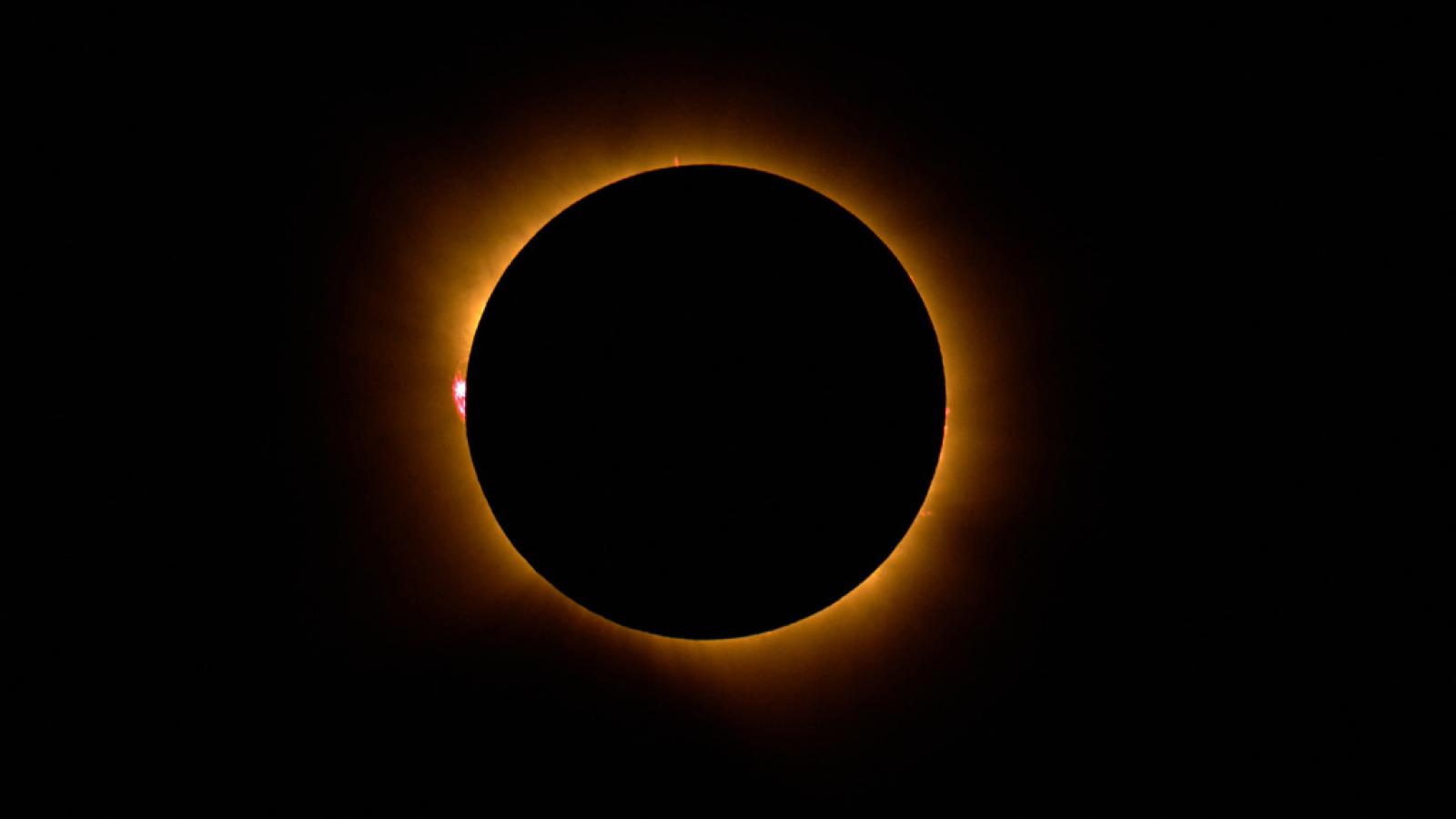
Europe and the United Kingdom have witnessed their most spectacular astronomical event in nearly 30 years, as millions of people and astronomy enthusiasts gathered outdoors, holding up smartphones and cameras to witness and capture the rare celestial phenomenon: a solar eclipse. According to BBC reports, the path of the 'totality' began at the northern tip of Siberia, Russia, crossed the Arctic Ocean to reach Iceland, and then moved southward. In most parts of southern and central UK, where skies were clear and cloudless, locals used special eclipse glasses or creative tools like cereal boxes and pinhole projections to observe the moon gradually 'devouring' the sun.
Meanwhile, in parts of Greenland, Iceland, and Spain, a magical 'daytime night' unfolded. When the sun, moon, and Earth aligned perfectly in a straight line, not only did a total solar eclipse occur, but the sky instantly plunged into darkness. Chilean scientist Yasmin Catricheo, who traveled to A Coruña in northern Spain to observe the event, expressed her excitement: 'The moment totality arrived, everyone cheered. The awe is indescribable—truly, the universe is incredible!'
Residents across Europe and the UK were able to witness varying degrees of the solar eclipse, with the rare 'total solar eclipse' visible in regions like Spain. (Associated Press)
In the UK, many areas observed a deeply impressive partial solar eclipse. According to observatory data, over 90% of the sun was obscured by the moon across most of the United Kingdom. In Cornwall, in the southwest, the coverage reached 95%, marking the most prominent eclipse in the UK since 1999.
Although the total eclipse lasted less than two minutes, for those fortunate enough to be within the path of totality, it offered a breathtaking view of the sun being gradually consumed, revealing the normally hidden 'corona'—superheated gas streams extending thousands of kilometers from the sun’s surface. With high-powered telescopes, observers could even spot the pink, loop-like gas structures known as 'prominences,' which follow the sun’s magnetic field lines.
To witness a perfect total solar eclipse from Earth requires a rare cosmic alignment. Although the sun is about 150 million kilometers from Earth—roughly 400 times the distance to the moon—its diameter is also about 400 times that of the moon. This coincidence makes the sun and moon appear nearly the same size in Earth’s sky, allowing the moon to perfectly cover the sun during orbital alignment.
Residents across Europe and the UK were able to witness varying degrees of the solar eclipse, with the rare 'total solar eclipse' visible in regions like Spain. (Associated Press)
Astronomers note that from 2026 to 2028, Earth will enter a 'golden age' of total solar eclipses. Enthusiasts interested in this celestial spectacle can plan to experience it in multiple locations around the globe.
FACT BOX
- Source: PR Times
- Category: News