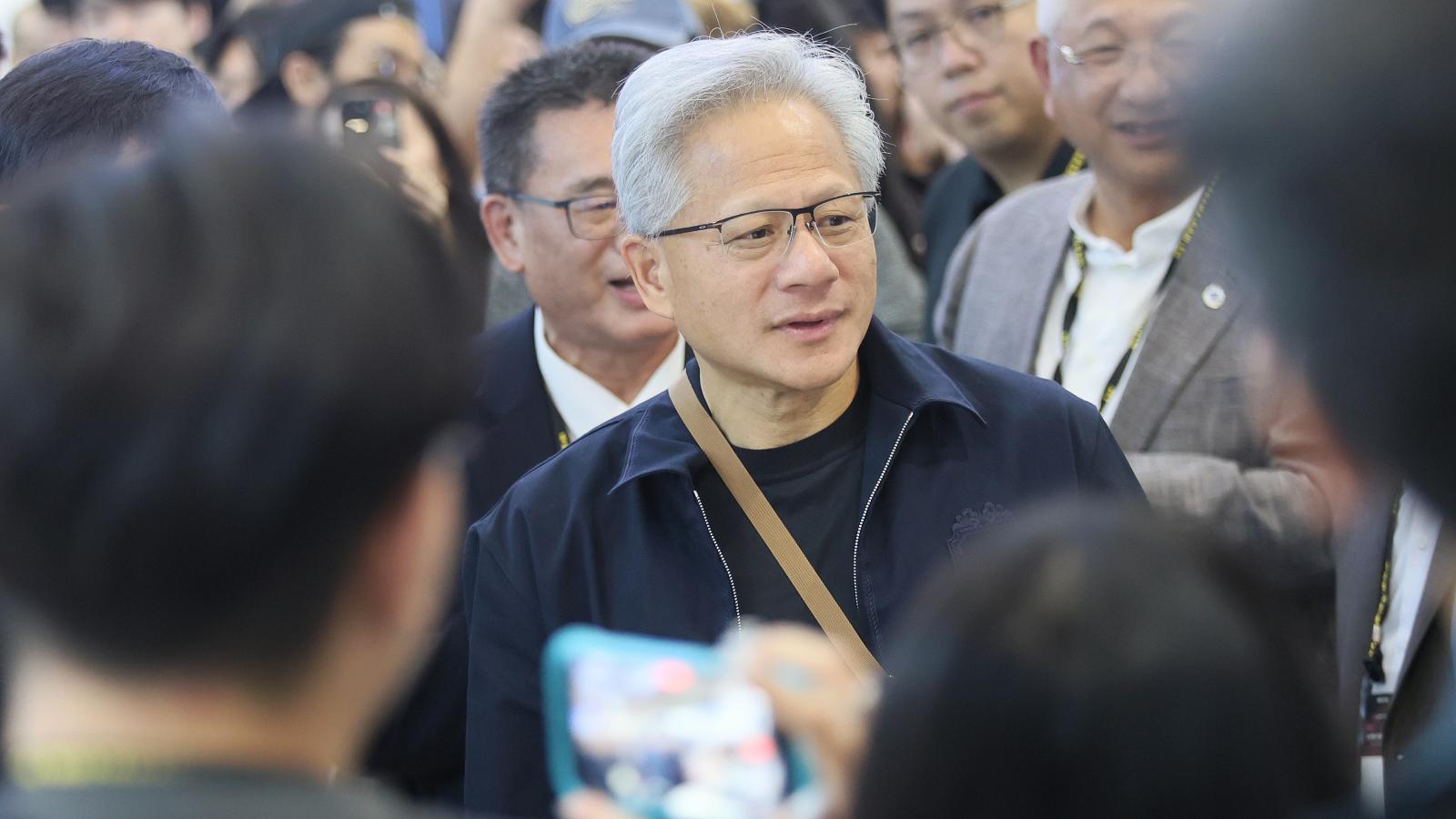
Jensen Huang is shifting the AI war from chip and model competition to an unprecedented 'capital war.'
NVIDIA has announced a partnership with six financial giants—Apollo, BlackRock, Blackstone, Brookfield, Goldman Sachs, and KKR—to establish a financing platform for AI computing infrastructure, aiming to mobilize over $500 billion in third-party capital. This indicates that NVIDIA is no longer merely waiting for customers to raise funds to buy GPUs, but is directly connecting Wall Street’s vast capital pools to major AI firms.
At first glance, this appears to be Jensen Huang once again施展 his capital magic: as the AI industry faces increasing capital shortages, he has found another $500 billion reservoir for the sector. But from another perspective, it also signals a deeper shift: the easiest money in the first phase of AI is nearing its limit, and the AI boom is gradually shifting from 'demand-driven' to increasingly 'credit-driven.'
### Tech Giants’ Money Is No Longer Enough
For the past few years, the AI investment model was simple. Tech giants like Microsoft, Google, Meta, and Amazon used massive cash flows from advertising, search, cloud, and software to purchase GPUs and build data centers.
But as the AI arms race intensifies, capital expenditures are growing beyond what internal cash flows can comfortably support. As a result, funding sources have shifted from free cash flow to corporate bonds, bank financing, private credit, special purpose vehicles (SPVs), and structured finance.
Now, Jensen Huang is going further by directly bringing in the world’s largest asset managers and private capital firms. When tech companies’ own funds are insufficient, Wall Street steps in; Wall Street then channels long-term global capital from pension funds, insurance money, and sovereign wealth funds into the AI ecosystem.
According to statistics, AI-related bond issuance this year has reached approximately $344 billion, an increase of over $200 billion compared to 2025. AI borrowers with weaker credit profiles are also beginning to pay higher yields to secure funding.
This is a crucial turning point: AI is gradually evolving from a 'technology investment cycle' into a 'credit cycle.'
### GPUs Are Becoming Financial Collateral
Beyond its scale, the most significant aspect of the $500 billion plan is its underlying financial structure.
According to current disclosures, financial institutions can raise funds through SPVs, which purchase AI equipment like GPUs and then lease them to AI companies or computing providers. Investors’ returns come from rental payments; if a client defaults, the GPUs themselves can serve as collateral, resold or re-leased.
In other words: Wall Street capital → SPV → GPUs → AI companies → computing rental income → debt repayment.
Thus, GPUs are no longer just tech products—they are becoming financial assets that can be pledged, financed, and leased.
However, the problem lies precisely here.
Homes last 30 years, airplanes fly for 20, power plants operate for decades—but GPUs may face a major performance leap every two to three years. How much will a top-tier GPU worth 100 today be worth in three to five years?
If debt maturities stretch to 7 or even 10 years, but GPU competitiveness declines sharply within 3–4 years, a classic asset-life versus debt-term mismatch emerges.
More notably, NVIDIA may provide up to 25% of project costs as support for certain initiatives. This could boost lenders’ willingness to fund, but it also means that if clients default or GPU residual values plummet, some risk may ultimately return to NVIDIA.
So Jensen Huang isn’t eliminating risk—he’s repackaging it, redistributing it, and using credit to amplify leverage.
### From Tech Industry Risk to Financial System Risk
This is the $500 billion plan’s most significant qualitative shift.
Previously, if Microsoft or Meta spent $10 billion of their own money building an AI data center, investment failure was primarily borne by shareholders.
But if a $10 billion AI factory becomes $3 billion in equity and $7 billion in debt, and asset value drops from $10 billion to $6 billion, not only is equity wiped out, but creditors also begin to incur losses.
If that $7 billion in debt is held in private credit funds, SPVs, or even further securitized and owned by insurers, pension funds, and institutional investors, risk spreads from the tech industry into the financial system.
This is why the structure begins to resemble mortgage-backed securities (MBS). While the two cannot be equated directly, and today’s AI financing scale, leverage, and securitization level are far from comparable to the 2008 financial crisis, the commonality lies in packaging illiquid assets and future cash flows into investable and financeable financial products.
Michael Burry, author of 'The Big Short,' famous for betting against MBS before the 2008 crisis, now warns that when bull markets near their end and increasingly complex credit structures are used to sustain growth momentum, that’s often where real risk accumulates.
### The Most Important Question: How Will the $500 Billion Be Earned Back?
Yet, stripping away all complex financial engineering, we’re left with three fundamental questions:
Where does the money come from?
Where is it spent?
And ultimately, how is it earned back?
The first question is becoming clearer: tech company cash flows, corporate bonds, banks, private credit, and further extended to pension funds, insurance, and sovereign wealth funds.
The second is also clear: GPUs, HBM, TSMC’s advanced processes, servers, networking equipment, data centers, land, cooling, and power.
The hardest is the third. Because while NVIDIA receives 'money invested in AI,' financial markets ultimately need 'money earned from AI.' These are entirely different.
If an AI company borrows $10 billion to buy GPUs, NVIDIA can book $10 billion in revenue. But whether those GPUs ultimately generate enough cash flow for enterprises and consumers to cover GPU depreciation, electricity, interest, principal, and shareholder returns determines whether the entire AI capital cycle holds.
Thus, increased NVIDIA revenue only proves more money is being invested in AI—it doesn’t prove AI is already earning money back.
More importantly, once financing becomes widespread, GPU sales growth can no longer be simply equated with increased end-demand for AI.
An AI company originally has only $1 billion and can buy at most $1 billion in GPUs; now Wall Street lends it another $2 billion, instantly giving it $3 billion in purchasing power.
From NVIDIA’s financial reports, GPU demand appears to surge 200%, but the additional $2 billion isn’t cash flow generated by AI services—it’s purchasing power created by credit.
Therefore, the real question is: were these GPUs bought with money earned from AI, or with borrowed money?
### Where Does the $500 Billion Go If Not Into AI?
Another overlooked issue is capital crowding-out.
The $500 billion doesn’t fall from the sky. Pension funds, insurance capital, banks, and private credit have asset allocation and risk limits. When AI offers higher returns and a hotter investment narrative, capital naturally flows from other sectors into AI.
So we must ask: if this $500 billion hadn’t gone into AI, where would it have gone instead? Housing, manufacturing, healthcare, biotech, energy, public infrastructure, or SMEs?
Moreover, AI isn’t just grabbing financial capital—it’s also competing for power, land, transformers, engineering talent, natural gas turbines, advanced processes, and grid capacity.
If AI ultimately creates far greater productivity than other industries, this is efficient capital allocation. But if money flows in simply because AI asset prices keep rising, NVIDIA’s credit is strong, and Wall Street is willing to lend, it may shift from capital allocation to capital misallocation.
### The Biggest Variable: China Is Waging a Price War on the Other Front
Even more troubling is that Wall Street’s $500 billion financial model has a variable it cannot control: China.
The U.S. is taking a highly capital-intensive AI path: more advanced GPUs → larger models → larger AI Factories → more capital spending → more financing.
China, restricted from acquiring advanced chips, is forced down another path: limited compute → model optimization → improved efficiency → lower inference costs → competing on lower prices.
The real threat isn’t necessarily Huawei producing a GPU tomorrow that outperforms NVIDIA’s—but rather China using 'not-so-cutting-edge but much cheaper' chips and models to drive down the price per unit of AI intelligence.
This is critically important for the $500 billion AI infrastructure financial model.
Because: AI service prices can fall, compute rental rates can fall, GPU resale prices can fall—but debt principal doesn’t fall.
If Chinese competition drives compute prices from 100 down to 70, or even 50, even if AI usage increases, the return on investment for expensive AI Factories may still deteriorate.
### The U.S. Bets on Capital, China Bets on Efficiency
Thus, the true strategic significance of Jensen Huang’s $500 billion plan may be far greater than a corporate financing move.
FACT BOX
- Source: PR Times
- Category: Funding
- Organizations: NVIDIA / Apollo / BlackRock
- Products / services: GPU