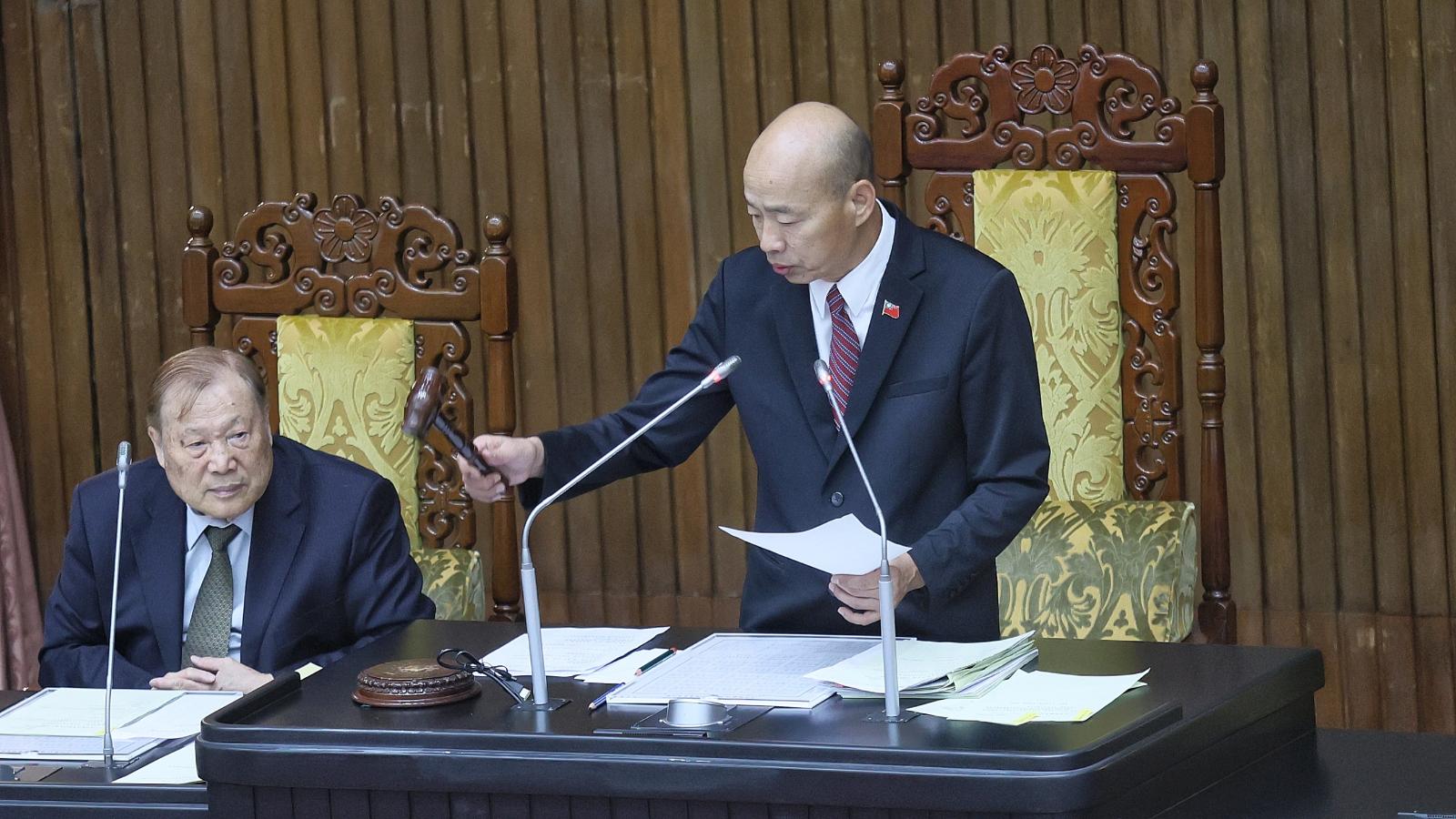
Legislative Yuan President Han Kuo-yu recently presided over cross-party negotiations on the central government's 2026 fiscal budget. He expressed rare fury after KMT caucus leader Fu Kun-chi failed to attend for the fifth time and did not authorize the caucus secretary-general to sign on his behalf. Han harshly criticized the situation, calling it "Empress Dowager Cixi ruling from behind a curtain," and directly pointed out that the Legislative Yuan is undergoing "pathological development."
While this anger highlights the absurdity of parliamentary operations, it also unexpectedly exposes a deeper, chronic problem in the review of the central government's total budget: Can trillions—or even over ten trillion—dollars in national finances truly be justified to the people simply by a few party caucus leaders sitting down, cutting or freezing funds, signing off, and adjourning?
The central government's total budget is not a political bargaining chip for party confrontations, nor is it a mere numbers game on the cross-party negotiation table. It is the most crucial democratic authorization for the executive branch to obtain the people's hard-earned tax money and allocate national resources. Article 63 of the Constitution clearly stipulates that the Legislative Yuan has the power to deliberate and approve budget bills, while Article 70 states that the Legislative Yuan may not propose increases in expenditures on budget bills submitted by the Executive Yuan. Since budgetary authority is a key tool for the legislature to check executive power, substantive review must not be reduced to last-minute party negotiations.
The Budget Act has already clearly defined how the total budget should be reviewed. Article 48 requires the Premier, the Director-General of the Directorate-General of Budget, Accounting and Statistics, and the Minister of Finance to attend and report on policy plans and the compilation process of revenue and expenditure budgets. Article 49 mandates that budget reviews focus on the scale of expenditures, budget surpluses or deficits, program performance, and priority rankings. Article 50 sets specific review priorities for business funds and other special funds. Most importantly, Article 53 explicitly states that during the plenary session review of the total budget bill, debates—either pro-con or party-based—may be held with limited topics and participants.
Since the law already provides for public debate, major budgetary revenues and expenditures should not be left at the final stage to be decided by a few party caucus leaders through backroom negotiations.
All major expenditures involving trillions of dollars—such as defense procurement, social welfare, major public infrastructure, and large-scale funds, subsidies, and commissioned projects—should undergo pro-con or party debates in the Legislative Yuan plenary session, as stipulated by the Budget Act. These debates should be fully broadcast via the Legislative Channel so that Taiwan's 23 million people can clearly see: Why does the Executive Yuan want to spend this money? Why does the Legislative Yuan approve it? Why are certain items deleted? Which parties support or oppose them? What are the actual reasons? All of this must be made public as the basis for political accountability!
This is true budgetary democracy.
However, Taiwan's total budget review has long suffered from another chronic problem: The executive branch incrementally increases the budget based on the previous year's figures, while the Legislative Yuan, in the final stage, resorts to massive cuts, freezes, across-the-board reductions, and cross-party negotiations. Compared to a total budget of several trillion dollars, even cutting tens or hundreds of billions at the end often amounts to mere pocket change.
This chronic issue was even acknowledged by Ko Chien-ming, a long-time DPP caucus leader in the Legislative Yuan. On September 28, 2020, during a party negotiation on the central government's budget, he frankly admitted: "Last year's administrative budget was nearly 2 trillion, and after full committee review, less than 3 billion was cut. Then we just used a percentage-based approach—every year it's the same. I know clearly it's just shouting 1.7%, 1.8%, or 2%." Regarding numerous budget freezes, he added bluntly: "Hundreds of cases are frozen at 10%, then released after reports are submitted. Frankly, this is a Legislative Yuan bad habit—it's really not good."
These few sentences are the most honest self-confession of the long-standing chronic problems in Taiwan's total budget review.
A nearly 2-trillion-dollar administrative budget, with less than 3 billion cut after full committee review, followed by a percentage-based across-the-board reduction; large amounts of budget frozen at 10% first, then released after administrative agencies submit reports. On the surface, it appears as intense cuts, freezes, and fierce partisan battles, but in reality, there may be no real questioning of the necessity, legality, and effectiveness of each major expenditure.
If Ko Chien-ming already knew in 2020 that this was "a bad habit of the Legislative Yuan, really not good," why hasn't there been fundamental reform after so many years?
Now, the 2026 budget cross-party negotiations have once again turned into a political storm of the Legislative President's fury and the caucus leader's absence, further proving that the problem has never been merely about how much is cut in a given year or whether a particular leader attends. Rather, the method of reviewing the total budget itself has accumulated systemic chronic problems over many years.
The 2027 budget must not repeat the same mistakes.
The Executive Yuan has proposed approximately 3.8 trillion in central government revenue and about 3.6 trillion in expenditures, but this does not represent the full picture of national finances. Under the Budget Act framework, this also includes state-owned enterprise operating funds and massive non-operating special funds. When all three books are opened, the annual budget scale reaches approximately 11 trillion. Can such a huge amount of public wealth be ultimately reduced to a few party leaders haggling in the chamber?
Moreover, the 2027 budget first faces the problem of abnormal revenue structure.
In recent years, government tax revenue has surged, closely tied to active stock and asset transactions. Stock trading is taxed via securities transaction tax, with day trading even enjoying a 50% discount. Yet, capital gains from individual trades of listed and OTC stocks have, since 2016, generally not been subject to securities transaction income tax. While salaried workers clearly pay income tax on monthly wages, massive stock price gains may remain untaxed. Does this truly conform to ability-to-pay and tax fairness principles? Is national finance overly dependent on stock market booms? These questions should be openly debated in the legislature, not dismissed by the Executive Yuan simply declaring "record-high revenue and balanced budgets."
If revenue is abnormal, expenditures must be scrutinized even more strictly.
Defense procurement and social welfare have already become trillion-dollar fiscal burdens. National security is undoubtedly important, but questions about whether military procurement prices are reasonable, procedures transparent, deliveries delayed, and equipment truly meeting defense needs cannot be overlooked by simply invoking "national security" to reduce legislative oversight. Social welfare is the same: While care for the elderly, children, long-term care, and the vulnerable is essential, are subsidies duplicated? Are commissioned projects excessive? Is there layering of subcontracting? How much money actually reaches those in need? Each item must be examined individually.
The government's continuous increase in commissioned projects, subsidies, policy promotion, and media marketing must fully implement zero-based budgeting. Budgets should not be automatically re-proposed just because they existed last year. Nor should a 100-billion budget from last year automatically become 120 billion this year, only for the Legislative Yuan to cut 10 billion, allowing the executive to claim "massive budget cuts."
True budget review should be the opposite: Every major expenditure must start from zero and prove its necessity.
State-owned enterprises and non-operating special funds must not become blind spots in oversight. Major investments, procurements, losses, and policy burdens of state-owned enterprises like Taipower and CPC may ultimately be borne by the public. The massive funds controlled by various ministries may also form a "second finance" outside the general budget. Agencies with overlapping missions, poor performance, or obsolete purposes should be merged or abolished, not perpetually funded year after year.
Therefore, what Han Kuo-yu should truly be angry about is not just Fu Kun-chi's fifth absence from negotiations, but this: Knowing this is a long-standing Legislative Yuan bad habit, why are we still using cross-party negotiations, across-the-board cuts, and freeze-unfreeze methods to handle national budgets of several to over ten trillion dollars?
What the 2027 budget truly needs is not an "angry negotiation," but a public, comprehensive national financial health check.
Where does 3.8 trillion in revenue come from? Where does 3.6 trillion in expenditures go? How do the three books totaling around 11 trillion operate? Are trillion-dollar defense and social welfare expenditures reasonable? How much public benefit do massive commissioned projects, subsidies, and policy promotions actually generate? All major budgetary revenues and expenditures should be publicly debated in the legislature as stipulated by the Budget Act, fully broadcast via the Legislative Channel, and subject to public scrutiny.
Because the money in the total budget is not the president's, not the Executive Yuan's, and not something that party caucuses can negotiate and dispose of at will. It is the hard-earned tax money of the people.
Han Kuo-yu may be angry, and cross-party negotiations are acceptable. But anger cannot replace review, negotiations cannot replace debate, and voting cannot absolve the responsibility to explain to the people.
Open up the 11 trillion in national finances book by book, debate each major revenue and expenditure item publicly, and bring the positions of the Executive Yuan and political parties directly to the people through the Legislative Channel—let the people see, hear, and judge.
That is budgetary democracy, and that is truly being accountable to the people.
*The author is a retired professor from the Department of Law at Tunghai University
FACT BOX
- Source: PR Times
- Category: News