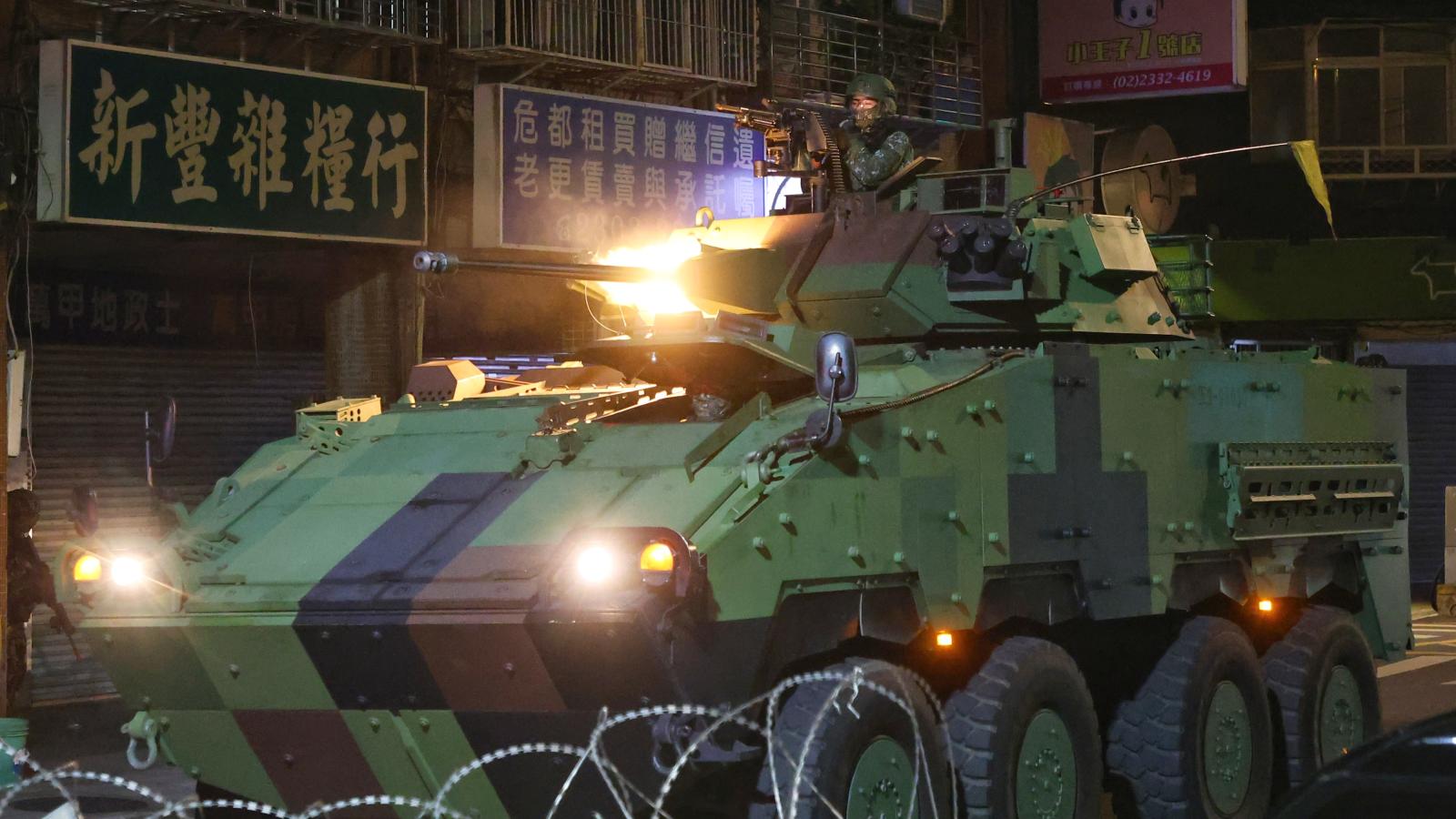
The Han Kuang 42 live-fire exercise entered its depth defense and prolonged combat phase early this morning (13th). The Military Police Command conducted a bridge closure drill at Guangfu Bridge, which connects Wanhua in Taipei and Banqiao in New Taipei, to verify its ability to block and defend critical external access routes to the capital under enemy threat. The drill continued until nearly 2 a.m., during which Yunpao armored vehicles and troops fired blank rounds, causing gunfire to echo throughout Taipei’s streets. Smoke grenades were also deployed, shrouding the road in thick smoke. Despite the intensity, onlookers watching the exercise gave soldiers a thumbs-up gesture after the drill concluded, showing no fear and expressing clear approval.
Starting around 11:30 p.m. on the 12th, with police assistance, traffic control was implemented in the drill area, integrating military and civilian resources to set up obstruction systems. Fully armed military police personnel, with support from private contractors, progressively deployed barbed wire, barricades, spike strips, and ASCO blast walls. Police managed outer traffic control, guiding civilians out of restricted zones. Around 1:30 a.m., the drill entered the enemy engagement phase, with gunfire and explosions erupting on-site, simulating an enemy assault from the Guangfu Bridge direction. Defensive troops immediately responded, resulting in sustained bursts of gunfire and continuous explosions, creating a realistic battlefield atmosphere.
Additionally, Yunpao armored vehicles provided fire support using 40mm grenade machine guns and 30mm cannons, simulating the elimination of enemy forces with superior firepower, further intensifying the sounds of gunfire across Taipei. Combat casualty care drills were also conducted, making the scene highly realistic. Notably, despite the continuous gunfire and explosions in the middle of the night, resembling an actual battlefield, onlookers remained calm and gave soldiers a thumbs-up after the drill, indicating strong public support for military police conducting realistic urban training outside barracks.
The Military Police Command stated that this drill incorporated drone operations, using simulated enemy threats and combat scenarios to verify the comprehensiveness of bridge blockage and defense plans, and to sharpen command officers’ real-time command, control, and emergency response capabilities, ensuring the security of the Taipei garrison area. The command emphasized that the Tamsui River system serves as a natural barrier, and its bridges are vital external access points for Taipei City, making them key to the success or failure of garrison defense operations. Effective blockage, defense, and denial of enemy use can create a strategic advantage in preventing enemy intrusion into the capital, thereby safeguarding the national center and protecting public property.
FACT BOX
- Source: PR Times
- Category: Event