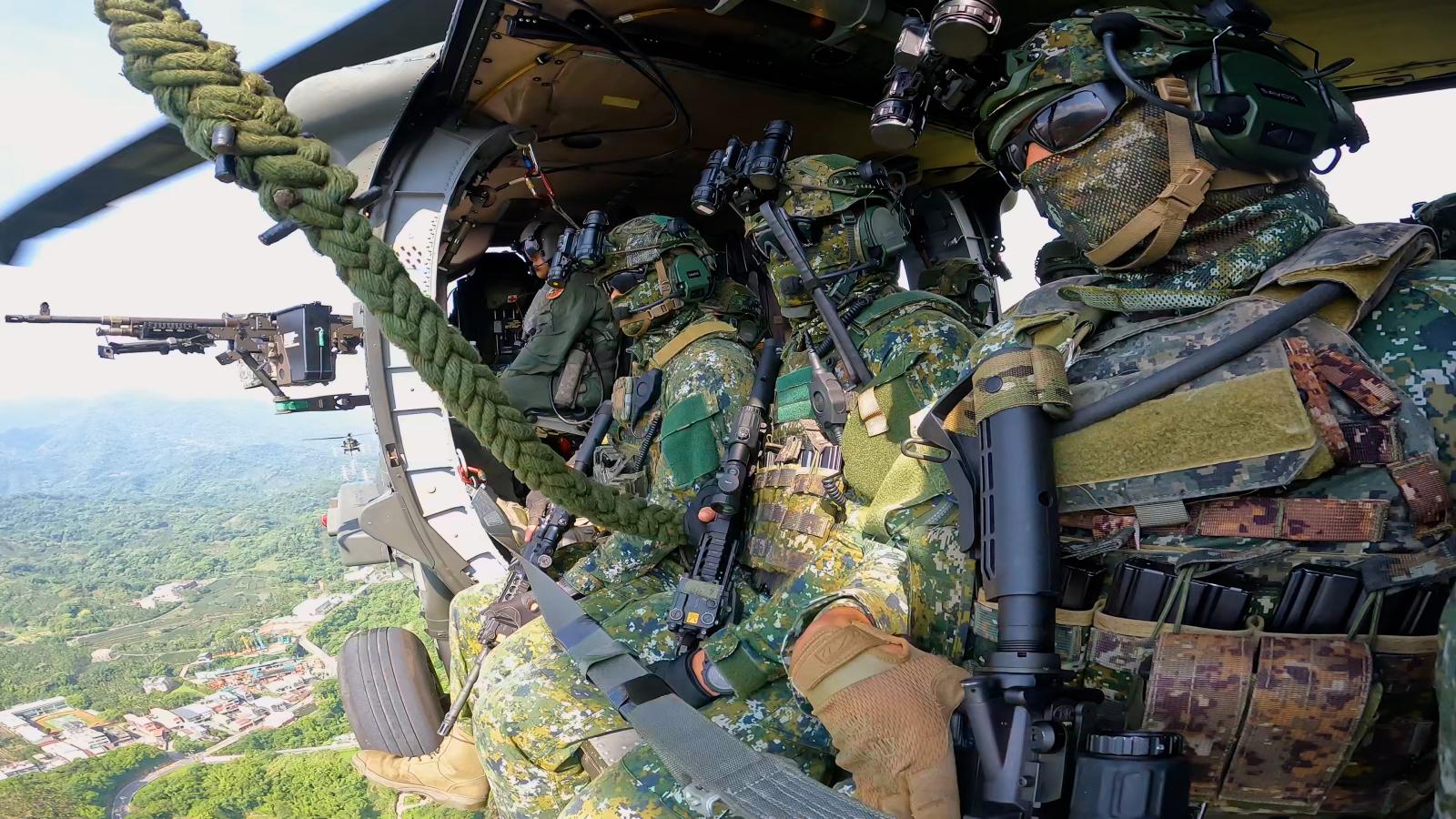
The Han Kuang 42 exercise has entered its final sustained combat phase. On the 12th, the Army Aviation and Special Forces Command moved from a tactical position in Taipei to the Taoyuan area to conduct live drills for the 'Han Kuang 42 Exercise'—specifically, the operationalized subject of 'enemy rear air infiltration.' Special operations troops formed assault squads, boarded UH-60M utility helicopters, and carried M4 rifles and other weapon systems to simulate small-unit special operations missions, demonstrating the Aviation Special Forces' rapid deployment and multi-domain combat capabilities.
After arriving above the target zone via UH-60M helicopters, flight crews adjusted approach routes and flight attitudes based on terrain and environmental conditions, steadily maneuvering the aircraft into the landing zone. At the same time, flight engineers monitored external conditions and terrain, continuously reporting altitude, obstacles, and personnel movements to ensure safe and smooth landing operations.
Upon infiltrating the target area, special operations troops swiftly initiated special reconnaissance. The assault squads rapidly advanced to tactical positions, using squad machine guns, M4 rifles, thermal imagers, and optical observation equipment to conduct reconnaissance. They transmitted enemy intelligence in real time via the TTN system. Subsequently, troops conducted professional combat techniques such as fire direction and demolition against enemy targets, launching continuous attacks to secure key transportation routes—demonstrating the special forces' real-time responsiveness, intelligence integration, and flexible small-unit combat effectiveness.
Meanwhile, the First作战区 Amphibious Reconnaissance Battalion conducted drills for 'offshore island special reconnaissance and joint fire strikes' on the same day. Special operations troops boarded Hai Long and Cheng Gong boats, approaching the target offshore island via maritime mobility and underwater infiltration. Reconnaissance teams, equipped with closed-circuit rebreathers, swam ashore, penetrated deep into the target area, established observation posts, and carried out enemy intelligence gathering and fire direction missions.
Upon receiving mission orders, troops assessed enemy positions, sea conditions, and target zone terrain to finalize infiltration routes, landing points, and withdrawal plans. After mission boats reached the target waters, drones were deployed to conduct preliminary reconnaissance of coastal terrain and enemy alert deployments. Reconnaissance personnel then submerged and secretly landed, moving toward designated observation points. Using drones and observation equipment, they confirmed enemy positions, troop deployments, and coordinates of key facilities.
The Army stated that after acquiring target intelligence, reconnaissance troops used the 'Tactical Awareness Kit' (TAK) to instantly transmit battlefield imagery, define fire strike zones, and guide long-range firepower for precision strikes on targets—validating the 'infiltration, target acquisition, fire direction' operational sequence, and refining amphibious infiltration, special reconnaissance, and joint fire coordination capabilities.
Additional exclusive reports from Wind Media: · Han Kuang Exercise: Navy and Coast Guard conduct 'anti-blockade escort' drills; Yushan-class ship simulates delivery of critical supplies to port · Han Kuang Exercise: Gunfire in Taipei streets at dawn! Military police validate roadblock operations on capital access routes; citizens praise the drill · Han Kuang Exercise: Fourth作战区 integrates 'air defense missile network'; Thunder 2000 and land-based Sky Sword II systems conduct coordinated operations
FACT BOX
- Source: PR Times
- Category: Event