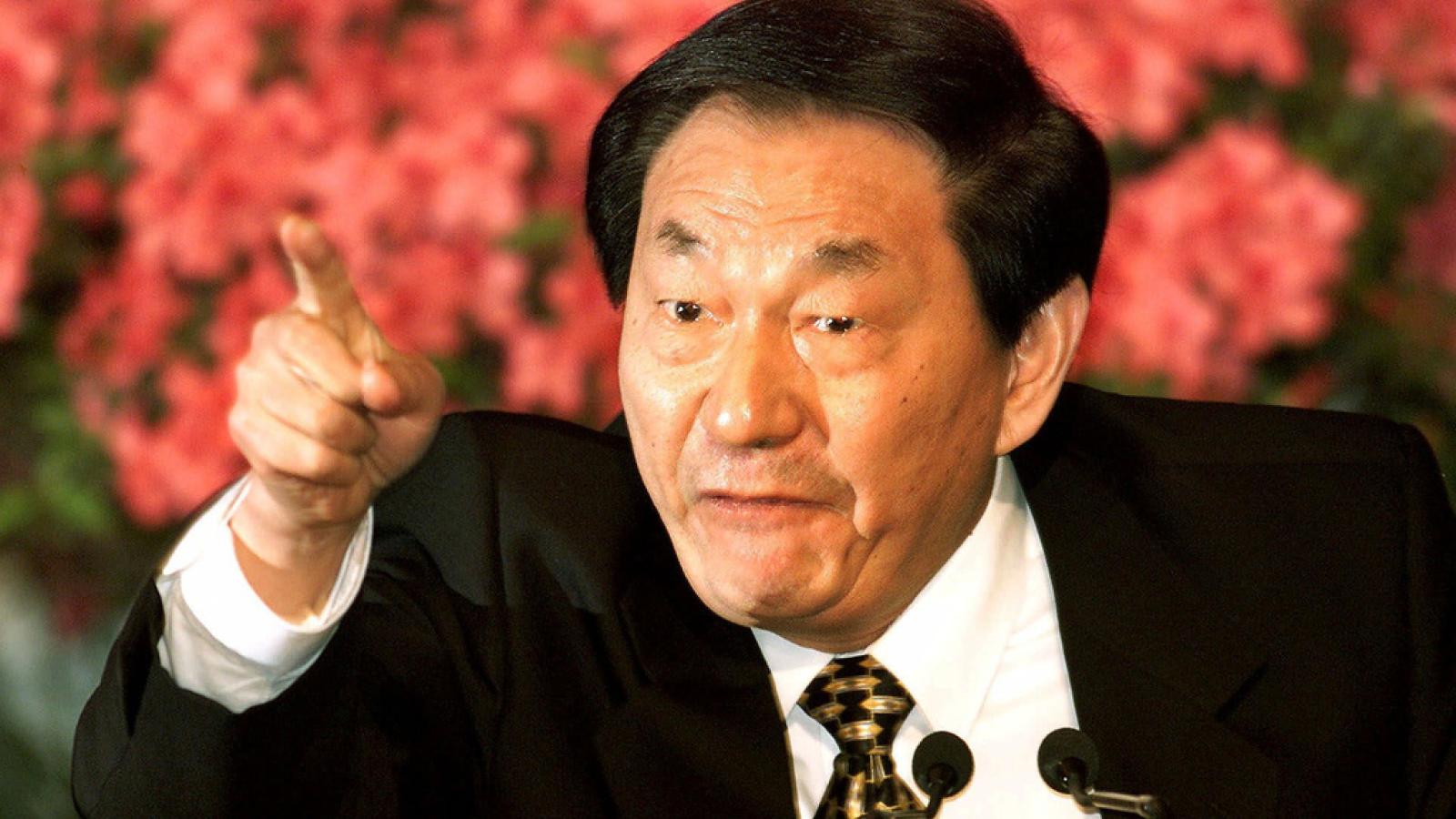
China’s current renewed emphasis on expanding domestic demand and building a unified national market is less a continuation of Zhu Rongji’s reform legacy than a necessary reflection and institutional correction of existing development pathways. Zhu Rongji’s passing also signifies that a generation of reformers has truly become historical figures.
Zhu Rongji, former member of the Political Bureau of the Chinese Communist Party and former Premier of the State Council, passed away in Beijing on August 12. As one of the most influential and distinctive economic leaders during China’s reform and opening-up era, he has long been portrayed in mainstream narratives as a 'strong-handed reformer': rectifying financial order, advancing state-owned enterprise reforms, and leading the critical negotiations for China’s accession to the World Trade Organization (WTO). Upon his retirement as Premier in 2003, the Southern Weekly ran a rare 24-page special feature on him, almost amounting to a 'final verdict,' cementing his lofty status in the history of reform.
However, if we shift our analytical focus from personal style and short-term performance to institutional pathways and long-term structures, a more explanatory question emerges: at the critical historical juncture of the 1990s, did China miss an important window to initiate and complete national economic reintegration? Did the reforms led by Zhu Rongji construct a successful developmental state for China, or while strengthening state capacity, did they further lock China into a deeply globalized development path?
The Nationalization of the 'Shanghai Model': External Integration Replacing Internal Restructuring
Zhu Rongji’s economic thinking was less a new strategic choice than a systemic expansion of the development experience he gained while governing Shanghai under specific historical conditions.
In the late 1980s, as market socialist reforms advanced, the national planning system continued to weaken. As a city with a strong traditional industrial base, Shanghai’s many industries—such as textiles—had long relied on coordinated national systems for raw material supply and market sales. However, under deepening decentralization and a clearly weakened central planning capacity, Shanghai could no longer reliably obtain key input factors through existing planning channels.
Under these institutional constraints, Zhu Rongji, as Shanghai’s top leader, could not push for systemic reconstruction at the national level. His response strategy reflected clear local rationality: leveraging Shanghai’s strong export competitiveness, securing a higher share of foreign exchange retention, and encouraging exports to resolve supply and industrial upgrading issues in international markets. This approach alleviated Shanghai’s resource bottlenecks in the short term, but the cost was equally clear—it bypassed rather than repaired national market coordination mechanisms, objectively weakening the overall integration of the domestic economic system.
As Zhu Rongji entered the central decision-making echelon, this originally locally urgent 'deep outward integration' path was elevated and promoted as a national development strategy. This was essentially a further amplification of the 'coastal opening strategy' of the late 1980s.
Lee Kuan Yew, founding Prime Minister of Singapore, pointed out as early as 1992 that China’s long-term development must rely on domestic demand. For a super-large economy like China, a deeply globalized path inherently carries obvious structural risks: continuously reinforcing outward-oriented growth not only fails to sustain endogenous development but also inevitably intensifies competition for resources and markets internationally, thereby worsening its external development environment—a warning clearly issued by economists like Yang Xiaokai in the late 1980s.
In 1992, when Zhu Rongji presided over national economic work, he enjoyed rare political advantages: trusted deeply by both Deng Xiaoping and Chen Yun, and known for his strong, decisive, and responsible leadership. Logically, this combination of political mandate and personal authority could have been used to promote an inward integration path centered on a unified national market—through the 'MITI-ization' of state planning departments to coordinate industrial layouts, enabling domestic industries to achieve economies of scale and enhance overall competitiveness, thus laying the institutional foundation for a Chinese-style developmental state.
Yet, Zhu Rongji avoided the critical option of 'domestic economic reintegration' and chose to embrace the 'deep globalization' path. In 1992, China reached the 'Memorandum of Understanding on Market Access' with the United States, committing to large-scale trade and investment liberalization, agreeing to abolish existing import substitution measures, and no longer using import substitution as an industrial policy tool. At the same time, 'market for technology' gradually became a key policy approach to attract foreign investment and promote industrial upgrading.
Under this strategic orientation, inward integration and autonomous development thinking were continuously shelved. Thus, despite the fiscal centralization achieved through the tax-sharing reform from 1993 to 1994, which significantly enhanced state capacity, the 'economic Balkanization' pattern remained unchanged: local governments remained the de facto actors in investment decisions and industrial layouts, engaging in disorderly competition over investment attraction, trapping domestic industries in a structural dilemma of 'diseconomies of scale' for the long term.
For a late-developing large country, a unified and protected domestic market is the fundamental institutional basis for industrial upgrading and technological catch-up. The nationalization of the 'Shanghai model' indicates that Zhu Rongji, in making critical development strategy choices, effectively abandoned an economic nationalist orientation. He systematically introduced and implemented certain policy tenets of the Washington Consensus through statist means—advancing privatization of small and medium-sized SOEs and trade and investment liberalization—diverting China from an autonomous development modernization path and gradually institutionalizing it into a dependent development model.
WTO Accession: Merits and Faults Undetermined
On February 9, 1996, then-German Chancellor Kohl (right) met with then-Vice Premier of China’s State Council Zhu Rongji in Bonn. (AP)
China’s accession to the WTO has long been regarded as one of Zhu Rongji’s most important reform achievements. Subsequent high-speed growth of the Chinese economy seems to provide factual support for this judgment. However, returning to the specific historical context of the late 1990s, this conclusion warrants re-examination.
In fact, by the turn of the century, China’s economic growth faced structurally unsustainable difficulties. These difficulties stemmed to a considerable extent from institutional consequences accumulated by excessive market opening and crony privatization. External shocks weakened the survival space of SOEs, and SOE decline, in turn, provided practical and ideological legitimacy for privatization—mutually reinforcing and further weakening the domestic demand base.
After the 1998 Asian financial crisis, expanding domestic demand was placed on the national agenda, but this awareness did not translate into systematic reflection on existing development pathways. On the contrary, market-oriented reforms in housing, education, and healthcare further weakened the existing socialist welfare system, largely offsetting the policy space needed for domestic demand expansion and further strengthening China’s economy’s dependence on exports and foreign capital.
Under the dual pressures of economic downturn and regime legitimacy constraints, attracting foreign capital through greater market opening gradually became a practical option to restore growth momentum. It was under this highly rigid political-economic pressure that WTO accession became exceptionally urgent.
To achieve the accession goal as quickly as possible, China accepted a series of commitments clearly exceeding the obligation levels of typical developing countries, including accepting special arrangements for the application of the 'non-market economy' methodology in anti-dumping investigations, and committing not to impose mandatory technology transfer on foreign investors—requirements exceeding existing multilateral trade rules. These concessions indeed accelerated the accession process, but left behind intractable institutional consequences—causing China to fall into structural passivity in subsequent market access negotiations, thereby reinforcing China’s path dependency on dependent development.
Moving Beyond the Zhu Rongji Myth
Undoubtedly, Zhu Rongji was a resolute nationalist; but as an economic leader of a late-developing country, he was not an economic nationalist like Park Chung-hee or Chiang Ching-kuo. The reforms he led did not enable China to become another East Asian developmental state oriented toward autonomous development. China’s high-speed growth after WTO accession, achieved under specific international political and economic conditions, was a阶段性 achievement within a specific historical window; and after '9/11,' the shift in U.S. strategic focus objectively extended this window. This international political contingency means that this growth model is neither sustainable nor replicable. Now, this historical window has closed.
China’s current renewed emphasis on expanding domestic demand and building a unified national market is less a continuation of Zhu Rongji’s reform legacy than a necessary reflection and institutional correction of existing development pathways. Zhu Rongji’s passing also signifies that a generation of reformers has truly become historical figures. At this moment, re-examining the institutional legacy left by his reforms may be more meaningful than continuing to debate personal merits and faults.
Moving beyond the 'Zhu Rongji myth' is not about negating reform itself, but about redefining the relationship between the state, the market, and development, thereby laying a more solid institutional foundation for China’s future autonomous development.
*The author is a scholar based in the UK and holds a PhD in Political Science from the London School of Economics. This article was originally published in Lianhe Zaobao and is reprinted with permission.
FACT BOX
- Source: PR Times
- Category: News