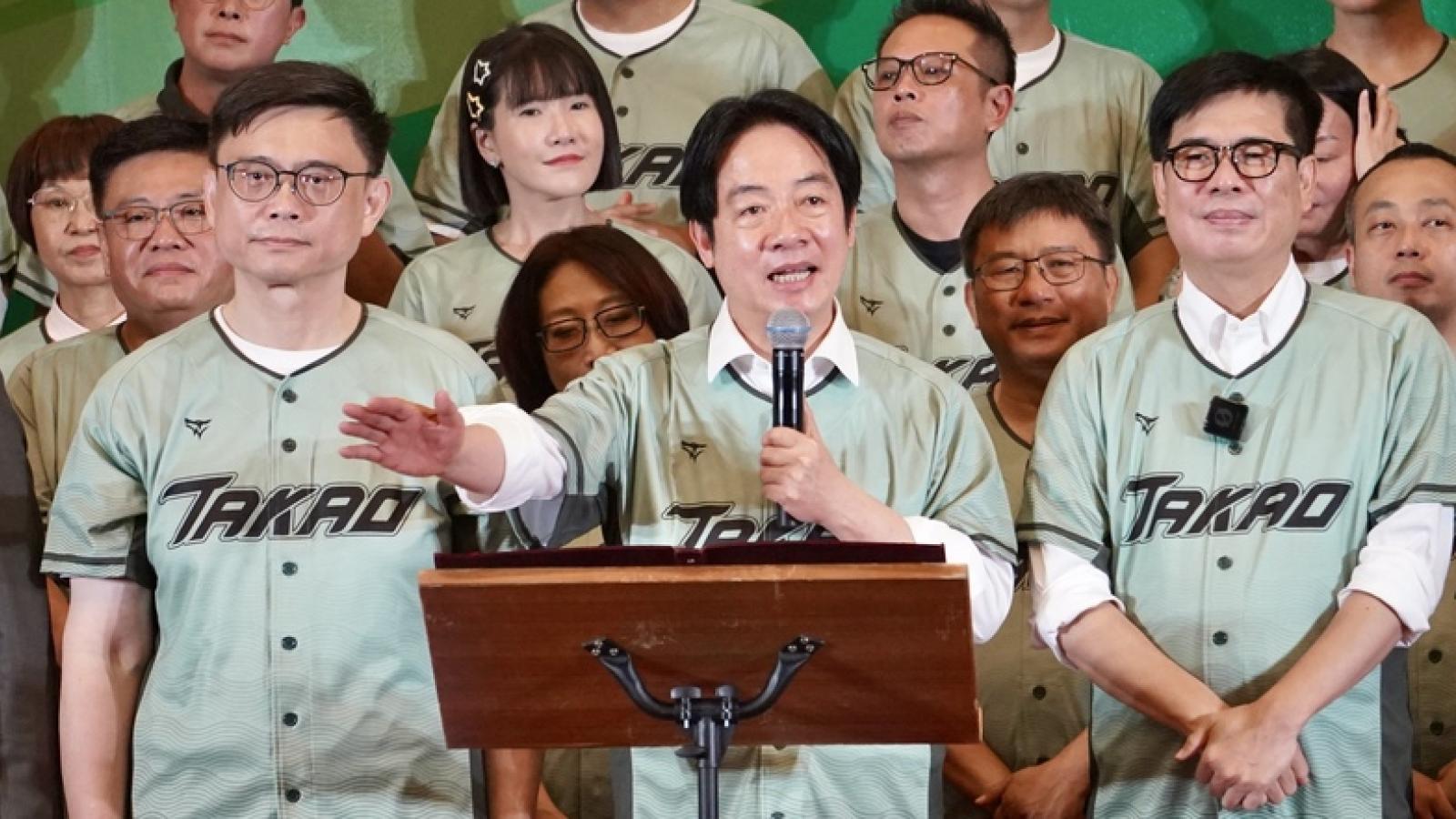
President Lai Qingde, who also serves as chairman of the Democratic Progressive Party (DPP), recently claimed during a campaign rally in southern Taiwan for Kaohsiung mayoral candidate Lai Jui-long that the Chinese Communist Party's (CCP) Beidaihe meeting had issued 'four secret orders.' The mysterious Beidaihe meeting, long shrouded in secrecy, has now become a public talking point, with a corner of its red curtain pulled back. Did the Beidaihe meeting truly issue 'four secret orders' to interfere in Taiwan's elections? Suddenly, debates have erupted.
"The Yellow River Flows into White Clouds": The Power of Indirect Implication
According to Lai Qingde, the four secret orders from the Beidaihe meeting are as follows:
1. Firmly oppose Taiwan's passage of its defense budget. If Taiwan successfully deploys drones, it would significantly complicate China's military annexation of Taiwan in the future.
2. China must strengthen its de facto governance over Taiwan by internationally isolating Taiwan and legally reinforcing the claim that Taiwan is part of the People's Republic of China.
3. China must strengthen its 'fifth column' within Taiwan to further promote unification.
4. Ahead of the 2026 local elections, China's forces in Taiwan must support pro-China 'patriotic forces' to win.
Such detailed 'intelligence'—if scrutinized for accuracy—reveals glaring inconsistencies in Lai Qingde's claims about the 'Beidaihe meeting.'
First, Beidaihe is not a 'meeting' but a 'summer retreat'—essentially a 'collective vacation.' Historically, around late July to early August, top CCP officials would retreat to Beidaihe in Hebei Province for summer rest. Security would be heightened, and informal discussions would occur between current leaders and party elders. However, no binding decisions are made. Institutionally, it is merely a period of informal exchange and mutual assessment among top party and government officials—what might be called 'Beidaihe time.' This is somewhat akin to the U.S. president's retreat at Camp David, where cabinet meetings may still occur, and foreign leaders may be hosted, while the president retains full command authority.
Second, the Beidaihe meeting is no longer significant, as Xi Jinping has consolidated power into a 'one-man rule.' In the past, 'Beidaihe time' was a venue for factions like the Shanghai clique, Youth League faction, and princelings to jockey for influence ahead of the five-year party congress. However, since 2003, the CCP Central Committee has abolished the practice of holding official business in Beidaihe. While top leaders still vacation there, no formal meetings are held. With Xi Jinping having centralized authority and established his own 'Xi faction,' the 'Beidaihe meeting' has become a mere formality. One must ask: Is it necessary to play the modern-day Don Quixote, charging at a windmill that no longer exists?
Third, if any topics are discussed during the Beidaihe retreat, they would more likely focus on Xi Jinping's September visit to the U.S., the October Fifth Plenum, or AI and the U.S.-China tech war—rather than Taiwan. 'On the shores of the Bohai Sea, south of the Yanshan Mountains, Beidaihe holds a special place in China's political landscape.' This is almost the standard opening line used by CCP state media when describing the 'Beidaihe retreat.' According to public reports from Xinhua News Agency, Cai Qi, a close ally of Xi Jinping and First Secretary of the Central Secretariat, visited scientists in Beidaihe on August 3 on behalf of Xi.
Lai Qingde is the first Taiwanese president to publicly reference the 'Beidaihe meeting.' He has inadvertently boosted Beidaihe's public profile—not due to 'misinformation,' but as part of a 'strategic propaganda' effort, specifically playing the 'CCP election interference card.'
Online lists of 'world spy organizations' rank the DPP's 'Bedroom Eavesdropping Intelligence Agency' first, surpassing the CIA, MI6, and Mossad. (Source: Facebook)
"Why Should the Qiang Flute Lament the Willow?": Cognitive Warfare's 'Export-to-Domestic' Model
This is a familiar DPP election tactic: 'implying CCP election interference.' The 'export-to-domestic' model is a standard DPP method—'national security officials' leak information to foreign media, Taiwanese media then report on the foreign coverage, and the government responds to the domestic reports. These 'officials' understand foreign media demand: they care less about Taiwan's internal affairs and more about the struggle between pro-China and pro-U.S. forces. Thus, they deliberately leak unverified high-level messages from across the strait. The DPP, skilled in election warfare, automatically transforms into a 'rumor factory' during every election. Today, it easily fabricates 'CCP election interference' news, making it appear as if it originated from Beijing or Washington—when in fact, it stems from Taiwan's security apparatus. Using 'cognitive warfare,' it maliciously brainwashes society and creates misunderstandings.
Lai Qingde has earned the title of 'chief rumor-monger.' During the presidential election, he maliciously criticized his two opponents—KMT's Hou Yu-ih and TPP's Ko Wen-je—for attempting to build a 'pro-China regime.' He accused Hou of 'colluding with China' through the Cross-Strait Economic Cooperation Framework Agreement (ECFA) and labeled Ko's 'family across the strait' rhetoric as 'joining the communists,' branding both as CCP accomplices. This tactic will likely be reused in the 2026 local elections.
With foreign media's high demand for China-related news and the DPP's election strategy, a political 'export-to-domestic' consumption supply chain has emerged. In this election cycle, the DPP has shifted from the 'anti-China card' to the 'CCP election interference card,' and from 'cognitive warfare' to 'transnational repression.' The party fabricates ambiguous 'CCP election interference' incidents to intensify voters' resentment and negative perceptions of China. This time, instead of using foreign media, perhaps due to increased foreign media caution, the DPP is directly feeding information to local media, which report it without verification.
The 'lip-sync controversy' surrounding the Taiwanese rock band Mayday's concert in Shanghai was manipulated into a 'CCP election interference' supply chain. (Image: Screenshot from Weibo/Believe Music)
"Spring Breeze Does Not Cross the Jade Gate Pass": The Convenience of 'Communist Conspiracy'
Lai Qingde is adept at the 'punch above your weight' election tactic—seizing on opponents' weaknesses and amplifying attacks. Previously used against the KMT, now deployed against the CCP. When his visit to Swaziland (now Eswatini) failed, he blamed CCP suppression, not his own national security team's failure. When controversies arose over allowing sprouted potato imports or U.S. peanut imports, he pointed the finger at the 'other side of the strait,' claiming 'it's all the CCP's conspiracy.'
Recall how the 'lip-sync controversy' involving Mayday in Shanghai was manipulated by interested parties into a 'CCP election interference' supply chain. The media distribution path—'national security officials' feed information to foreign media, foreign media report first, Taiwanese media cite the reports, and online brigades follow up with secondary content—forms a precise, seamless production line, influencing young Taiwanese voters' electoral intentions.
Lai Qingde insists the Beidaihe meeting issued 'four secret orders,' fabricating a plot more dramatic than a Korean drama. He has no intention of clarifying the truth about Beidaihe, nor was he misled by his own security agencies. His goal is to play the 'CCP election interference card' and paint the opposition as 'CCP accomplices.' Should he lose, the scapegoat for blame-shifting is already prepared.
FACT BOX
- Source: PR Times
- Category: News
- Organizations: CIA / MI6