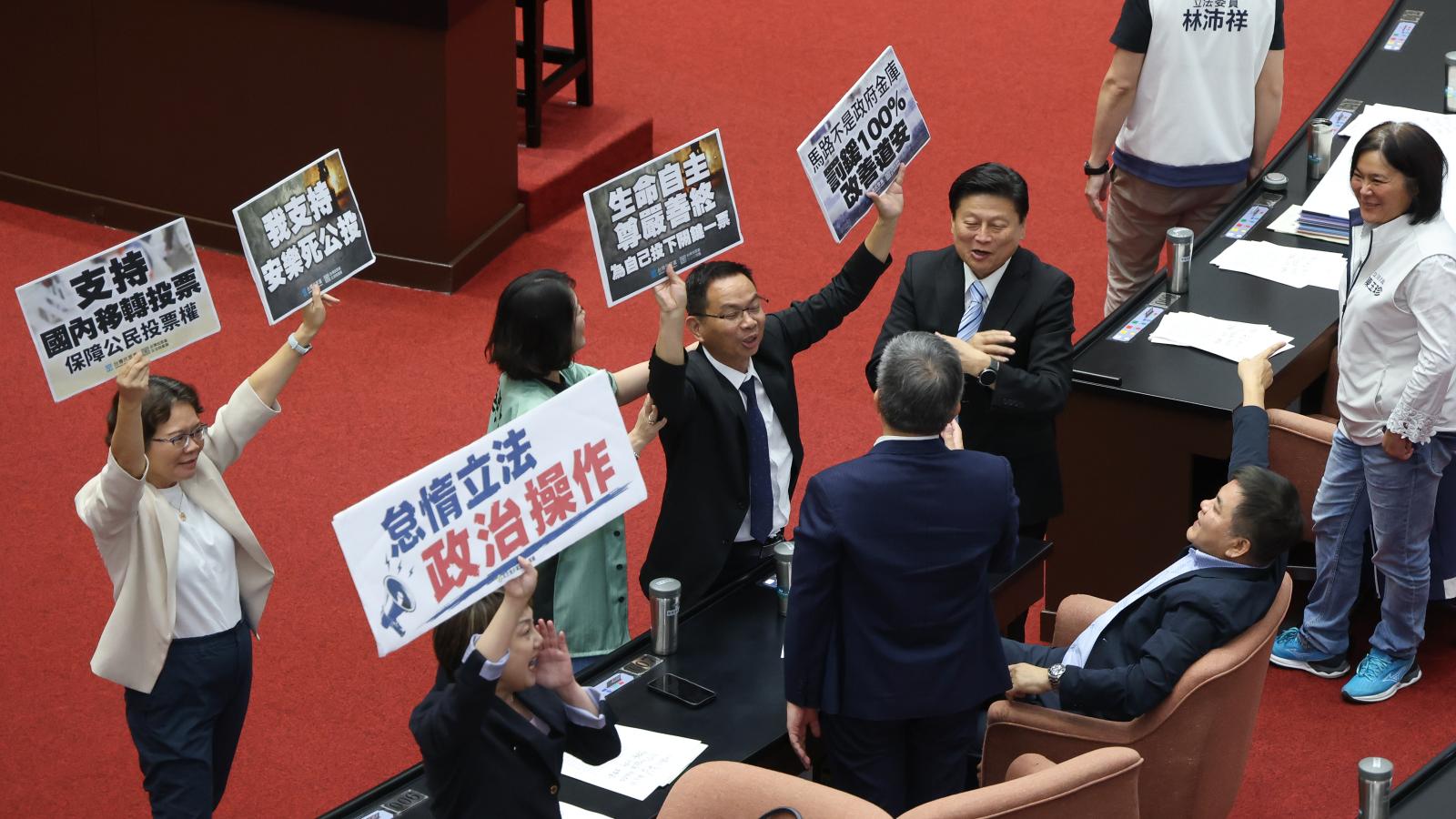
The Legislative Yuan convened a plenary session today (April 14) to address referendum proposals submitted by opposition party caucuses. After voting, only three proposals advanced out of the legislature. These included the TPP caucus’ proposal to allocate all traffic fine revenues toward improving road safety and subsidizing public transportation, and two proposals from the KMT caucus: one on reinstating corporal punishment (caning), and another on abolishing the nuclear-free homeland policy.
Notably, the TPP caucus’ referendum proposal to legalize a vote transfer system was excluded from the agenda by the KMT caucus. Similarly, the TPP’s proposal on legalizing euthanasia failed to pass, as the KMT caucus collectively abstained during the vote.
This year, the TPP caucus introduced three referendum proposals: (1) legalizing a vote transfer system, (2) allocating all traffic violation fine revenues exclusively to road safety improvements and public transport subsidies, and (3) legalizing euthanasia. Meanwhile, the KMT caucus proposed three referendums: (1) reintroducing caning as a criminal penalty, (2) repealing the non-nuclear homeland policy, and (3) opposing the abolition of the death penalty.
However, during today’s session, although the TPP caucus included all three of its proposals in the draft agenda, the final agenda approved after voting — led by the KMT caucus — listed only two proposals each from both the blue (KMT) and white (TPP) camps, out of the six total proposals jointly proposed.
During the voting process on four referendum proposals, there were occasional incidents of incorrect voting by the Democratic Progressive Party (DPP) caucus. Even DPP caucus whip Tsai Chi-chang mistakenly pressed the 'yes' button when voting on the KMT’s caning referendum, later correcting his vote through a revote.
Meanwhile, during the caning referendum vote, all seven attending TPP legislators — except Hsu Chung-hsin, who was abroad in the U.S. — uniformly abstained, adhering to their 'unified entry and exit' (group discipline) principle. However, due to the KMT caucus’ numerical advantage, along with support from non-partisan legislators Kao Chin Su-mei and Chen Chao-ming, the caning referendum ultimately passed.
Significantly, the TPP’s vote transfer proposal was excluded during the agenda-setting vote, while the euthanasia referendum saw the KMT caucus abstain en masse during the floor vote. As a result, only the seven attending TPP legislators voted in favor, while the entire DPP caucus voted against. Without KMT support, the 51 opposing votes from the DPP overwhelmed the seven in favor, leading to the proposal’s defeat.
Regarding the exclusion of both the vote transfer and euthanasia proposals, Chen Ching-lung, convener of the TPP Legislative Caucus, stated earlier this morning before the session began that the party had maintained its commitment to pushing forward all three referendum proposals and continued communicating with the KMT caucus in 'good faith.'
Chen explained that the vote transfer system aims to reduce voting costs for young people and migrant workers, but would be strictly limited to national-level referendums and nationwide elections such as presidential, vice-presidential, and legislative elections — a scope manageable for election authorities. The TPP caucus would 'do its utmost' to negotiate with the KMT caucus.
He added that the traffic fine revenue proposal seeks to ensure that penalties collected from traffic violations are fully reinvested into improving transportation environments, infrastructure, and subsidizing public transit — preventing these funds from becoming a government 'slush fund' or financing automated enforcement systems, thereby eliminating 'pedestrian hells.'
As for the euthanasia proposal, Chen emphasized it is grounded in autonomy and dignity, allowing terminally ill patients suffering unbearable pain and with no hope of recovery the right to decide how their lives end.
Regarding the TPP caucus’ decision to abstain on the KMT’s caning referendum, Chen had previously announced that among the eight TPP legislators, there were differing opinions. Through internal democratic debate, the party acknowledged diverse viewpoints and chose not to force consensus. Therefore, consistent with its principle of 'group unity,' the caucus collectively abstained and did not cast votes.
FACT BOX
- Source: PR Times
- Category: News