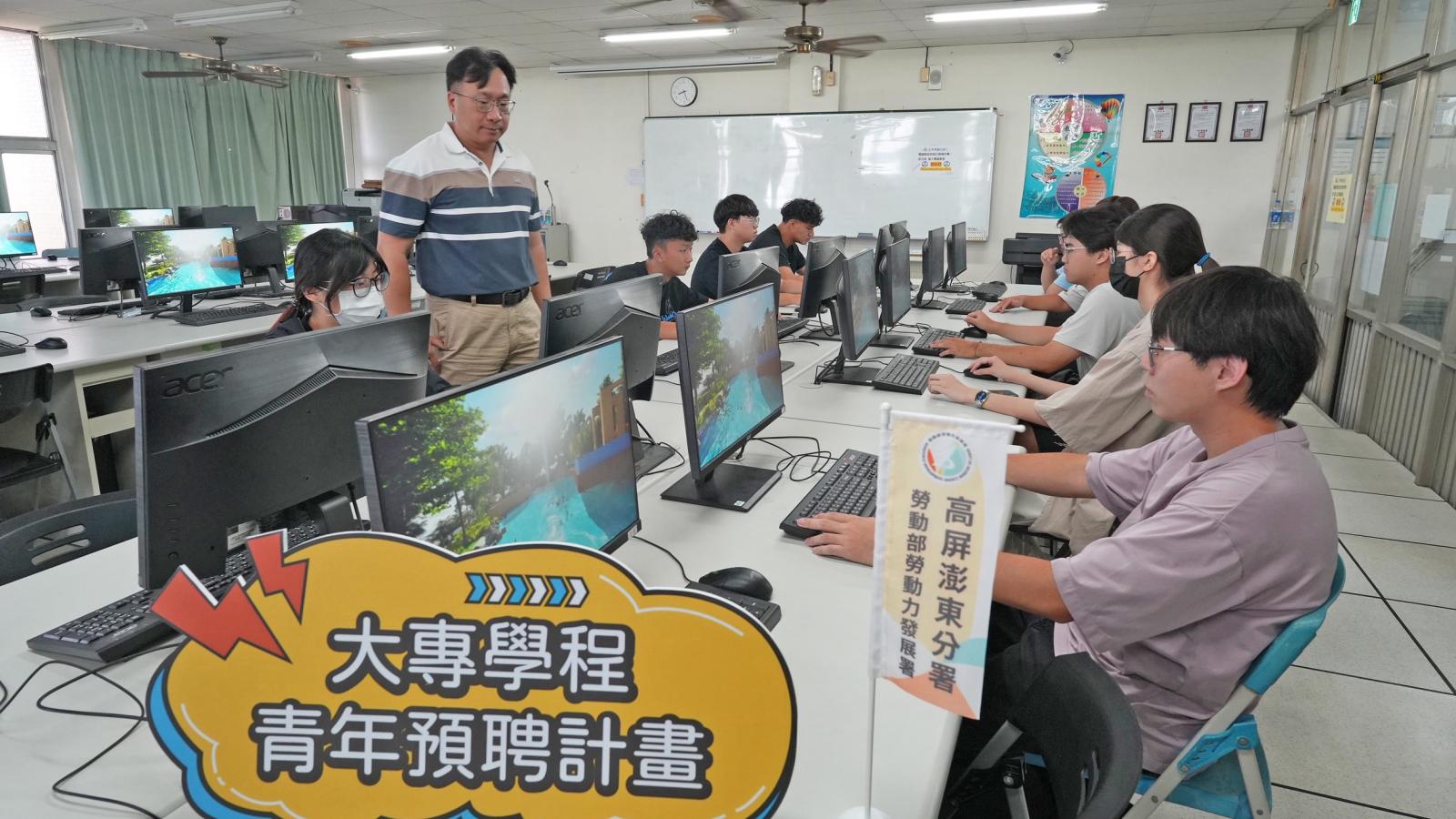
As graduation season approaches, many students face the challenge of transitioning from campus life to the workforce. The gap between theory and practice often leaves graduates feeling uncertain. To support students, the Kaohsiung Branch of the Ministry of Labor's Workforce Development Agency continues to promote the 'Subsidy Program for Pre-hiring Youth through University-Employer Collaboration.' Through industry-academia partnerships, the program guides students into real-world workplace training, helping soon-to-graduate students acquire industry skills early and achieve a smooth transition from graduation to employment.
Taking civil engineering and architectural design as examples, students often face practical challenges during their studies, such as interpreting structural mechanics, integrating mechanical and electrical piping systems, and understanding regulatory drawings. Chen Jian-Hua, a student from the Department of Civil Engineering and Spatial Information at Cheng Shiu University, participated in the 'BIM Modeling Technology in Engineering Application Practice Program' during his studies. He learned Revit 3D modeling and engineering drawing calculations, and in his senior year, he underwent on-the-job training at Da-Cheng Engineering Co., Ltd. After graduation, he was retained due to his outstanding performance and now handles quality control and progress tracking for engineering projects.
Another student, Wu Wei-Heng from the Department of Architecture and Interior Design, joined the 'Architectural and Interior Design Bidding and Workplace Practice Program.' In his final year, he trained at Yi-Xiang Architects, where industry mentors taught him practical skills such as design competitions and budget planning. Before graduation, Wu successfully obtained the Basic 3D Architectural and Interior Design Drafting Certificate and was retained by the firm, demonstrating the program's tangible impact in seamlessly connecting academia and industry.
The Kaohsiung Branch reported that in the 115th academic year, it has partnered with nine universities to launch 38 job-oriented training programs. The program provides substantial resources to build bridges among universities, enterprises, and students. It offers universities up to NT$900,000 per program for training expenses, and enterprises receive up to NT$72,000 per trainee. Additionally, participating youth receive a NT$10,000 retention bonus upon successful employment.
The branch emphasized that the program not only reduces the cost for enterprises to train new talent but also creates opportunities for youth to intern at well-known companies and secure long-term employment.
For youth interested in joining the program, the Ministry of Labor's 'Youth Vocational Training Resource Network' provides information on available programs at various universities. Alternatively, individuals can call the branch's consultation hotline (07-8210171 ext. 1332) for details, assess which program best suits their major, and strategically plan their career development early during their studies.
FACT BOX
- Source: PR Times
- Category: News