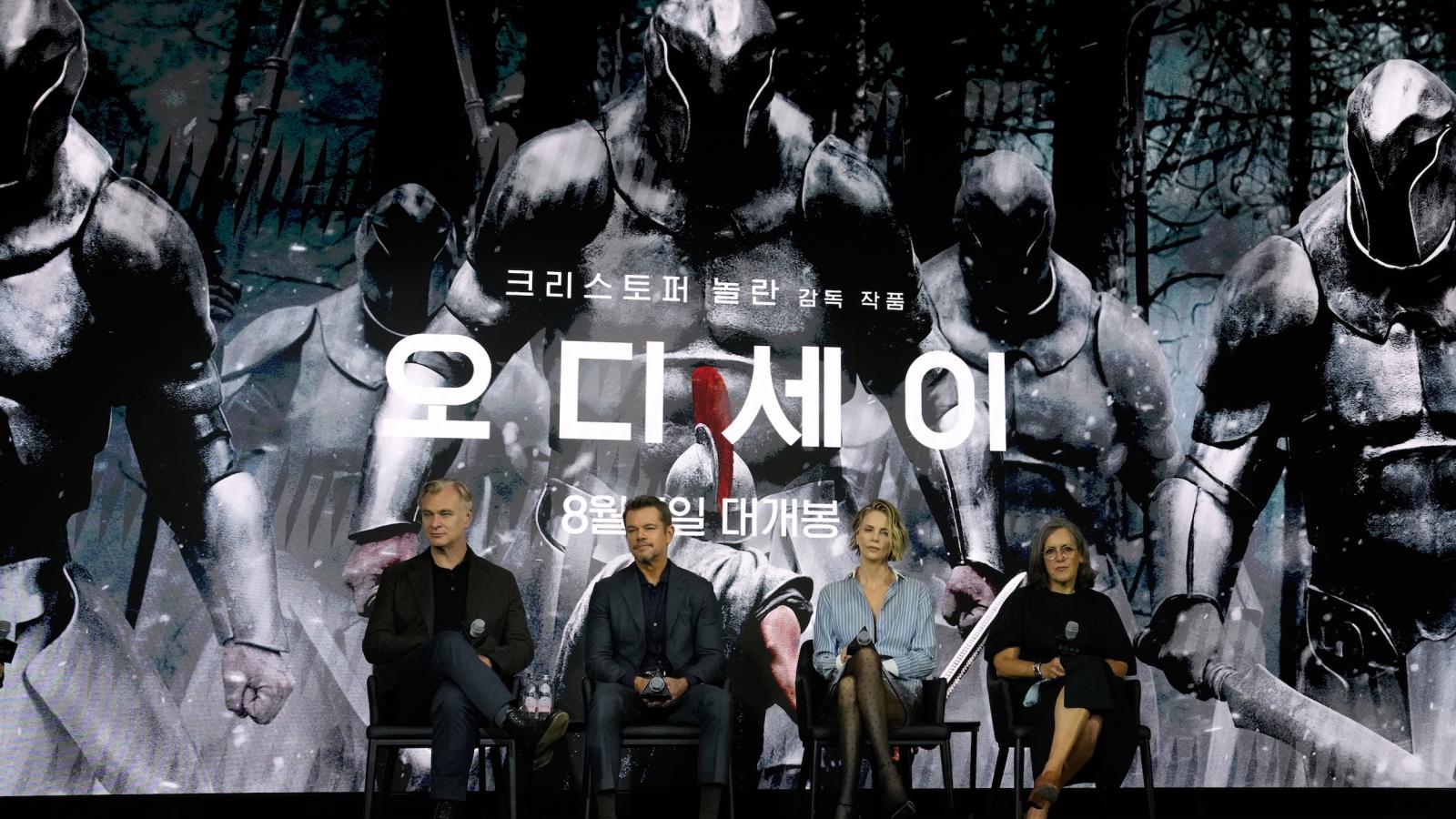
The film 'The Odyssey' is now screening globally. As we sit before the screen watching the movie based on ancient Greek mythology, observing Odysseus endure ten years of maritime wandering, face countless trials from monsters, and ultimately return home under the power struggles and covert protection of the gods in the heavens, a strange sense of déjà vu often arises. Isn't this exactly the Eastern 'Journey to the West'?
Indeed, placing 'The Odyssey' alongside 'Journey to the West' reveals astonishing similarities.
First, both involve long and perilous journeys—quests for sacred scriptures—facing various challenges and continuously 'defeating monsters.'
Second, behind both narratives lies divine orchestration: 'celestial arrangements, gods as master directors, protagonists as pawns.'
Third, through numerous trials, the main characters undergo spiritual cultivation, becoming 'better people.'
This striking similarity across Eastern and Western cultures inevitably raises a question: Did the Ming Dynasty Chinese 'Journey to the West' 'plagiarize' the ancient Greek 'The Odyssey'?
'Plagiarism' is, of course, too strong a conclusion. Wu Cheng'en could not possibly have read the ancient Greek 'The Odyssey,' and there is absolutely no direct textual borrowing between the two works. Yet, to conclude that these two works are entirely independent and unrelated would overlook the secrets hidden deep within literary DNA.
To solve this mystery, we must deeply analyze the 'non-indigenous nature' of 'Journey to the West' within the history of Chinese literature. In fact, the structure of 'Journey to the West' is highly unique within China's native literary tradition. The three points of similarity mentioned above perfectly illustrate its 'non-indigenous' character.
First: The Absence of a Grand Epic Tradition and the Lack of Indigenous Literary Soil
At the origin of Western literature, Homeric epics established the 'heroic journey and monster-slaying' gene, a lineage that later nourished countless adventure legends.
In Chinese literary history, no true long-form work existed before 'Journey to the West' that used 'long-distance travel and monster-defeating' as its narrative backbone. This involves a dual absence.
The first absence: the lack of the narrative framework itself—'advancing a long journey by overcoming a series of concrete external obstacles.' Qu Yuan's 'Chu Ci: Yuan You' imagines a journey riding dragons and phoenixes, touring the nine heavens. But this journey contains no obstacles that must be 'overcome' to proceed forward. Qu Yuan floats effortlessly, encountering no hindrances or risks of failure. The momentum of the work comes from the layered unfolding of inner emotions and philosophical reflections, not from external suspense such as 'if this obstacle isn't cleared, the story cannot progress.' 'Mu Tianzi Zhuan' is also a travelogue, but along the way, it only involves receiving tributes from各地, being fawned over like a moon surrounded by stars. In other words, both lack the most basic narrative engine: 'difficulty, trial, and overcoming.'
The second absence: even if we concede that 'Yuan You' contains some 'obstacles' (such as emotional distress or disappointment with reality), these difficulties were never created by gods, demons, or monsters. What Qu Yuan encounters along his journey are Peng Xian, Bo Yi, ancient sages he imagines conversing with, and a series of philosophical questions he poses to himself. This is fundamentally different from the Sirens, Cyclops, and witch Circe in 'The Odyssey,' or the White Bone Demon and Bull Demon King in 'Journey to the West.' The latter are concrete, sentient, supernatural adversaries who actively harm the protagonists. This further illustrates that in traditional Chinese narrative, the mechanism of 'gods or demons as specific aggressors who must be defeated to progress' is absent.
These two layers of absence together form a complete argument that the 'journey + monster-slaying' framework of 'Journey to the West' has no true precedent in Chinese literary history.
This is no accident. China has long lacked an epic tradition. China's orthodox literature has followed a completely different developmental path. Since Confucius and Mencius, Confucian culture has always emphasized 'literature as a vehicle for moral teaching,' 'poetry expressing will,' and 'sincerity of heart and intention.' The core concern of the literati class has always been self-cultivation, family regulation, state governance, and world pacification. Confucianism stresses 'while parents live, do not travel far.' Within China's traditional cultural ecosystem, there is simply no indigenous soil to nurture 'long-distance adventure.' The entire orthodox literati culture is neither skilled at nor interested in creating long epics filled with fictional monsters, divine-magical battles, and journeys across thousands of mountains and rivers. Without external nourishment, such a grand narrative framework could hardly emerge spontaneously from native soil.
Second: The Void of Divine Orchestration
The concept of divine orchestration is another point of similarity. It must be noted that the narrative skeleton of 'journey and monster-slaying' does not necessarily require the setup of 'gods manipulating everything behind the scenes.' The protagonist could rely entirely on courage, intelligence, or sheer luck to defeat demons and complete the journey. This is a narratively coherent model that exists abundantly in folk tales worldwide (a lone hero overcoming adversity through personal effort).
Yet 'The Odyssey' and 'Journey to the West' both coincidentally adopt this 'non-essential' structure. In 'The Odyssey,' whether Odysseus can return home, what trials he encounters, when he is delayed or allowed to proceed, largely depends on Athena's covert protection and Poseidon's vengeful wrath. The entire narrative rhythm is actually controlled behind the scenes by the divine council on Mount Olympus.
Similarly in 'Journey to the West': Tang Sanzang's pilgrimage to obtain scriptures was originally commissioned by the Buddha and arranged by Guanyin. Almost every trial along the journey unfolds under the observation and orchestration of the heavenly administrative system—Buddha, Guanyin, and the Jade Emperor. Even the origins of the demons often trace back to a celestial deity's mount descending to earth or a celestial's pet going astray. The pilgrimage team appears to be 'clearing levels,' but in reality, the entire journey's framework was pre-arranged by the heavens.
This point can be examined more deeply: Chinese orthodox thought not only 'respects ghosts and spirits but keeps them at a distance,' but more crucially, the indigenous Chinese concept of 'Heaven' has never been a concrete, personified decision-making body, but rather a projection of abstract moral principles. The 'Book of Documents' states, 'Heaven sees through our eyes, Heaven hears through our ears,' meaning that heavenly will is manifested through popular sentiment—Heaven has no personal office of will, no procedural deliberations. In the 'Spring and Autumn Annals,' 'heavenly retribution' refers to natural anomalies like comets, earthquakes, and solar eclipses, interpreted as warnings against a ruler's moral failure. This is a 'symbolic' form of communication, not an 'administrative' decision-making process.
This contrasts sharply with the 'Journey to the West' depiction of the Jade Emperor holding morning court, the Buddha convening the Ullambana Festival, and Guanyin mobilizing troops across regions. The entire 'celestial bureaucratic system' in 'Journey to the West' blends the Buddhist cosmological hierarchy of the 'Thirty-Three Heavens,' the narrative pattern from Buddhist scriptures of 'Buddhas gathering to discuss Dharma,' and Ming Dynasty secular bureaucratic procedures (morning court, memorials, troop mobilization). In other words, the celestial world in 'Journey to the West' is not a natural extension of traditional Chinese 'Mandate of Heaven' concepts, but rather a Buddhist cosmological administrative framework dressed in the shell of Ming Dynasty bureaucracy.
China does have indigenous local beliefs in land gods and earth spirits, traceable back to Shang and Zhou dynasty soil sacrifices. But these deities were originally scattered, functionally vague, and lacked hierarchical relationships. The organization of these spirits into a bureaucratic hierarchy—'land gods subordinate to city gods, city gods corresponding to human prefects, reporting upward layer by layer, each with defined duties'—only emerged after Buddhism entered China. This organizational process highly overlaps with the period of Buddhist transmission eastward and the stimulation of Daoism to reorganize its own pantheon. In other words, while 'ghosts and gods' themselves are indigenous, organizing them into a system with 'clear jurisdictions, hierarchical subordination, and division of decision-making' only took shape under the influence of foreign religious cosmologies.
Third: The Scarcity of 'Bildungsroman' in Chinese Tradition
Traditional Chinese narrative extremely lacks the Western literary trajectory of 'Bildungsroman'—soul purification, psychological maturation, and moral elevation through a long journey.
Surveying classical Chinese novels—whether 'Romance of the Three Kingdoms,' 'Water Margin,' or even 'Dream of the Red Chamber'—characters often maintain a 'fixed personality, fated cycle' throughout the long narrative. Their fates shift with the times, but their minds and souls lack substantial transformation. In 'Romance of the Three Kingdoms,' Zhuge Liang appears as a perfected sage from the start—'knowing the division of the world into three before leaving his thatched cottage'—and throughout his life, his character and wisdom show no real arc of growth. In 'Water Margin,' the Liangshan heroes' story is essentially a tragedy of 'official oppression forcing rebellion, gathering in righteousness, then being suppressed.' The 'true nature' of each of the 108 heroes (Lu Zhishen's rashness, Li Kui's cruelty) remains almost unchanged from beginning to end. 'Dream of the Red Chamber,' while unprecedented in psychological detail, sees Jia Baoyu's final 'enlightenment' and monastic retreat as closer to a one-time, sudden realization.
In contrast, Sun Wukong in 'Journey to the West' evolves from a wild, arrogant monkey who wreaks havoc in Heaven, to one imprisoned under Five Elements Mountain, undergoing painful reflection, wearing the golden headband as restraint, and gradually shedding pride and attachment through eighty-one trials—one trial at a time. This is a gradual, analyzable process of mental cultivation. It is a complete journey of self-transcendence, becoming a 'better person.' Tang Sanzang, Zhu Bajie, and Sha Wujing are similar. This growth narrative centered on 'mental cultivation and transcendence through trials' is virtually unprecedented in Chinese indigenous literature.
Crucially, 'Journey to the West' was not a sudden literary innovation by Wu Cheng'en, but the culmination of centuries of folk storytelling
FACT BOX
- Source: PR Times
- Category: News