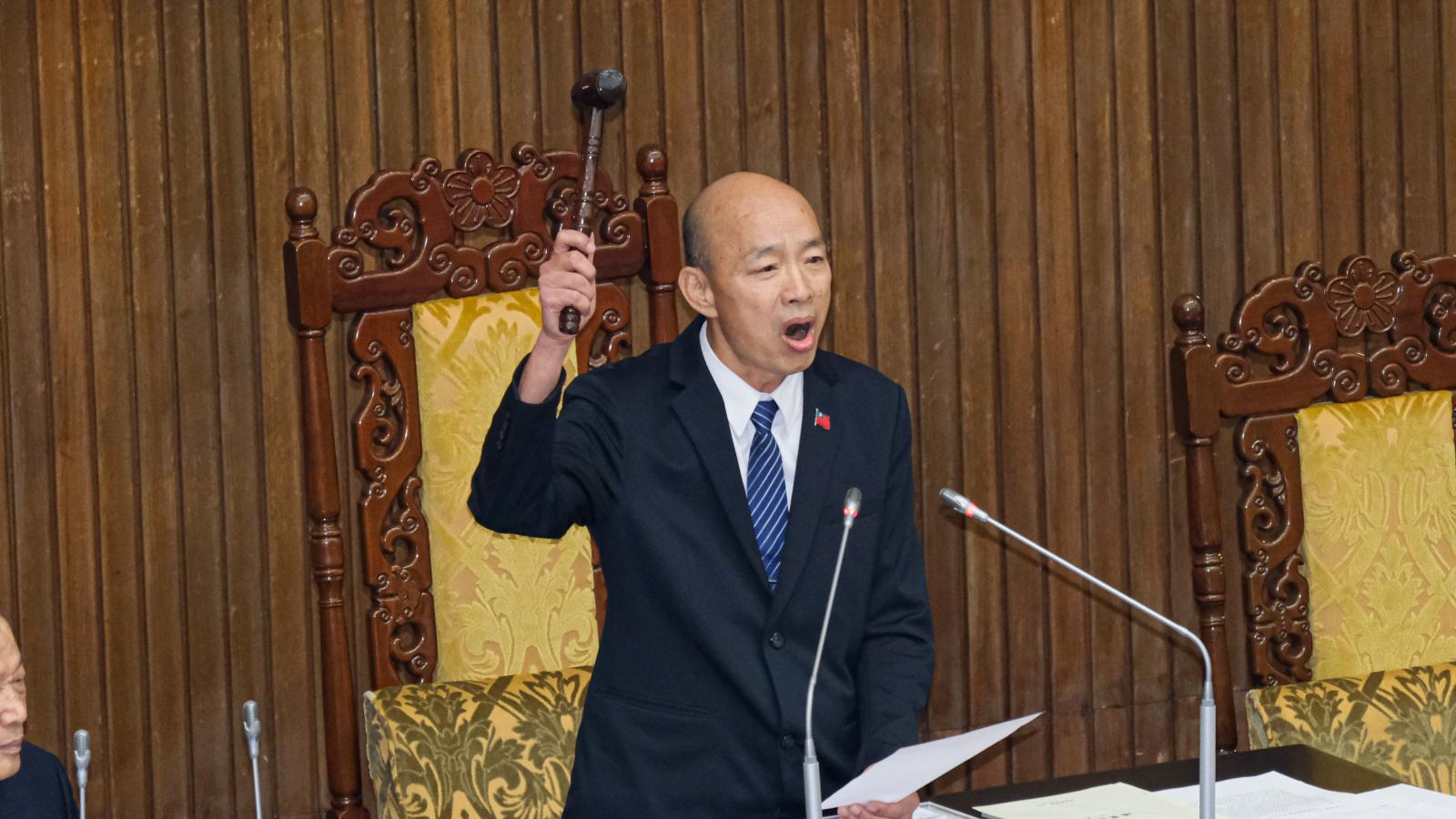
After nearly a year of delays, the Legislative Yuan completed the third reading of the 2026 central government budget on the 14th. Legislative Speaker Han Kuo-yu urged opposition party lawmakers to reduce their number of proposals to under 100. After negotiations and consolidation among opposition caucuses, only 39 proposals were ultimately voted on, all of which passed as proposed by the opposition, which holds a majority of seats. The Democratic Progressive Party (DPP) caucus did not request a re-vote, and the voting concluded around 5:30 PM. Confidential budgets were then processed. Around 6:00 PM, clerks announced the results of the second and third readings, after which Han Kuo-yu declared the amended bill passed.
The Legislative Yuan convened on the 14th, finishing deliberation on the non-reserved portions of the 2026 central government budget by midday before taking a break. Regarding reserved items, KMT caucus leader Fu Kun-chi stated before the session that opposition proposals had been reduced to 75 cases. He urged Premier Cher-Ren Tsai to fully carry out legal co-signing, announcements, and enforcement, and not to undermine the dignity of the legislature. He also urged President Lai Ching-te to cherish Speaker Han's goodwill. Meanwhile, TPP caucus leader Chen Ching-lung stated that Lai and Tsai bore primary responsibility for the budget's prolonged delay.
Overall budget cut by NT$48 billion; special allowances for 20 agencies including Executive Yuan fully eliminated
At 3:35 PM on the 14th, the Legislative Yuan resumed, with Han Kuo-yu announcing that cross-party consensus had been reached on a general budget reduction. According to the agreement, aside from previously approved advance disbursements for new initiatives (NT$71.8 billion) and additional funding for the labor insurance fund (NT$120 billion), the 2026 central government budget was reduced by 1.689%, totaling NT$4.8 billion. Specifically, special allowances for 20 agencies—including the Executive Yuan and Control Yuan—were entirely eliminated. Other agencies saw their special allowances cut by 60%, publicity expenses by 50%, military equipment and facilities by 2.5%, and administrative and commissioned fees by 10%.
Around 4:00 PM, the legislature began voting on reserved proposals. Ultimately, except for Speaker Han Kuo-yu, Deputy Speaker Chiang Chi-chen (who had left the chamber), and TPP legislator Hsu Chung-hsin (on a U.S. visit), all 110 attending legislators voted. In nearly every case, the opposition caucus passed proposals with 59 votes in favor versus 51 opposed from the DPP caucus. No re-vote was requested, and all reserved items passed as proposed.
At 6:05 PM, clerks read out the second reading results. The 2026 central government budget originally listed revenues of over NT$2.8622 trillion. After deliberation, NT$60.19 billion was added, temporarily adjusted to over NT$3.4642 trillion. Expenditures were originally over NT$3.0349 trillion; after deliberation, NT$4.8 billion was cut, temporarily adjusted to over NT$2.9869 trillion, with final adjustments to be made by the Directorate General of Budget, Accounting and Statistics (DGBAS) under the Executive Yuan. In other words, the final budget cuts by legislative committees did not exceed the cross-party agreed-upon general reduction, making it a 'ceiling'.
Cher-Ren Tsai's salary frozen for four months
According to Wind Media's summary of the 39 budget-cut and freeze proposals put forward by opposition caucuses and passed by vote, one notable case was proposed by KMT legislator Weng Hsiao-ling: freezing Premier Cher-Ren Tsai's salary from September to December, totaling NT$1.488 million. The freeze will only be lifted after Tsai fully complies with legal budget compilation and co-signing procedures, submits a written report to the Interior Committee, and receives legislative approval before disbursement. Meanwhile, the TPP caucus proposed freezing NT$5 million in Executive Yuan operational funds, requiring the Executive Yuan to explain its timeline for backpaying police and firefighter pensions before disbursement is permitted.
President's state affairs discretionary fund reduced by NT$10 million
Regarding cuts and freezes to the Presidential Office budget, the Legislative Yuan passed proposals including one by Weng Hsiao-ling to reduce the president's state affairs discretionary fund by NT$10 million and freeze NT$20 million. The frozen portion will only be released after President Lai Ching-te publishes five bills passed in third reading by the legislature, submits a written report to the Judiciary and Organic Laws and Statutes Committee, and receives approval. Weng also proposed reducing the Presidential Office's special allowance by NT$1.5 million and freezing another NT$1.5 million, with the frozen portion released only after the five bills are published.
PTS budget cut by NT$21.85 million; TaiwanPlus reduced by NT$200 million
The much-discussed budget cuts for Public Television Service (PTS) and TaiwanPlus were also voted through. For PTS, the legislature passed Weng Hsiao-ling's proposal to cut NT$21.85 million and freeze approximately 10% of its budget (NT$200 million), with the frozen portion released only after the new chairman of PTS's 8th board officially takes office and the Ministry of Culture submits a special report to the Education and Culture Committee, subject to legislative approval. The TaiwanPlus budget cut was passed in a revised version after coordination between the TPP and KMT caucuses, reducing funding by NT$200 million.
For the National Communications Commission (NCC), the KMT caucus proposed freezing 30% of its budget and requiring a special report to the Transportation Committee within one month before disbursement. They also proposed cutting NT$5 million for four vacant commissioner positions from January to July and freezing NT$6.429 million for seven vacant positions from August to December, with future unfreezing based on actual appointments. Meanwhile, the TPP caucus proposed cutting NT$1 million from the 'B5G/6G development' and low-orbit satellite industry development policy budgets and required a written report from the NCC.
Control Yuan's budget cut by NT$110 million; Judicial Yuan's special allowance cut by NT$2.19 million
Regarding the Control Yuan, which has faced criticism for vacancies, the legislature passed a TPP caucus proposal on the 14th to cut NT$110 million from its budget excluding personnel expenses. It also froze salaries for the Control Yuan president, vice president, and commissioners from August to December, totaling NT$32.6621 million. For the Judicial Yuan, the TPP caucus proposed cutting its special allowance by NT$2.19 million, urging strict adherence to legal norms and constitutional order. Additionally, NT$5 million was cut each for 'ensuring transparent trials' and 'judicial digitalization policy', and two budget items related to 'juvenile delinquency' were frozen. The KMT caucus proposed excluding defendants in 'premeditated murder, drunk driving fatalities, fraud, sexual assault, and child abuse' cases from mandatory legal aid, cutting NT$5 million and freezing another NT$5 million.
FACT BOX
- Source: PR Times
- Category: News