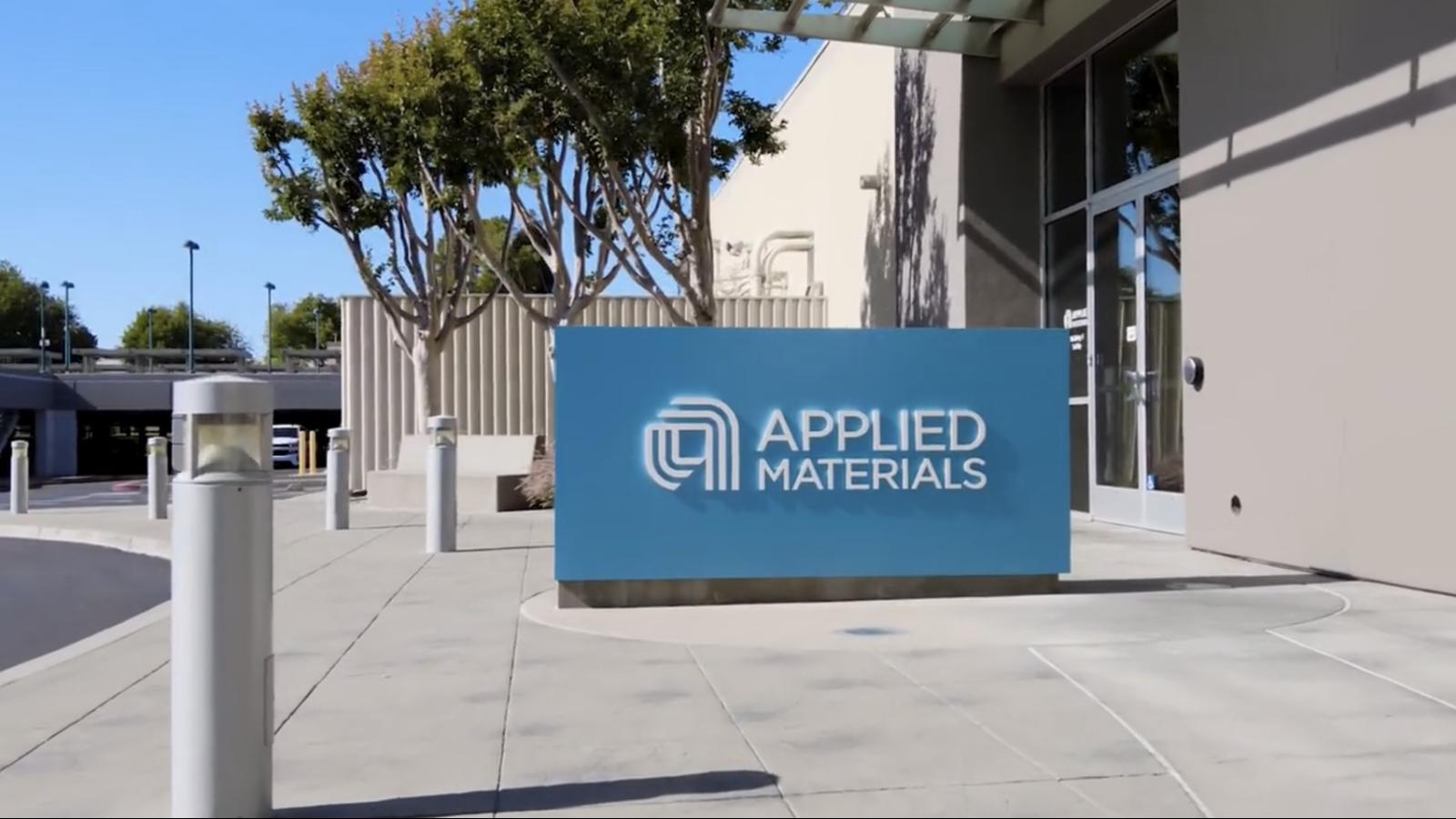
Artificial intelligence (AI) infrastructure investment continues to expand globally, driving equipment demand beyond advanced logic chips into DRAM, high-bandwidth memory (HBM), and advanced packaging. Semiconductor equipment leader Applied Materials (NASDAQ: AMAT) released its fiscal 2026 third-quarter financial results, reporting record quarterly revenue of $9.115 billion, a 25% year-over-year increase. GAAP (Generally Accepted Accounting Principles) diluted earnings per share (EPS) reached $3.17, up 43% year-over-year, while non-GAAP EPS hit $3.50, up 41% year-over-year, both setting new highs. With AI-related equipment demand continuing to heat up, Applied Materials forecasts its fourth-quarter revenue midpoint will surpass $10 billion, reaching $10.25 billion.
Gary Dickerson, President and CEO of Applied Materials, stated, "As AI rapidly proliferates worldwide, demand for our materials engineering solutions has reached unprecedented levels." As a result, the company has further raised its 2026 revenue outlook for the Semiconductor Systems business group and is confident its growth rate this year will outpace the overall market. With customer demand visibility continuing to improve, Applied Materials expects 2027 to be another year of strong growth.
Financially, Applied Materials not only set new revenue records in Q3 but also enhanced profitability. The GAAP gross margin reached 50.3%, up 1.5 percentage points from 48.8% in the same quarter last year. Operating income hit a record $3.08 billion, with operating margin rising from 30.6% to 33.7% year-over-year.
GAAP net income for the quarter was $2.538 billion, up 43% from $1.779 billion in the prior-year quarter, while diluted EPS increased from $2.22 to $3.17, also up 43%. On a non-GAAP basis, gross margin reached 50.4%, operating income was $3.1 billion (operating margin 34%), net income was $2.795 billion (up 41% year-over-year), and diluted EPS reached $3.50 (up 41% year-over-year), all setting new records.
Cash flow performance also improved, with operating cash flow reaching $3.04 billion in Q3, another record high. The company returned $860 million to shareholders through $440 million in share repurchases and $420 million in dividends.
Brice Hill, Senior Vice President and CFO of Applied Materials, noted that the company has achieved gross margin expansion year-over-year for 13 consecutive quarters, reflecting the value it creates by helping customers improve chip and system performance and increase fab ROI. He expects revenue to remain strong in the second half of the year, particularly driven by demand from DRAM, advanced-process foundry and logic, and advanced packaging.
AI demand spreading beyond logic chips: DRAM revenue share rises to 26%
Breaking down the performance of Applied Materials' business segments reveals that AI equipment demand is gradually spreading from advanced logic processes to DRAM and advanced packaging.
The Semiconductor Systems business group reported Q3 revenue of $7.04 billion, up approximately 27% from $5.564 billion in the same quarter last year. Gross margin improved from 53.4% to 55.3%, while operating income surged from $1.837 billion to $2.657 billion, and operating margin rose from 33% to 37.7%.
Analyzing the revenue mix within Semiconductor Systems, foundry, logic, and other businesses accounted for 67%, slightly down from 69% last year; DRAM increased from 22% to 26%, a 4-percentage-point rise; while flash memory declined from 9% to 7%. As AI servers continue to drive higher memory bandwidth requirements, DRAM and HBM have become critical components of this wave of AI infrastructure investment. Applied Materials' management has identified DRAM as one of the key growth drivers for the second half of the year.
Notably, during its latest earnings call, Applied Materials pointed out that most advanced logic and DRAM fabs are currently operating at full capacity, and customer demand visibility extends further than in the past, with some discussions already reaching into 2030. The company estimates that advanced foundry and logic, DRAM, and advanced packaging will account for approximately 80% of wafer fab equipment market growth from 2026 to 2027. (Applied Materials)
HBM stacking layers increase: Applied Materials launches six new systems for DRAM and advanced packaging
Another structural shift driven by AI is that chip advancement is no longer limited to process scaling—HBM stacking layers, 3D chip integration, and advanced packaging complexity are also increasing, further boosting demand for materials engineering, deposition, polishing, metrology, and defect analysis equipment.
Applied Materials recently unveiled six new chip manufacturing systems targeting DRAM and advanced packaging. The upgraded Centura Prime Epi epitaxy system enhances transistor drive current and efficiency through advanced strain engineering and precise doping control, targeting faster, more energy-efficient DRAM and HBM.
The Producer Avila 2 PECVD (Plasma-Enhanced Chemical Vapor Deposition) system addresses structural challenges posed by increasing HBM stacking layers by depositing stress-balancing dielectric films around TSVs (Through-Silicon Vias), enhancing the mechanical stability of ultra-thin DRAM dies. It supports 12-layer, 16-layer, and even higher-layer HBM stacking.
For advanced packaging, the Opta Quad CMP (Chemical Mechanical Polishing) system continuously monitors wafer conditions during polishing and dynamically adjusts process parameters to improve wafer uniformity and thickness variation control, targeting advanced processes like Hybrid Bonding. The Nokota Vmax 2 electrochemical deposition system covers TSV filling required for 3D stacking and fine-pitch interconnect processes such as microbumps.
During the earnings call, Applied Materials further emphasized that advanced packaging has become a critical area for AI computing innovation. The company projects its overall advanced packaging-related revenue will grow over 70% in 2026 and sees long-term growth opportunities from HBM and 3D Chiplet stacking.
In other words, the AI chip performance race is no longer just about chasing more advanced transistor processes. As HBM layer counts increase and Chiplet architectures and 3D integration become more complex, chipmakers must invest more in materials engineering, advanced packaging, and process control equipment—creating more entry opportunities for equipment vendors with each new generation of AI chip architecture upgrades.
Raising semiconductor systems revenue outlook: Dickerson says 2027 will remain strong
Facing continued AI infrastructure investment, Applied Materials has further raised its 2026 revenue outlook for the Semiconductor Systems business group. Dickerson stated, "As AI rapidly proliferates worldwide, it is driving demand for our materials engineering solutions to unprecedented levels." The company has therefore further increased its Semiconductor Systems revenue outlook and is confident its 2026 growth rate will exceed the overall market. With improving customer demand visibility, Applied Materials also expects 2027 to deliver another year of strong growth.
On the capacity side, Applied Materials is already preparing for longer-term demand. The company recently expanded its manufacturing and R&D footprint in Singapore, investing $500 million to build a new Tampines Campus, more than doubling its local advanced cleanroom capacity. Brice Hill stated the company is further increasing manufacturing capacity to support customers' expected demand over the next several years.
During the earnings call, Applied Materials revealed that its manufacturing space has nearly doubled in recent years as global fabs continue to expand. With customer demand visibility extending further, the company continues to expand its supply capacity. In addition to new fab construction, existing fabs improving yield, output, and faster ramp-up are also driving demand for service, metrology, and inspection equipment.
Q3 record high may not be the peak: Q4 revenue midpoint to surpass $10 billion
Applied Materials' guidance for Q4 suggests that the record $9.115 billion revenue in Q3 may not be the peak of this growth cycle. The company forecasts fiscal 2026 fourth-quarter revenue of $10.25 billion, plus or minus $500 million, translating to a range of $9.75 billion to $10.75 billion. Non-GAAP diluted EPS is expected to be $4.02, plus or minus $0.20, or $3.82 to $4.22.
Brice Hill noted that Applied Materials expects strong revenue growth to continue in the second half of the year, particularly from DRAM, advanced-process foundry and logic, and advanced packaging.
From Q3's record-high revenue and profits to Q4's revenue midpoint surpassing $10 billion for the first time, the underlying trend reflects more than just demand for AI accelerators like GPUs. As AI infrastructure continues to expand, equipment investment is spreading to DRAM and HBM, advanced logic processes, 3D chip integration, and advanced packaging. The increasing requirements for materials engineering, deposition, etching, polishing, and metrology control in these processes form the foundation for Applied Materials' continued optimism about 2027 growth momentum.
FACT BOX
- Source: PR Times
- Category: 財務
- Organizations: Applied Materials
- Products / services: Centura Prime Epi / Producer Avila 2 PECVD