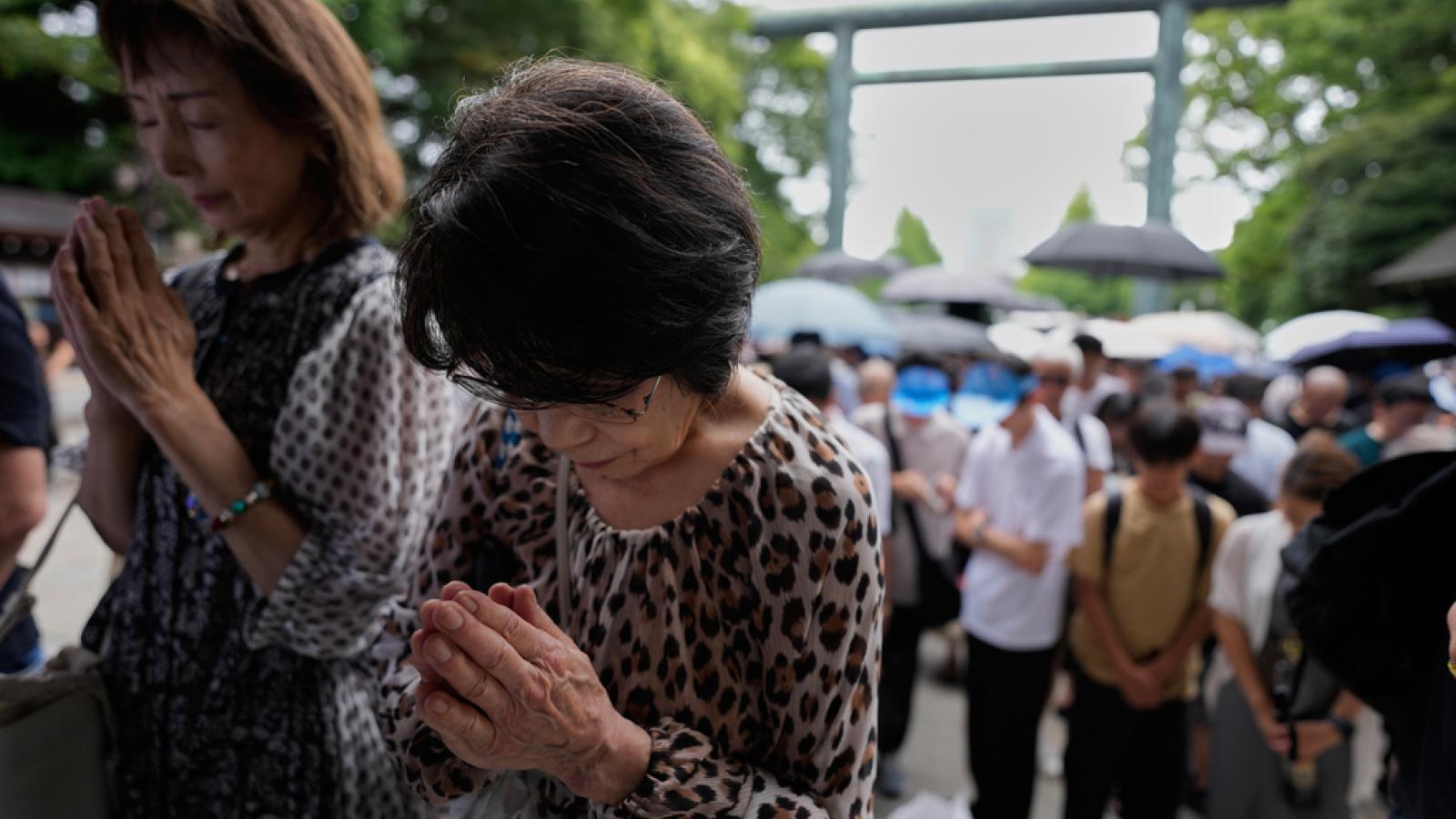
Today marks the 81st anniversary of the end of World War II, and the 'National Ceremony for Bereaved Families of the War Dead' was held at the Nippon Budokan. This year, the oldest bereaved family member in attendance was 98-year-old Takahashi Kazuhiko, whose brother died in the Philippines. As memories of the war gradually fade, he came to the venue with a cane, holding onto his hope for peace. According to Kyodo News and TBS, Takahashi's brother, Tomohiko, who was 11 years older, graduated from the Faculty of Science and Engineering at Waseda University and joined the Japanese Navy in 1942, where he was responsible for aircraft maintenance. He was subsequently deployed to the Marshall Islands, the Philippines, and Taiwan. Many Japanese people gathered at Yasukuni Shrine in Tokyo to mourn their families. (AP) In Takahashi's memory, 'Besides my father, the person I feared the most was my brother Tomohiko,' but his brother also played with him with a steam train toy and took him to the bookstore, leaving many memories between the brothers. Before the war situation worsened, his brother often returned to their home in Tokyo and once brought back bamboo crafts from the Marshall Islands as a gift for their parents. In late 1944, Takahashi happened to meet his brother returning home at a station, and they simply exchanged a brief 'yo.' That became the last time they saw each other. The following year, Tomohiko was sent to the Philippines and died in battle on Luzon Island in April 1945 at the age of 27. On August 15 of the same year, 17-year-old Takahashi remained in Tokyo and, along with a couple who took care of him, listened to the 'Imperial Rescript on the Termination of the War' on the radio. 'I deeply felt that we had lost the war. The first thing that came to my mind was those who had died in battle.' Takahashi still remembers the couple, who had lost their only son in the war, crying after hearing the broadcast. After the war, people around him gradually returned from overseas, but his brother never came back. Many Japanese people gathered at Yasukuni Shrine in Tokyo to mourn their families. (AP) It was only several years after the war that the Takahashi family learned that their brother had died in battle. He went to Kanei-ji Temple in Ueno, Tokyo, to receive the remains, but the urn was so light that he felt 'as if there was nothing inside.' Without checking, he directly buried the urn in the grave. After the war, Takahashi continued to meet with former navy personnel, established a bereaved families' association, and has visited the Philippines twice for consolation. Last year, he registered his DNA information with the Japanese government's remains collection plan, hoping to find his brother's remains. This year, Takahashi's health deteriorated due to illness, but because of his thoughts for his brother and the war victims, he still decided to attend the memorial ceremony. Takahashi said, 'I don't think there is any Japanese person who would willingly want war. Not a single one. But it is possible to be drawn into a war.' He stated, 'War must never happen again,' and hopes that the next generation will cultivate wisdom to lead the world towards peace. On the other hand, the youngest bereaved family member attending the ceremony this year was only 3 years old, and his great-grandfather had died in the war. The child's mother brought him to the venue, hoping that the memory of the war would continue to be passed down. 'I hope that the tragedy of war will not fade away with time. I hope he will always remember and think about it. If today's events can leave even a little in his memory, that would be enough.' According to statistics from Japan's Ministry of Health, Labor and Welfare, this year, 56.3% of the bereaved families attending the memorial ceremony were born after the war. As the generation that directly experienced the war gradually decreases, how to pass down the memory of the war has become a new challenge.
FACT BOX
- Source: PR Times
- Category: Event