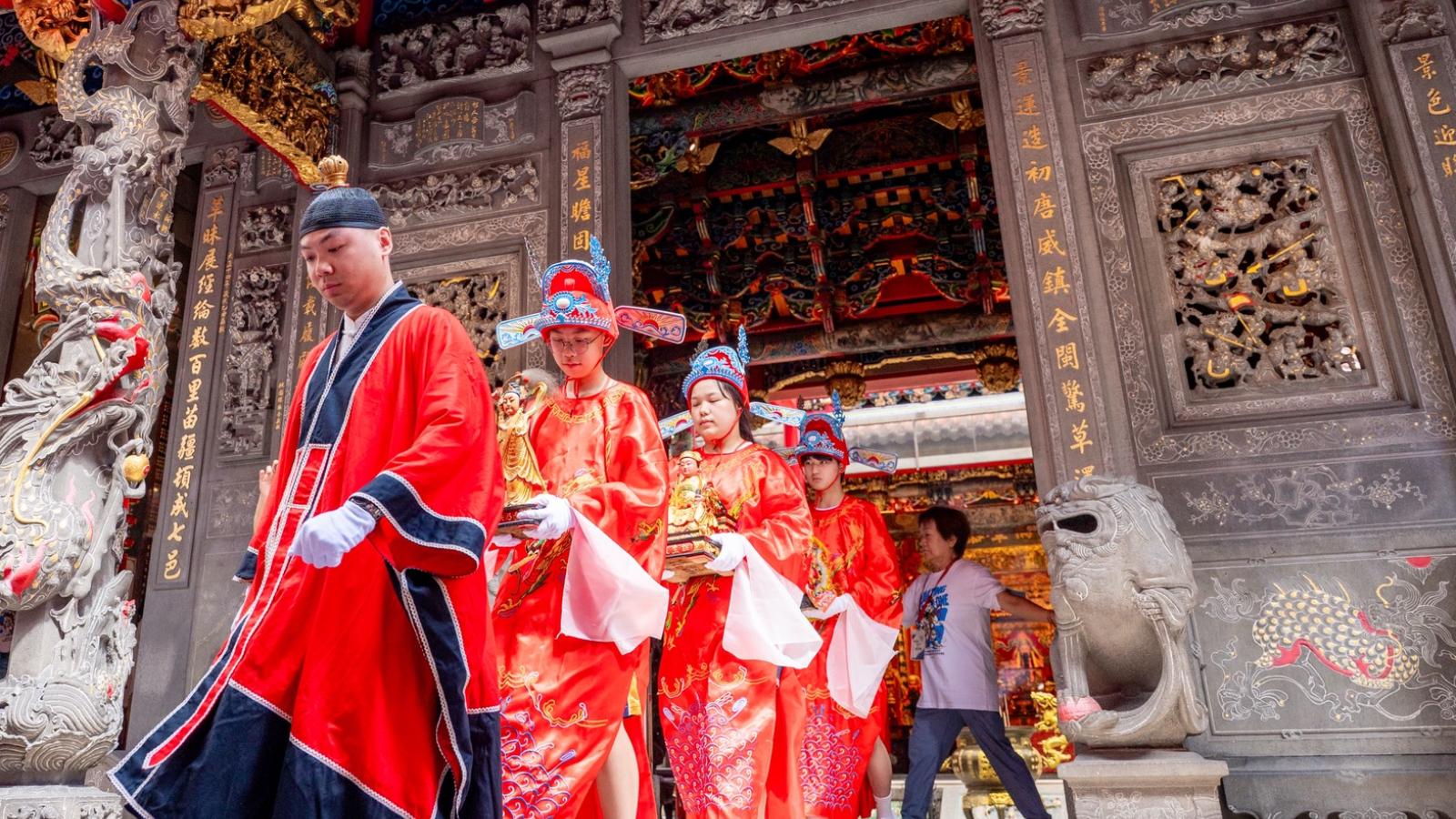
How do you officially 'become an adult' upon turning 16? The 'Jingfu Palace 2026 Coming-of-Age Ceremony' in Taoyuan, recognized as one of Taiwan's top three coming-of-age rituals, was grandly launched today (15th), attracting 300 local high school and vocational students to participate in the traditional 'Tuo-Jiong' ceremony. Taoyuan Deputy Mayor Su Chun-Pin attended the event and revealed that Jingfu Palace (Taoyuan Daming Temple) was established as far back as 1737, serving as the historical starting point for the name 'Taoyuan'. By following ancient rites to express gratitude to deities and parents, youth formally assume responsibility and step into a new phase of life, witnessed by the God of Kaizhang and their families.
Su Chun-Pin pointed out that Jingfu Palace is a deeply historic cultural and religious center in Taoyuan, making the holding of the coming-of-age ceremony here especially significant. The temple's founding traces back to 1737, when pioneer Xue Qilong led a group of 100 settlers to develop the region, stretching from Nankan in the north to Bade Xiaoli in the south, Guishan (modern-day Guishan) in the east, and Kanzi Jiao (modern-day Neili) in the west—collectively known as the 'Fifteen Street Villages'. However, because peach trees were extensively planted during the development, the area became known as 'Taoyuan' (Peach Garden), the origin of today's name 'Taoyuan'. Xue Qilong later proposed the construction of Jingfu Palace, which locals affectionately call the 'Great Temple'.
According to Jingfu Palace Chairman Jian Zhengtan and the Taoyuan City Government's Civil Affairs Bureau, in early Taiwanese folk customs, parents would bring their children to local grand temples to request divine guardianship, a practice known as 'making a godchild' (Zuo Qi Zi), praying for protection from deities such as the Seventh Goddess (Qiniangma), the Birth-Giving Goddess (Zhusheng Niangniang), or the local patron deity, the God of Kaizhang, to ensure their children grow safely until age 16.
This year (2026), a total of 300 local high school and vocational youth from Taoyuan registered to participate. The temple strictly followed traditional ancient rites in conducting the ceremony. Through 'Tuo-Jiong', youth symbolically shed the protective amulet worn since childhood, marking their formal transition into adulthood and the beginning of greater personal responsibility, while deepening their identification with local religious beliefs and traditional culture.
The Taiwanese traditional life ritual 'Coming of Age at 16' holds significant cultural symbolism, representing youth's formal transformation from children protected by family and deities into independent, socially responsible adults. The core ritual of 'Tuo-Jiong' involves removing the red string and ancient coin (Jiong) worn around the neck since infancy for safety, expressing gratitude to the Seventh Goddess, the Birth-Giving Goddess, and the patron deity, the God of Kaizhang, for their long-standing protection.
As the symbolic heart of Taoyuan's city origins, Jingfu Palace integrates three key elements—worship of the God of Kaizhang, historical roots of land reclamation, and gratitude to parents—enabling 300 local youth to 'joyfully become adults' in a solemn and heartwarming ceremony. This not only fully preserves Taiwan's precious folk cultural heritage but also instills a profound sense of cultural identity and civic responsibility in the new generation of youth.
FACT BOX
- Source: PR Times
- Category: Event