The US-Iran military conflict has now lasted nearly six months, with neither side able to end the war of attrition. The Strait of Hormuz remains completely paralyzed, and on the 15th, Iran's Foreign Ministry strongly demanded that the United States "accept the reality of defeat." US President Trump, in turn, harshly criticized Tehran as "extremely evil," urged Americans to prepare psychologically for high oil prices, and even threatened to "annex the Strait of Hormuz as US territory." Bloomberg News warns that both nations are deeply mired in a half-century-old enmity, and any temporary ceasefire is merely a "breathing space to reload," signaling that the Middle East has entered a new, brutal normal of endless conflict.
According to Reuters on the 15th, since the US-Israeli coalition launched airstrikes against Iran on February 28, peace negotiations and shipping through the Strait of Hormuz have both stalled. Data from maritime tracking firm Kpler shows that on the 14th, only two vessels risked passage through the strait—and neither were oil tankers. Compared to pre-war levels of over 130 ships daily carrying one-fifth of the world’s crude oil, this strategic waterway is now effectively shut down. Any vessel attempting transit without Tehran’s permission faces a high risk of missile or drone attacks, leaving no insurer willing to underwrite coverage and no tanker operator willing to take the risk.
Kazem Gharibabadi, Iran’s Deputy Foreign Minister, posted strongly on social media platform X on the 15th: "The opening and closing of this strait is entirely under Iran’s control. As long as you refuse to accept defeat and remain immersed in fantasy, Iran will continue its blockade." He further retorted to the US: "The Strait of Hormuz cannot be seized by a tweet, an aircraft carrier, an executive order, or a campaign speech."
Iranian Foreign Minister Abbas Araqchi, in an interview with Iranian outlet Shahrara News, emphasized that Tehran has not yet decided whether to resume talks with Washington, and that the US must first meet Iran’s conditions regarding navigation in the strait. On the June ceasefire agreement, which briefly held, Araqchi stated bluntly that the consensus has already collapsed: "We never had a ceasefire that needed extending. What we faced was the 'end of war,' and now we are in a completely new situation."
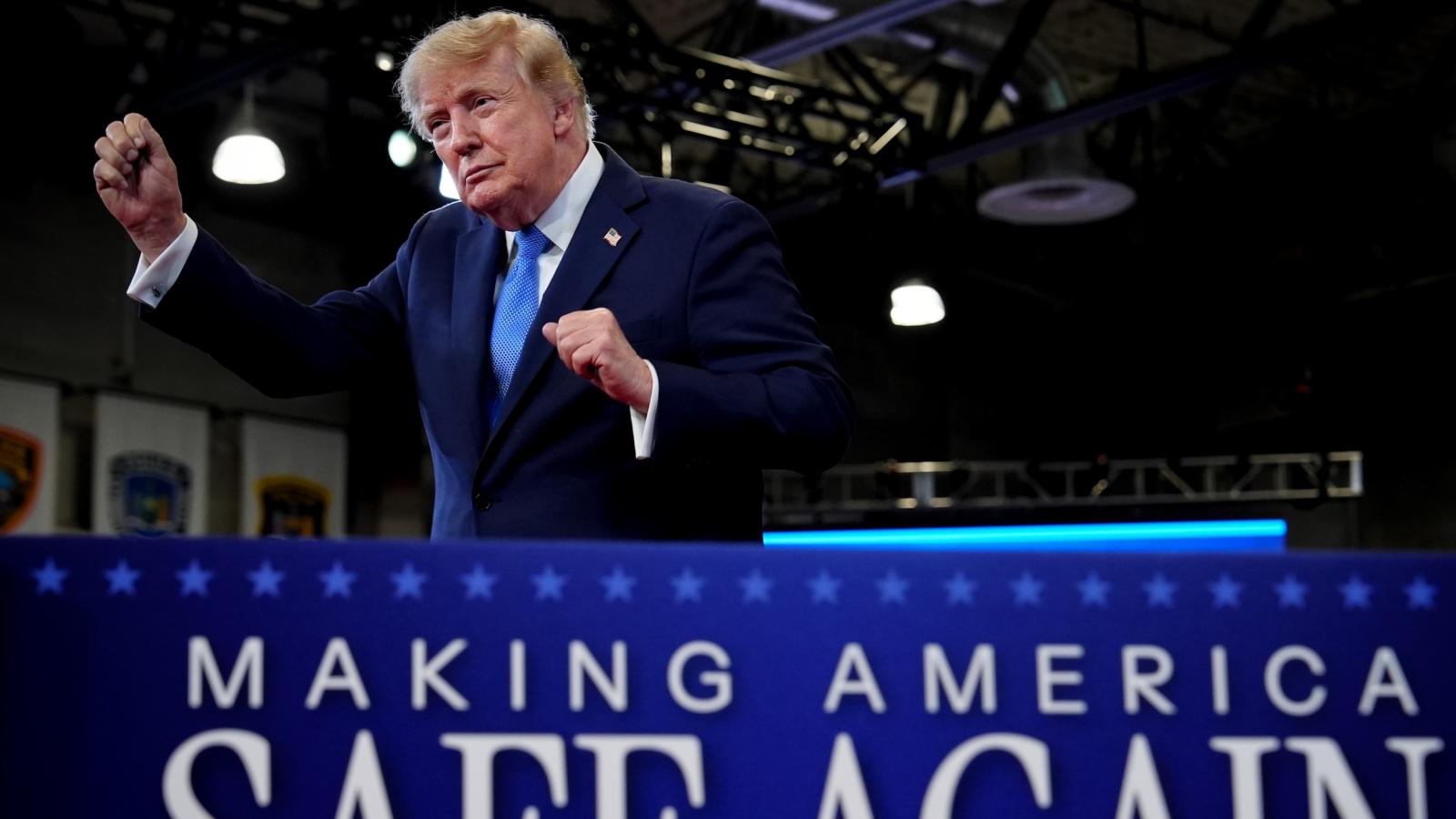
Facing international oil price volatility and domestic inflation, President Trump, speaking at a rally in Garden City, New York, on the 14th, publicly urged voters to accept high fuel prices—clearly abandoning any strategy to resolve the conflict and lower prices. Trump claimed that paying "a tiny little bit more for your gasoline" is a necessary cost to prevent Iran, an "extremely evil country," from acquiring nuclear weapons.
Trump even declared in his speech: "After we completely defeat Iran… very soon, I will announce that the Strait of Hormuz will become a territory of the United States." He emphasized to supporters: "We are making a huge contribution to the world, not just to ourselves… We are doing an excellent job."
US Gas Prices Surge 29% Year-on-Year
While Trump urges supporters to "just swallow it," high oil prices are already impacting the US economy and upcoming elections. The American Automobile Association (AAA) reported that the national average retail price for regular unleaded gasoline reached $4.08 per gallon on the 14th, a 29% surge from the previous year. One of Trump’s original campaign promises was to lower energy costs, and Democrats are preparing to attack this inflationary effect in the November midterm elections. On the 14th, international crude futures rose by $1 per barrel, with London Brent crude gaining 6.0% weekly and West Texas Intermediate (WTI) up 5.4%.
Despite projecting strength externally, Iran’s domestic economy is also under severe strain. President Masoud Pezeshkian acknowledged in a state television address that US blockades on Iranian ports and sanctions on oil exports have directly triggered severe domestic inflation. US Treasury Secretary Scott Bessent, in an interview with Newsmax, announced that Washington will formally unveil a new round of economic sanctions against Iran next week.
Meanwhile, the war’s spillover effects continue to expand. The UAE’s state-run WAM news agency reported that Iran attacked a third tanker operated by Abu Dhabi National Oil Company (ADNOC) on the 14th, following attacks on two vessels the night before. The UK Maritime Trade Organisation (UKMTO) also reported on the same day that a bulk carrier was struck by an unknown object in the strait. In the Red Sea, Yemen’s internationally recognized government stated that Iran-backed Houthi forces launched six ballistic missiles at the port of Mocha on the 14th, killing four civilians.
Bloomberg: US and Iran Trapped in the 'Short-War Fallacy' of 50-Year Rivalry
Regarding the full-scale US-Iran deadlock, Becca Wasser and Dina Esfandiary of Bloomberg Economics published a deep analysis, arguing that the nearly half-century-long hostility has locked both nations into a no-win war of attrition, warning that "history tells us such wars rarely end well."
In their article on the 14th, they recalled that last June, the US military conducted its first direct airstrike on Iran during "Operation Midnight Hammer," dropping 420,000 pounds of explosives on uranium enrichment facilities within 37 hours—prompting Trump to declare Iran’s nuclear capabilities "completely destroyed." Yet just eight months later, on February 28, the US and Israel launched "Operation Epic Fury," and the conflict has raged for nearly half a year with no sign of ending.
Wasser and Esfandiary argue that despite Trump’s frequent criticism of past US military interventions in the Middle East, he has once again fallen into the "short-war fallacy." He initially expected that overwhelming military-technological superiority would force Tehran—already under internal unrest and protest—into submission within 4 to 6 weeks. However, tactical bombing success has failed to translate into strategic victory.
Ceasefire Agreements Are Just 'Reload' Breathing Space
The article further notes that before the 1979 Iranian Islamic Revolution, Pahlavi-era Tehran, alongside Saudi Arabia, served as one of the two pillars of US regional security during the Cold War. But the post-revolution hostage crisis completely turned US-Iran relations adversarial. Iran learned from the eight-year Iran-Iraq War of the 1980s, developing a highly sophisticated "asymmetric deterrence strategy," adept at using low-cost unconventional means to inflict heavy costs on adversaries.
In response to US-Israeli coalition strikes on military facilities, energy infrastructure, and even high-ranking military and political leaders including the Supreme Leader, Tehran has maintained its regime through long-term preparation, launching precise retaliatory actions: using large numbers of cheap drones and ballistic missiles to attack US military bases in neighboring Middle Eastern countries and Persian Gulf infrastructure, continuously draining the extremely expensive and inventory-limited air defense systems and long-range missiles of US forces and allies. At the same time, Iran has for the first time fully blockaded the Strait of Hormuz, using the high cost imposed on the global economy as leverage to drag the conflict into a prolonged stalemate.
The article emphasizes that the current situation has become an intractable deadlock: the US military can precisely destroy launchers and command centers but cannot force Iran into humiliating agreements through airstrikes. Conversely, while Iran can drive up global energy costs, it lacks the conventional military strength to defeat the US. As Yemen’s Houthi forces threaten Red Sea shipping, Iraqi militias attack the Persian Gulf, and US forces intercept Iranian oil tankers under sanctions as far as the Indian Ocean, the conflict continues to spread.
The two scholars warn that with no resolution in sight, freedom of navigation has become a thing of the past, and "repeated conflict, elusive peace" has become the Middle East’s new normal. Even if Washington and Tehran temporarily agree to a ceasefire in the future due to excessive resource depletion, it will only be seen as a breathing space to regroup forces—not true peace. Unless both sides recognize that military means alone cannot break the cycle of hatred and must resolve fundamental political differences since 1979 through diplomatic concessions, this prolonged war of attrition will continue to consume global economic stability and regional security.
FACT BOX
- Source: PR Times
- Category: News
- Organizations: Kpler / AAA / ADNOC