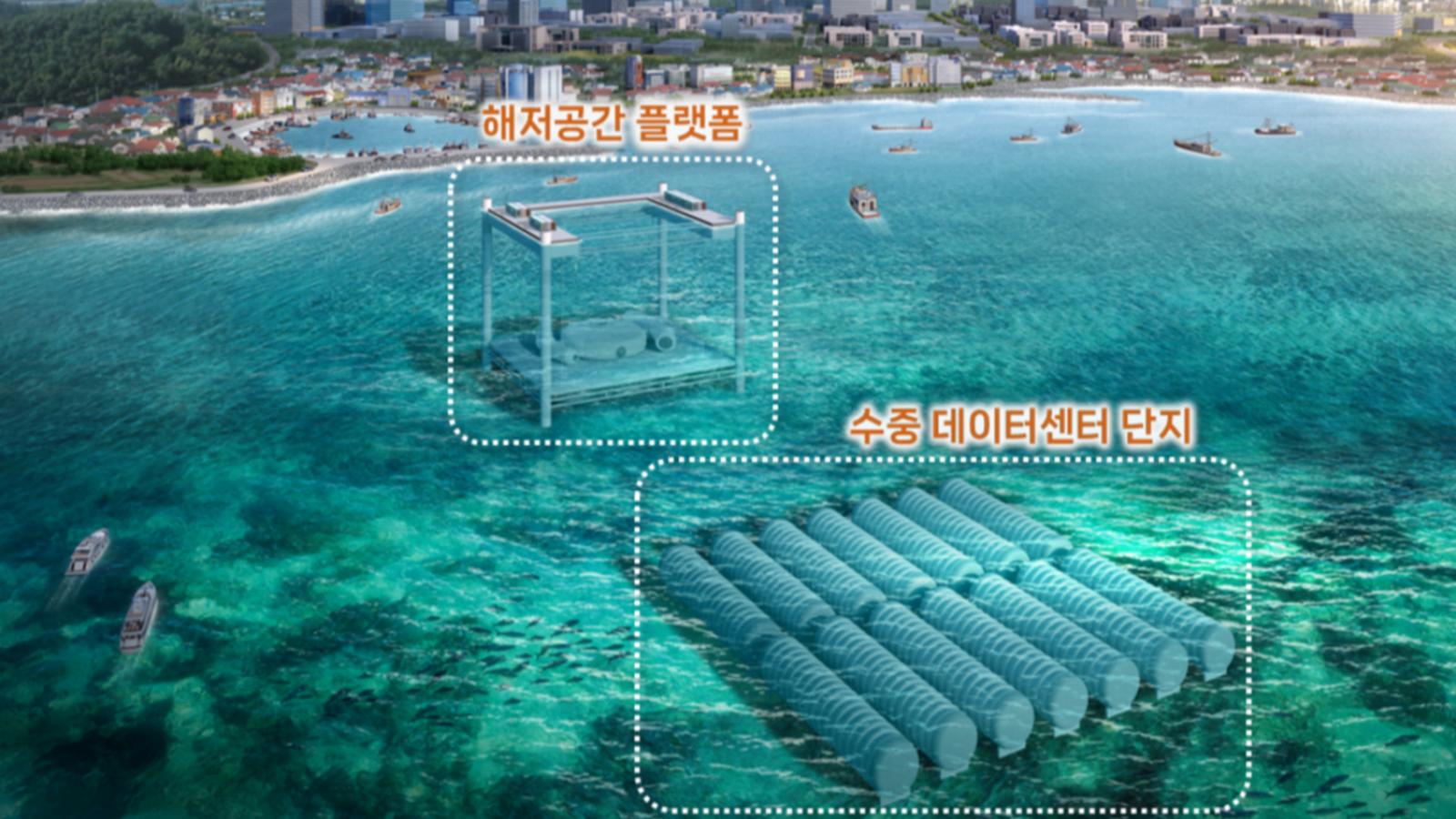
Confronted with the dual challenges of limited land area and rapidly increasing artificial intelligence (AI) computing demands, while companies like NVIDIA, SpaceX, and Google plan to build space-based data centers, South Korea is shifting its focus to the ocean—preparing to construct large underwater data centers on the seabed to overcome land-based constraints in space and cooling, according to Nikkei Asia. Nikkei Asia reported on the 16th that South Korea’s Ministry of Oceans and Fisheries finalized its decision in April this year to select Ulsan, a southeastern port city renowned for its heavy industry, as a demonstration site. The project will leverage Ulsan’s stable seabed geology, suitable water temperatures, and abundant seawater resources to cool servers and validate performance. If the pilot project succeeds, it could expand into a massive underwater AI infrastructure park in the future. The underwater facility will house servers and related equipment in large, container-like modules, which will be submerged to the seabed 20 meters below sea level. Thanks to modular design, these containers can be stacked like building blocks, with the capacity to accommodate up to 100,000 servers. Land-based data centers require not only large plots of land for server rooms but also massive power generation, transmission, and cooling systems. South Korea, with only a quarter of Japan’s land area and mountainous terrain, faces growing shortages of available construction land and skyrocketing construction costs. These pressures have driven developers to explore seabed space despite the challenges of deep-sea engineering. In particular, generative AI often requires hundreds or even thousands of GPUs during training and inference, generating immense heat. Underwater data centers can directly channel natural seawater for cooling, drastically reducing cooling costs, with power consumption projected to drop by 30–40%. However, operating AI servers beneath the sea poses significant engineering challenges. The submerged container modules must withstand water pressure equivalent to three times standard atmospheric pressure and prevent corrosion from seawater salinity and internal condensation. South Korea’s research team aims to combine pressure- and corrosion-resistant materials with temperature control technology to ensure underwater electronic equipment remains stable for at least five to seven years. The project is led by the Korea Institute of Ocean Science and Technology (KIOST), under South Korea’s Ministry of Oceans and Fisheries, with a total budget estimated at 511 billion Korean won (approximately NT$11.6 billion). Test operations are expected to begin as early as this year, with commercial-scale complex construction scheduled to start in 2031. To improve the efficiency of seabed infrastructure construction, the South Korean government launched a technical partnership in January with SK Telecom, the country’s telecom giant, leveraging its expertise in data center operations. Lotte E&C and POSCO have also joined the consortium, jointly developing specialized robots for underwater remote monitoring. Additionally, South Korea is simultaneously advancing 'floating data center' technology: HD Korea Shipbuilding & Ocean Engineering, the country’s leading shipbuilder, formed an alliance with France’s Schneider Electric in July to co-develop offshore power infrastructure and floating structure technologies. Samsung Heavy Industries’ floating data center design has already received 'Approval in Principle' (AiP) from maritime authorities in the U.S. and U.K., and is now advancing commercialization in partnership with a Greek shipowner. Nikkei Asia notes that the South Korean government has declared its ambition to become one of the 'top three AI powers in the world,' with policies focused on advanced semiconductor mass production and AI infrastructure. Although building large data centers is seen as key to achieving this goal, geographical land constraints have led South Korea to extend its frontier into the ocean. However, the concept of 'underwater data centers' is not unique to Korea. Microsoft published results from its underwater data center proof-of-concept test several years ago; China’s first commercial underwater data center officially launched in Lingshui County, Hainan Province, in 2022, and Shanghai Lingang’s second-generation facility began operations in May this year.
FACT BOX
- Source: PR Times
- Category: News
- Organizations: SpaceX / Google