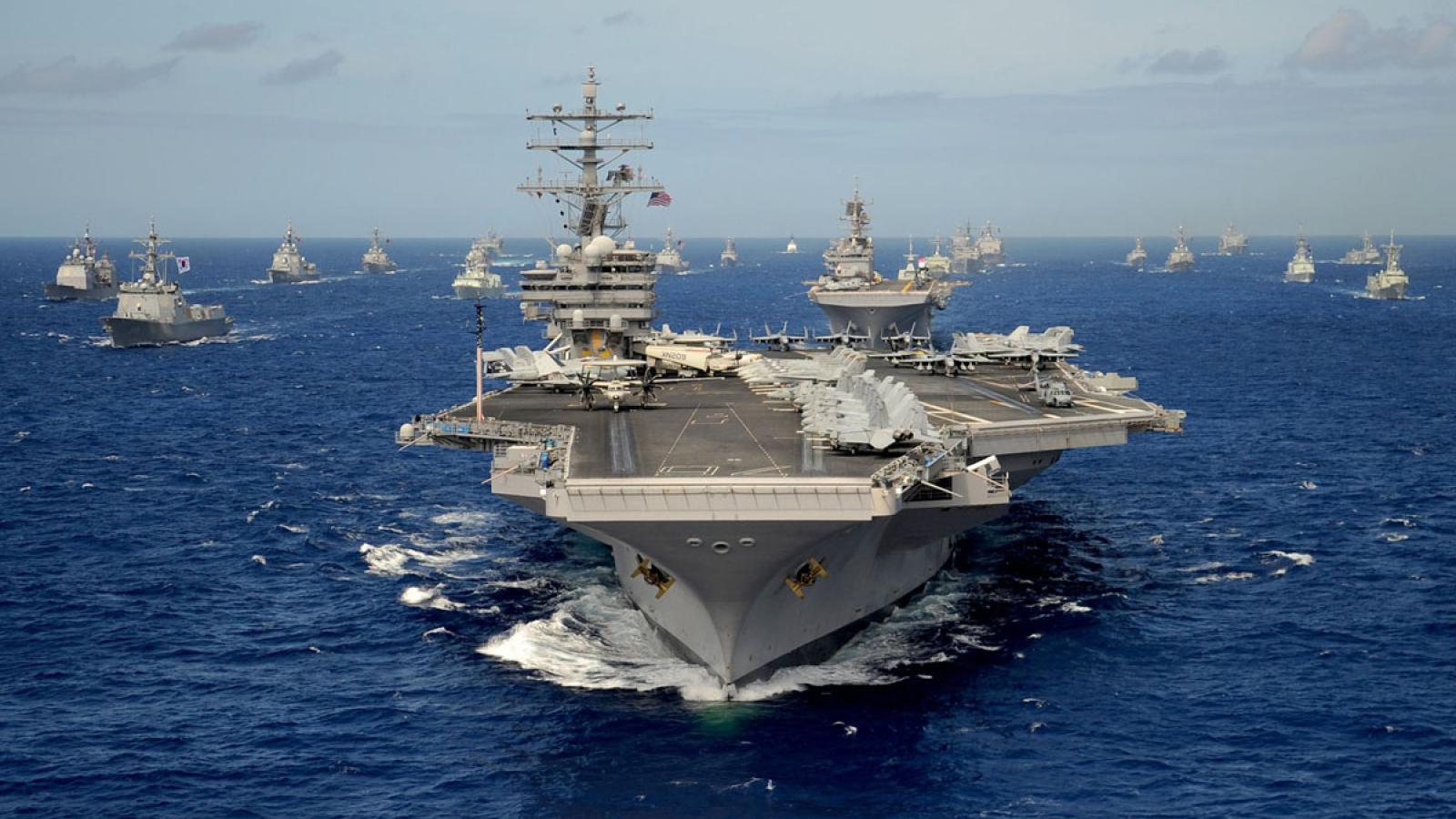
Although drones have shined on battlefields in Ukraine and the Middle East, aircraft carriers remain the United States government's preferred method of power projection. The law even mandates in Title 10, Section 8062 of the U.S. Code that the Navy must maintain no fewer than 11 aircraft carriers. Whenever the U.S. military deploys two or even three carriers to a region, it signals Washington is turning up the pressure on adversaries. On February 28 this year, President Trump launched the 'Operation Epic Wrath' against Iran, temporarily deploying three carrier strike groups—Ford, Lincoln, and Bush—to the Middle East, demonstrating America's determination to prevail. However, while Iran continues to resist and the Strait of Hormuz, a critical global energy artery, remains blocked, it is the U.S. carrier strike groups that are faltering first. After the Ford, the Lincoln is now preparing to withdraw from the front line. America's global power projection faces a harsh challenge between geopolitical ambition and logistical maintenance limits. The Ford, the U.S. Navy's newest aircraft carrier, has already set a record with 326 consecutive days of deployment and returned to its home port in Norfolk in May for rest. The Lincoln, having deployed continuously for over eight months, has long suffered from supply shortages. Its seawater desalination system, hot water supply, and vacuum sewage toilets have repeatedly malfunctioned, with reports even emerging of multiple sailors attempting suicide by jumping overboard. Despite Pentagon denials, the Navy was forced to urgently dispatch the Washington, stationed in Yokosuka, to replace the Lincoln. Why has the Lincoln deteriorated to this state? A deep investigation by The New York Times revealed that early in the U.S.-Iran conflict, Iran attacked the U.S. military's logistics hub and supply distribution base in Bahrain. The Pentagon was forced to extend its supply lines by 2,000 miles to Diego Garcia in the Indian Ocean, causing cascading breakdowns and delays in fresh food, soap, and toothpaste supplies for the Lincoln. Even more severe are the humanitarian and public health crises aboard the Lincoln. Military media Navy Times and Stars and Stripes, which manages half the Pentagon's budget, reported that the Lincoln's seawater desalination and vacuum sewage toilets frequently fail. Sailors are forced to rotate in cramped cabins with mold growth, unable to take hot showers for months, and must cross half the carrier to queue for backup toilets. Under prolonged high-pressure isolation from land, several psychological crisis incidents involving sailors attempting suicide by jumping overboard have been reported. Families of the crew later held a heated protest at the San Diego base, confronting military leadership. Although Defense Secretary Pete Hegseth strongly denied the allegations as exaggerated, the Navy urgently dispatched numerous psychologists and social workers to board the ship. The Washington, previously stationed in the Western Pacific, was immediately sent to the Middle East, underscoring the crisis's severity. Where are the other aircraft carriers? As Trump seeks a permanent solution to the Iran issue, the overworked Ford and Lincoln are clearly at the end of their endurance, forced to withdraw one after another. This raises public skepticism: U.S. law mandates the Navy maintain 11 aircraft carriers, yet when Lincoln's crew face mental and physical collapse and the ship's systems near failure, why couldn't the U.S. Navy, the world's maritime superpower, deploy a single carrier to relieve them before the scandal broke? The simplest answer is that these 11 nuclear-powered supercarriers, once feared globally, have already fallen into severe structural decline due to insufficient shipbuilding capacity and overextended geopolitical ambitions. They are now merely 'paper figures' for strategic deterrence. Examining the actual status of the other ten active carriers reveals the truth of stretched deployment: Retirement and Major Overhaul: Nimitz and Truman The oldest Nimitz-class carrier, USS Nimitz (CVN-68), has reached its 50-year design lifespan. After completing its final cruise to Jamaica in May, it has officially entered decommissioning and reactor dismantling, unable to deploy again. It remains on the books only because the second Ford-class carrier, USS Kennedy (CVN-79), is not yet commissioned, preserving the legal requirement of 11 carriers. USS Harry S. Truman (CVN-75), also 25 years in service, is queued for a multi-year 'Refueling and Complex Overhaul' (RCOH), currently lacking远洋 combat readiness. Trapped in Shipyards and Undergoing Maintenance: Stennis and Ford USS John C. Stennis (CVN-74) has been stuck at Newport News Shipbuilding since entering for overhaul in 2021. Due to a shortage of skilled workers and unexpected structural damage found in its steam turbines, maintenance has been repeatedly delayed, with costs exceeding $500 million. The lead Ford-class carrier, USS Gerald R. Ford (CVN-78), after 326 days of deployment, suffered severe wear and immediately entered Norfolk Naval Shipyard (NNSY) for 'Planned Incremental Availability' (PIA), making it unavailable for short-term deployment. Preparing to Return to Frontline: Eisenhower and Carl Vinson USS Dwight D. Eisenhower (CVN-69) previously deployed in the Red Sea and Gulf of Aden, leading 'Operation Prosperity Guardian,' continuously defending against and striking anti-ship missiles and drones launched by Yemen's Houthi rebels. After 15 months of maintenance, upgrades, and system checks in Norfolk, it is now conducting carrier-based aircraft landing certifications and integrated drills in the Atlantic. USS Carl Vinson (CVN-70), after cross-regional deployments in Indo-Pacific and the Middle East, recently completed scheduled major maintenance and is now in the sustainment and integrated phase. Deterring Indo-Pacific Theater: Roosevelt and Reagan USS Theodore Roosevelt (CVN-71), flagship of RIMPAC, bears frontline deterrence missions in the Taiwan Strait and South China Sea, but has returned to its home port in San Diego, moored at Naval Air Station North Island for short-term rest. USS Ronald Reagan (CVN-76), after years of forward deployment in Japan, entered dry dock in March last year for a 17-month comprehensive overhaul and is now in the final delivery phase, serving as a reserve force in the Indo-Pacific theater. Frontline Strategic Lock: Bush and Washington USS George H.W. Bush (CVN-77), though combat-ready, currently forms a 'dual-carrier strike group' with Lincoln to suppress the Middle East situation. Replacing Bush would immediately halve Middle East combat power. The only hope to replace Lincoln, USS George Washington (CVN-73), has received orders to redeploy to the Middle East, but the transoceanic voyage takes time. During this rotation gap, the Pentagon can only forcibly extend Lincoln's deployment. Carrier Deployment System Failure The Ford and Lincoln's consecutive over-deployments signal the complete failure of the Navy's force allocation mechanism—the Optimized Fleet Response Plan (OFRP). OFRP was designed as a 36-month cycle divided into four phases: shipyard maintenance, basic training, a planned seven-month overseas deployment, and a 14-month 'Sustainment/Surge Phase' ready to deploy within 30 days. However, Bryan Clark, senior researcher at the Center for Strategic and Budgetary Assessments (CSBA), analyzed for Defense News that OFRP is based on overly ideal assumptions of 'sufficient budget' and 'perfect equipment.' Admiral Daryl Caudle, Commander of the Atlantic Fleet, bluntly stated that OFRP assumes carriers and their Aegis escorts can enter and exit shipyards simultaneously. But due to imbalanced shipyard capacity, it often becomes 'ships waiting for shipyards, shipyards waiting for ships,' disrupting the entire fleet's training rhythm. Additionally, the Washington-based think tank The Heritage Foundation, in its report 'An Assessment of US Military Power,' pointed out that to support deployed fleets, the Navy often dismantles spare parts and ammunition from docked reserve ships, meaning the so-called '14-month ready-to-fight' reserve carriers lack full combat capability. Once a reserve ship suffers sudden power or propulsion failure, the entire
FACT BOX
- Source: PR Times
- Category: News