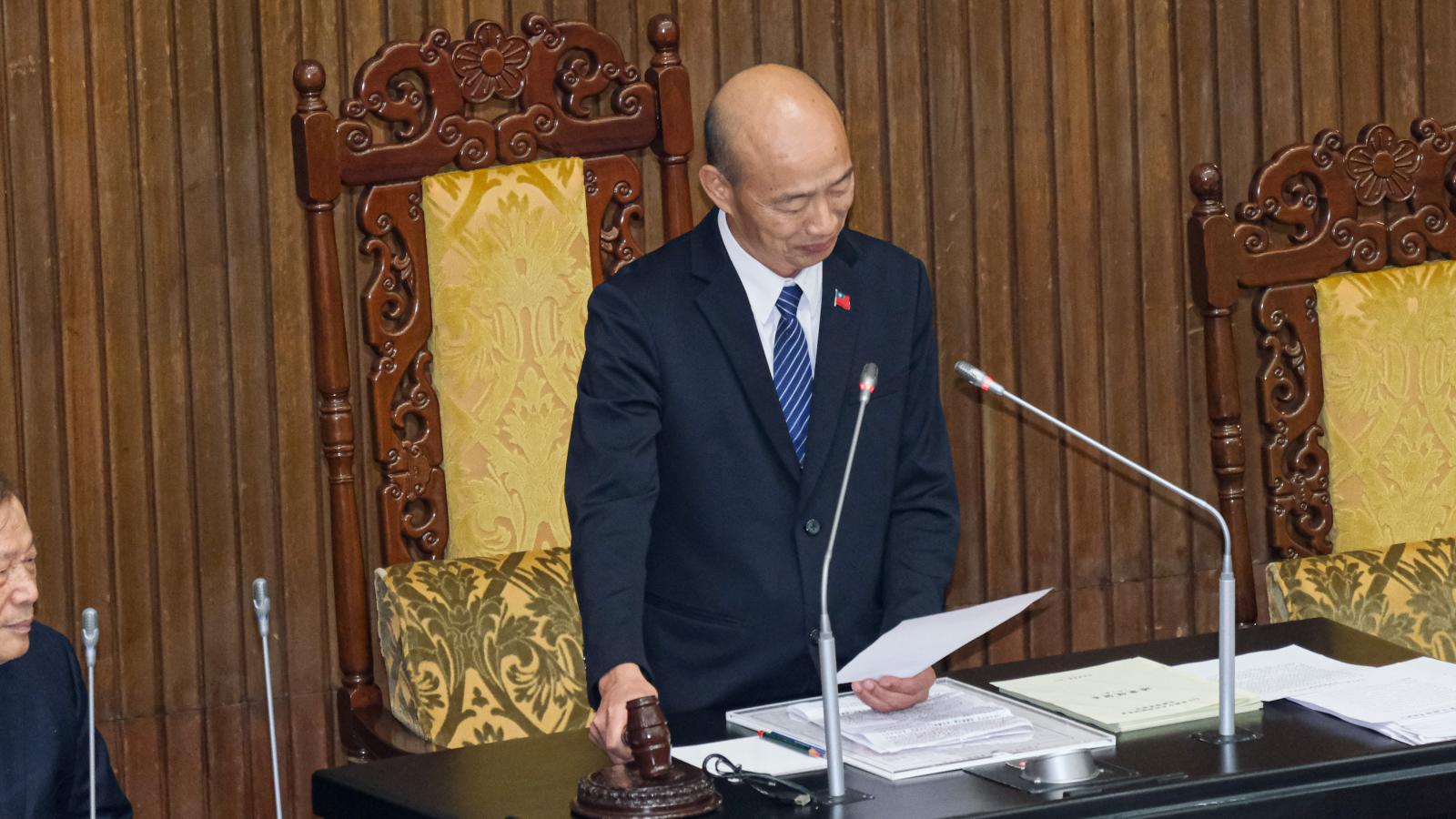
The long-delayed central government budget for fiscal year 115 was finally passed in the Legislative Yuan on the 14th. Originally listing expenditures of over 3.0349 trillion NT dollars, it was reduced by 48 billion NT dollars, lowering the across-the-board cut rate from the initially discussed 2% to 1.689%. Nonetheless, total expenditures remain near 2.9869 trillion NT dollars. The Executive Yuan immediately issued a statement condemning what it called "seven irrational resolutions," criticizing certain budget cuts and freezes as unreasonable. Legislative Yuan Speaker Han Kuo-yu, after gaveling the session closed, publicly urged Executive Yuan Premier Cho Jung-tai not to withhold countersignature or refuse implementation, and called on both ruling and opposition parties to compromise.
However, the year-long debate over the 3-trillion-NT-dollar government agency budget may have only begun to touch on the real issues the public should be asking: Does the central government’s annual control of public resources really stop at these 3 trillion NT dollars?
By examining the three budget ledgers compiled by the Directorate-General of Budget, Accounting and Statistics (DGBAS) under the Executive Yuan for fiscal year 115, the full picture becomes clear.
First, the central government’s consolidated agency budget, with initial revenues of approximately 2.8622 trillion NT dollars and expenditures of 3.0349 trillion NT dollars.
Second, the operating portion of the central government’s affiliated unit budgets—state-owned enterprises (SOEs)—with total revenues of about 3.5023 trillion NT dollars and total expenditures of about 3.2973 trillion NT dollars.
Third, the non-operating special funds, with total business revenues and fund sources of approximately 3.8235 trillion NT dollars, and total business expenditures and fund uses of about 3.7791 trillion NT dollars.
Just looking at expenditures and fund uses, the latter two ledgers combined exceed 7 trillion NT dollars—more than double the government agency budget. Combined across all three ledgers, the total exceeds the 10-trillion-NT-dollar threshold.
Moreover, the scale will expand further in fiscal year 116. Based on current drafting data, the central government’s consolidated agency budget for fiscal year 116 is projected to have revenues of about 380 billion NT dollars and expenditures exceeding 3.6 trillion NT dollars, setting a new record. The full revenue and expenditure figures for SOEs and non-operating funds in fiscal year 116 will be announced after the Executive Yuan formally approves the overall budget and affiliated unit budgets, but they are expected to exceed 7 trillion NT dollars.
Legislators should be reminded: these figures and the following concerns are not media leaks or partisan attacks, but come from the Legislative Yuan’s own professional staff agency—the Budget Center—which annually issues comprehensive evaluation reports on the central government’s overall budget and provides extensive assessment data on SOEs and non-operating funds, precisely to assist legislators in their review.
The Budget Center exists to help legislators navigate thousands of pages of budget documents and complex government accounting data, checking whether revenues are reliable, expenditures are justified, funds are overestimated, major projects are delayed, SOEs are efficiently managed, and how previous year budgets were executed. These reports are, in essence, the nation’s “fiscal health check.”
Since the state uses taxpayer money to fund the Budget Center and professionals have already identified these issues for the legislature, legislators have no excuse not to read them—and the public must also monitor and scrutinize the budget formulation and review process.
Yet, the long-standing flaws in Taiwan’s budget compilation and review process, while perhaps not fully known to the public, are well understood by legislators across party lines.
Ko Chien-ming, former DPP caucus convener in the Legislative Yuan, openly admitted during a budget party negotiation on September 28, 2020, that the previous year’s nearly 2-trillion-NT-dollar public budget, after full committee review, resulted in cuts of “less than 3 billion NT dollars.” In the end, cuts were made proportionally: “It’s always been this way,” he said, even bluntly stating, “The 1.7%, 1.8%, or 2% figures are just shouted out.”
Regarding numerous budget freeze proposals, he frankly admitted that hundreds of cases involved freezing 10%, with funds released after a report was submitted: “To be honest, this is a longstanding practice in the Legislative Yuan.”
This statement from six years ago remains strikingly relevant today.
This year’s budget of over 3 trillion NT dollars for government agencies, after prolonged political confrontation, party negotiations, and voting battles, ended with an across-the-board cut of 1.689%—48 billion NT dollars. Was this the result of a thorough, item-by-item evaluation of policy necessity and cost-effectiveness, or merely another round of political bargaining—“shouting out 1.7%, 1.8%, or 2%”?
National budgets are not like haggling at a market.
When the Legislative Yuan deletes a budget item, it must explain why it is unnecessary. When freezing a budget, it must specify what improvements the executive branch must make. When the Executive Yuan proposes a budget, it must explain to the public the policy purpose, legal basis, cost-benefit analysis, and previous year’s performance. This is what budget review should be.
Therefore, the Executive Yuan has no right to simply blame the Legislative Yuan.
The Budget Center’s comprehensive evaluation report on the 115th fiscal year central government budget has already revealed many issues worthy of detailed scrutiny. For example, the execution rates of fixed-asset construction, improvement, and expansion plans for certain non-operating special funds are low, with some funds failing to reach 80% for multiple consecutive years, and some previous-year budgets remaining unspent. When plans are repeatedly delayed and budgets go unexecuted, yet new budgets are proposed year after year, the public has every right to ask: Is this due to inadequate execution capacity in the Executive Yuan, or are budgets simply overestimated and arbitrarily compiled?
The very existence of some non-operating funds should also be questioned. Some have long controlled vast resources without fully achieving their intended purposes. Once established, a fund develops its own organization, operations, and funding sources, compiling budgets annually. Over time, they may evolve into a “second fiscal system,” operating outside the same level of scrutiny as regular government budgets.
For example, the Employment Stability Fund has been cited by audit agencies for multiple deficiencies. The National Development Fund, tasked with massive industrial investments and policy missions, has also shown serious shortcomings in investment execution and corporate governance of its portfolio companies, and thus should face strict legislative scrutiny and oversight.
State-owned enterprises are even more problematic. Taipower is projected to accumulate losses of over 453.9 billion NT dollars by the end of fiscal year 115. CPC Corporation faces not only massive operating deficits but also issues related to natural gas safety reserves, storage tank capacity, and LNG terminal construction progress—all directly tied to national energy security. These SOEs control hundreds of billions, even trillions, of NT dollars in operations, investments, and procurement. Ultimately, their performance is borne by the public. How can the legislature focus only on a few million NT dollars in special allowances or publicity fees for government agencies, while ignoring SOEs’ arbitrary budgeting, reckless spending, and misuse—resulting in losses of thousands of billions—yet still paying year-end bonuses far exceeding those in the private sector?
Therefore, I urge the following:
Legislators must read, and the public must examine, the Budget Center’s comprehensive evaluation report on the 115th fiscal year central government budget and its assessment materials on affiliated unit budgets.
Legislators read it to fulfill their constitutional responsibility under Article 63 to deliberate budgets; the public reads it to exercise their fundamental democratic right as taxpayers to know and supervise. When the public understands which budgets remain unexecuted for years, which funds underperform, and which SOEs suffer long-term losses, budget review will no longer devolve into the Executive Yuan’s arbitrary compilation and political theatrics among party caucuses.
We must also re-understand the budgetary power granted under Article 63 of the Constitution. It is not merely legislators’ “power to cut money,” but the people’s power, exercised through the legislature, to control government finances. Without the consent of the people’s representative body, the government cannot arbitrarily obtain or dispose of public resources. The legislature, entrusted by the people, must rigorously examine what the government spends money on, how it performs, and why it needs more funds next year.
Therefore, the Executive Yuan must not compile budgets arbitrarily, and the Legislative Yuan must not review them carelessly.
Especially since the central government’s finances can no longer be fully understood through just one “central government budget book.” Complex relationships—such as investments, subsidies, transfers, and policy burdens—exist among the three ledgers: government agencies, SOEs, and non-operating funds. If we only argue over the 3-trillion-NT-dollar government agency budget while allowing the other 7 trillion in affiliated unit budgets to remain outside the spotlight of democratic oversight, the public sees only a fragment of central government finances, not the full picture.
The three ledgers for fiscal year 115 already total over 10 trillion NT dollars; for fiscal year 116, government agency expenditures alone will exceed 3.6 trillion NT dollars. Once the official figures for SOEs and non-operating funds are released, all three ledgers should be summed up to inform the public exactly how much public resources the central government controls and spends annually.
The prolonged delay of the 115th fiscal year budget should serve as a lesson for both ruling and opposition parties: budget review cannot continue to be finalized through last-minute party negotiations, across-the-board cuts, and bundled votes.
The central government’s overall budget for fiscal year 116 will be submitted to the Legislative Yuan on August 20. The Executive Yuan should fully disclose the policy linkages, major expenditures, entrusted projects, subsidies, investments, and performance records across all three ledgers. The Legislative Yuan should hold public debates on major budget items, allowing legislators from all parties to openly explain their support or opposition, rather than deciding behind closed doors whether to cut by 1.7%, 1.8%, or 2%.
The people pay taxes to fund the government, but that does not mean they lose the right to question how the money is used. The funds controlled by SOEs and government funds are not the executive branch’s private money.
If the 3-trillion-NT-dollar government agency budget is already in such disarray, with another 7 trillion in affiliated unit budgets behind it—and with fiscal year 116’s budget scale set to reach a new high—I urge: the people’s 10 trillion NT dollars in hard-earned tax money must no longer be arbitrarily compiled and reviewed.
Therefore, all three ledgers—central government agencies, SOEs, and non-operating funds—must be fully disclosed. The Executive Yuan must explain each item, the Legislative Yuan must review each item, major budget items must be publicly debated, and ultimately, a full account must be given to the people. This is the budgetary democracy demanded by Article 63 of the Constitution.
*The author is a retired professor from the Department of Law at Tunghai University.
FACT BOX
- Source: PR Times
- Category: News