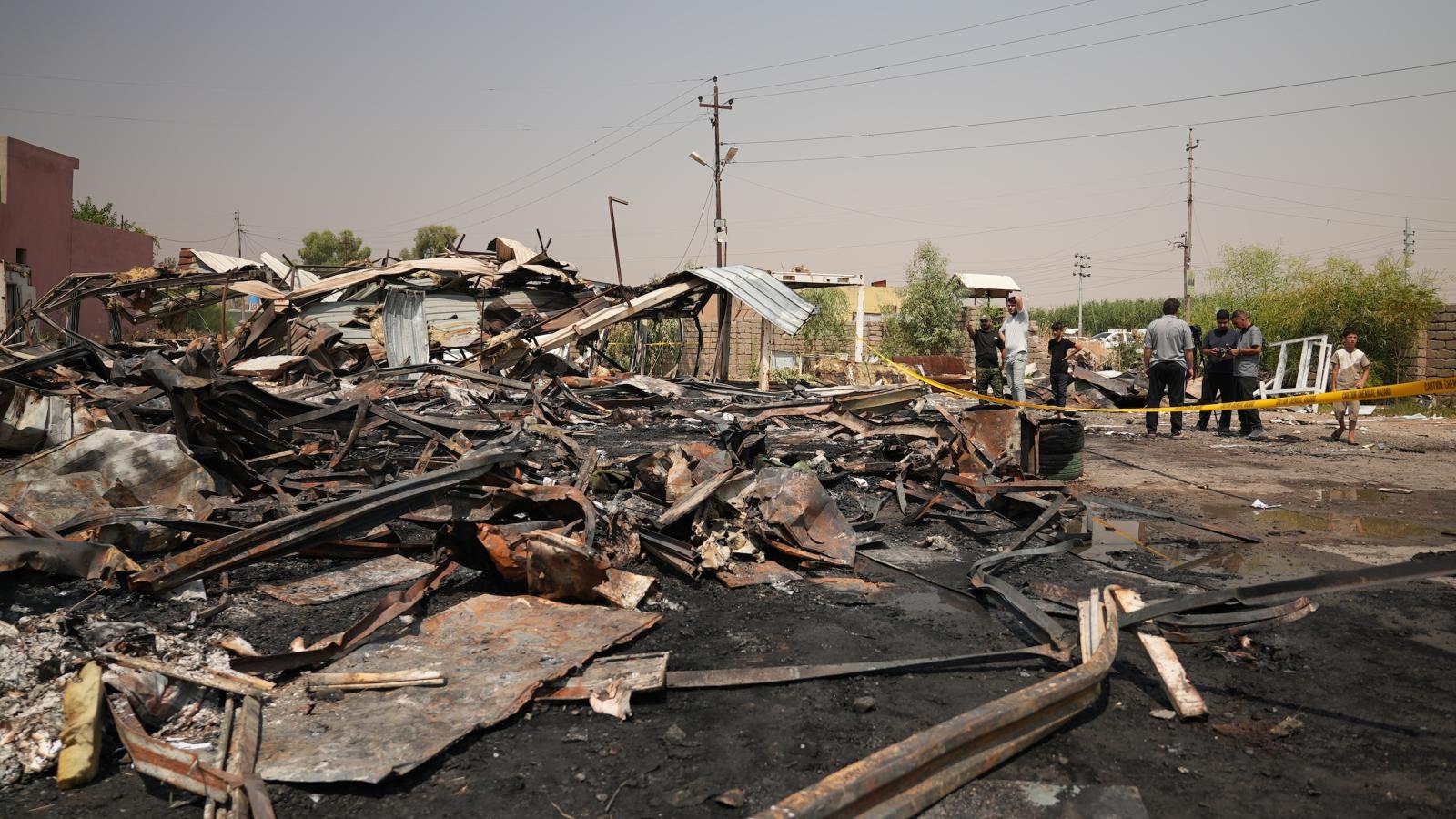
I will never forget it. On February 28, 2026, around noon local time in Abu Dhabi, three massive explosions suddenly rang out, shaking buildings and rattling windows.
In the weeks prior, the United States had been negotiating with Iran while simultaneously amassing troops around its borders. Journalists work around the clock, every day of the week. That day was a Saturday. In the morning, I was sipping coffee, researching and writing, planning to take my child to the beach in Abu Dhabi after recording the news. For this outing, I had even bought a blue plastic toy truck filled with a small shovel, sieve, and crab molds, intending to surprise my child at the seaside.
After having a child, weekends became an unshakable 'family day.' For many parents, this was a weekly routine, interrupted only by bad weather or illness.
But no one expected that what would disrupt 'family day' was—war.
Shortly after 10 a.m., just as I finished writing and was about to record for Dongfang News, the flagship program of Dongfang TV, a news alert flashed on my phone: Israel had launched airstrikes on Iran, and the U.S. had joined the conflict under 'Operation Epic Fury.'
The draft I had written on U.S.-Iran negotiations was instantly scrapped, and my work shifted to real-time coverage. The beach trip was naturally canceled. I kept monitoring the latest developments. About an hour after the war began, I suddenly heard three loud explosions, and my apartment building shook at the same time.
I’ve reported on many wars and seen countless related images. I immediately recognized those three sounds as missile explosions.
I thought: Could Iran have launched missiles?
This wasn’t baseless speculation. The previous year, mid-2025, I had reported from the United Arab Emirates (UAE) on the first 'Twelve-Day War' launched by the U.S. and Israel against Iran.
Near the end of that war, Iran fired over a dozen missiles at a U.S. military base in Qatar, retaliating for American strikes on its nuclear facilities.
I lived on a high floor in Abu Dhabi, with a vast undeveloped sandy area beside my building, followed by a lagoon-like shallow sea, and beyond that, desert. The view was expansive.
I noticed thick black smoke rising from the desert to the southeast. Then, I received an alert: The U.S. Embassy in the UAE urged citizens to seek immediate shelter. I quickly checked the map and confirmed the smoke was coming from the location of the U.S. military base in the UAE.
My worst fear came true: Iran had attacked the UAE.
At that moment, my wife and child were outside. My child was playing with his favorite white kick scooter. The sudden three explosions were deafening, unprecedented in intensity, and my wife momentarily thought a building had collapsed.
There were many construction sites near our home. The UAE’s real estate market was booming, with property prices rising up to 30% annually. Sometimes, even before pre-sales began, prime units in new developments sold out within 24 hours. Abu Dhabi was thriving, with construction everywhere.
The attack came completely out of the blue. The media hadn’t reported anything yet, but I was certain it was a missile strike, so I immediately called my wife, telling her to rush home with our child. On the phone, I shouted: 'The war has reached the UAE!'
I didn’t know if indoors was safer, but no matter what happened, at least we’d be together. And as a husband and father, I could do something for my family.
Why was this attack so unexpected?
Because before the U.S.-Israel-Iran war, it was unimaginable. The UAE and Iran had long maintained extremely close economic and trade ties. Before the war, the UAE was Iran’s third-largest export destination and its largest source of imports. Iran, under U.S. sanctions and restricted in international finance, had complex financial ties with the UAE. Iran’s survival depended heavily on the UAE.
By attacking the UAE, Iran was essentially smashing its own wallet, severely damaging both its financial and trade systems, pushing its already dire economy closer to collapse.
Some might argue: Iran attacked U.S. military bases, not the UAE itself. But subsequent events proved that Iran targeted far more than just U.S. bases—it attacked infrastructure like airports, factories, industrial zones, and even sent drones directly into residential homes. Everything became a target. Iran didn’t just cut off its economic lifeline; it also destroyed its diplomatic pathways.
And it wasn’t just the UAE. Iran launched attacks on every Gulf Arab state, including Oman, which had mediated U.S.-Iran talks, and Qatar, which had long maintained close ties with Iran.
Returning to the UAE: According to official data released afterward, during the 40-day U.S.-Israel-Iran war, the UAE endured over 2,800 missile and drone attacks. This number exceeded the total attacks on all other Gulf Arab states combined—and was more than double the attacks on Israel.
What does over 2,800 missiles and drones mean?
Even at maximum capacity, U.S. defense giant Lockheed Martin can produce only about 600 Patriot missiles per year. Most are reserved for the U.S. and Israel, with the rest for export. Each Patriot missile costs about $4 million—roughly NT$130 million. In just 40 days, the UAE consumed its long-accumulated, costly air defense inventory.
This forward-looking preparation, planning decades ahead, is characteristic of desert nations like the UAE. For millennia before oil was discovered, Bedouins in the desert could lose livestock and tents to a single storm. With extreme heat and scarce vegetation, they developed the habit of preparing for everything in advance.
This also reflects the UAE’s long-standing wariness and preparedness toward its powerful neighbor, Iran.
But no one expected this war to erupt with the U.S. and Israel launching undeclared attacks on Iran—and Iran, in turn, launching undeclared attacks on the UAE and other Gulf Arab states.
FACT BOX
- Source: PR Times
- Category: News