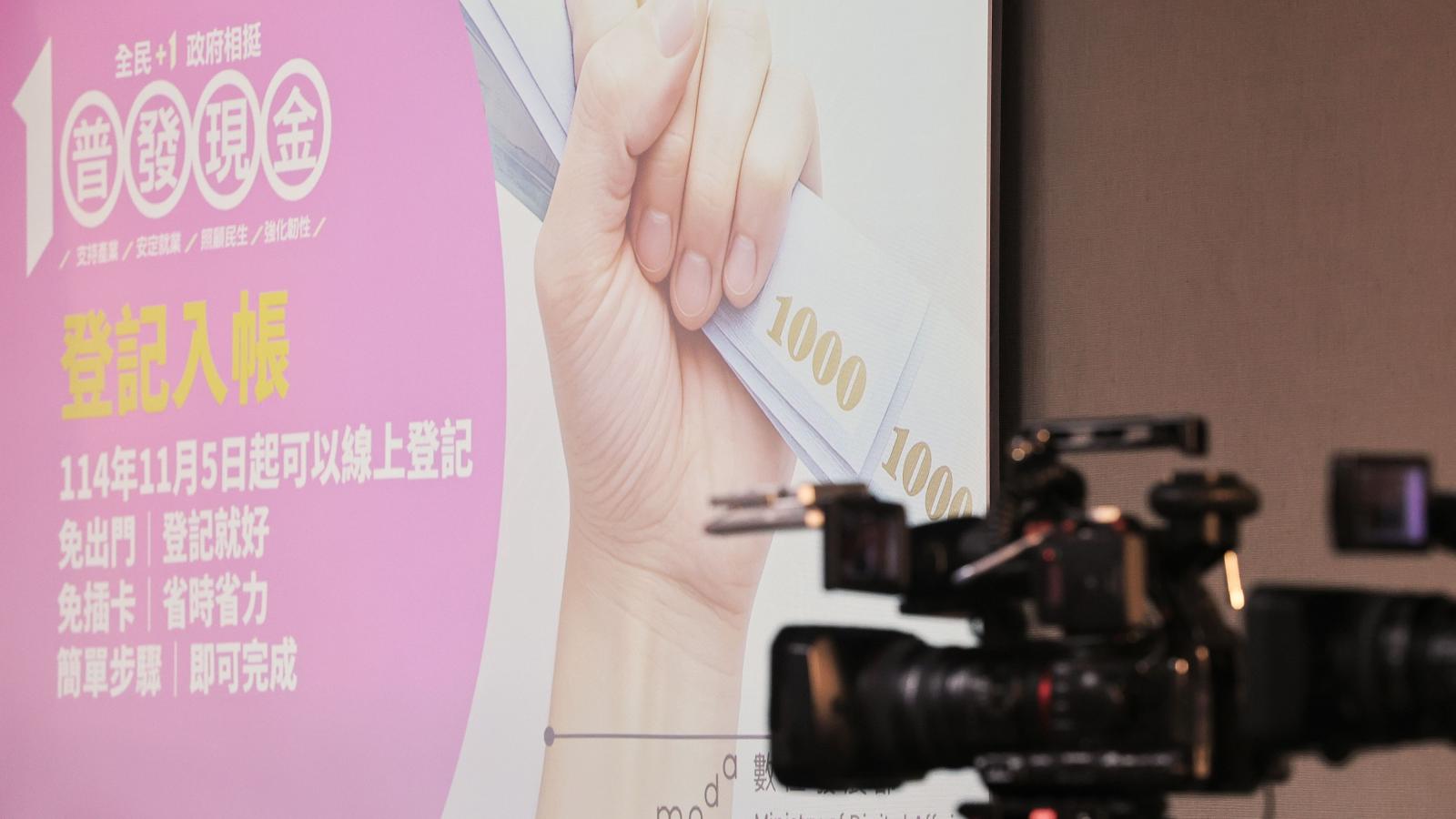
The central government's budget proposal for fiscal year 2026 has been finalized, with the total budget scale reaching over NT$3.6 trillion—the highest in history. On the 17th, President Lai Ching-te announced that, due to an upward revision of economic growth forecasts, the government's revenue for the next fiscal year would also be increased. Under the premise of maintaining zero net new debt, expenditures will be increased by NT$235.7 billion and funded accordingly.
In response, Hsieh Chin-ho, Chairman of Financial News Media, posted on Facebook on the 17th under the title 'The Foundation Behind Universal Distribution of $10,000 in Cash by 2027 as an AI Dividend'—noting that opposition parties were surprised by the ruling party's adoption of a universal cash handout policy. He further proposed that, using a similar budget scale, the government could gift one share of TSMC stock to every newborn, suggesting this as a viable direction to encourage fertility.
When Will the $10,000 Be Distributed? What Are the Collection Methods?
On the 17th, President Lai stated that Taiwan's economic performance this year has been continuously upgraded, with the full-year economic growth rate forecast revised upward from 9.64% to 11.05%. As a result, the government decided to let the public share in the 'AI dividend' on a solid fiscal foundation. The Executive Yuan has already included funding for the $10,000 universal cash disbursement per person in the next fiscal year's budget planning.
However, the public's key concerns—'When will disbursement begin?', 'Who qualifies?', and 'How will it be collected?'—have yet to be officially announced. As the $10,000 disbursement is still in the budget planning stage, these details await official government announcements.
Why Did President Lai Announce the $10,000 Disbursement?
Hsieh Chin-ho pointed out that opposition parties were initially surprised by President Lai's announcement of a universal $10,000 disbursement. This time, the ruling party took the initiative, but opposition parties could respond with countermeasures—for example, Taipei Mayor Chiang Wan-an suggested a $20,000 disbursement. The central government could also ask local governments to 'add extra incentives'.
Hsieh emphasized that President Lai's move is backed by solid fiscal grounds. In 2025, central government tax revenue reached NT$3.7879 trillion, with corporate income tax at NT$1.1482 trillion being the largest source. This was followed by individual income tax at NT$873.7 billion and business tax at NT$615.9 billion. Notably, securities transaction tax collected NT$292.8 billion last year, serving as a major revenue pillar.
Will Tax Revenue Exceed NT$4 Trillion by 2027? How Much Net Profit Do Listed Companies Make?
Regarding individual income tax, Hsieh analyzed that approximately 3.16 million people in Taiwan (45.3%) do not pay income tax; 2.65 million people (38%) pay at a 5% tax rate, totaling NT$17 billion. Meanwhile, around 69,000 people bear the highest tax burden, paying the top 40% tax rate and contributing NT$704.7 billion in total—accounting for 80.7% of individual income tax revenue. This means 1% of taxpayers shoulder about 80% of the tax burden.
Looking ahead, the net profit of all listed and OTC companies in 2026 may exceed NT$7 trillion, leading to higher tax revenues across the board. Tax revenue in 2027 could reach over NT$4.5 trillion.
Is Stock Market Trading Volume Rising? How Much Securities Transaction Tax Can the Government Collect?
Given the recent sustained rise in the stock market, Hsieh noted that if 2026 sees 243 trading days with an average daily trading volume of NT$1 trillion, the government could collect NT$549.2 billion in securities transaction tax. If the average daily volume reaches NT$1.5 trillion, tax revenue would rise to NT$823.8 billion; at NT$2 trillion, it would reach NT$1.0984 trillion. Sharing this tax revenue universally would be welcomed by all.
In conclusion, Hsieh proposed that instead of the government's recently announced monthly NT$5,000 subsidy for newborns, it could gift one share of TSMC stock at birth to encourage fertility. With around 106,000 newborns in Taiwan annually, the cost would be roughly equivalent to the $10,000 universal disbursement. Using the increased securities transaction tax to fund fertility incentives is a direction worth considering.
FACT BOX
- Source: PR Times
- Category: News