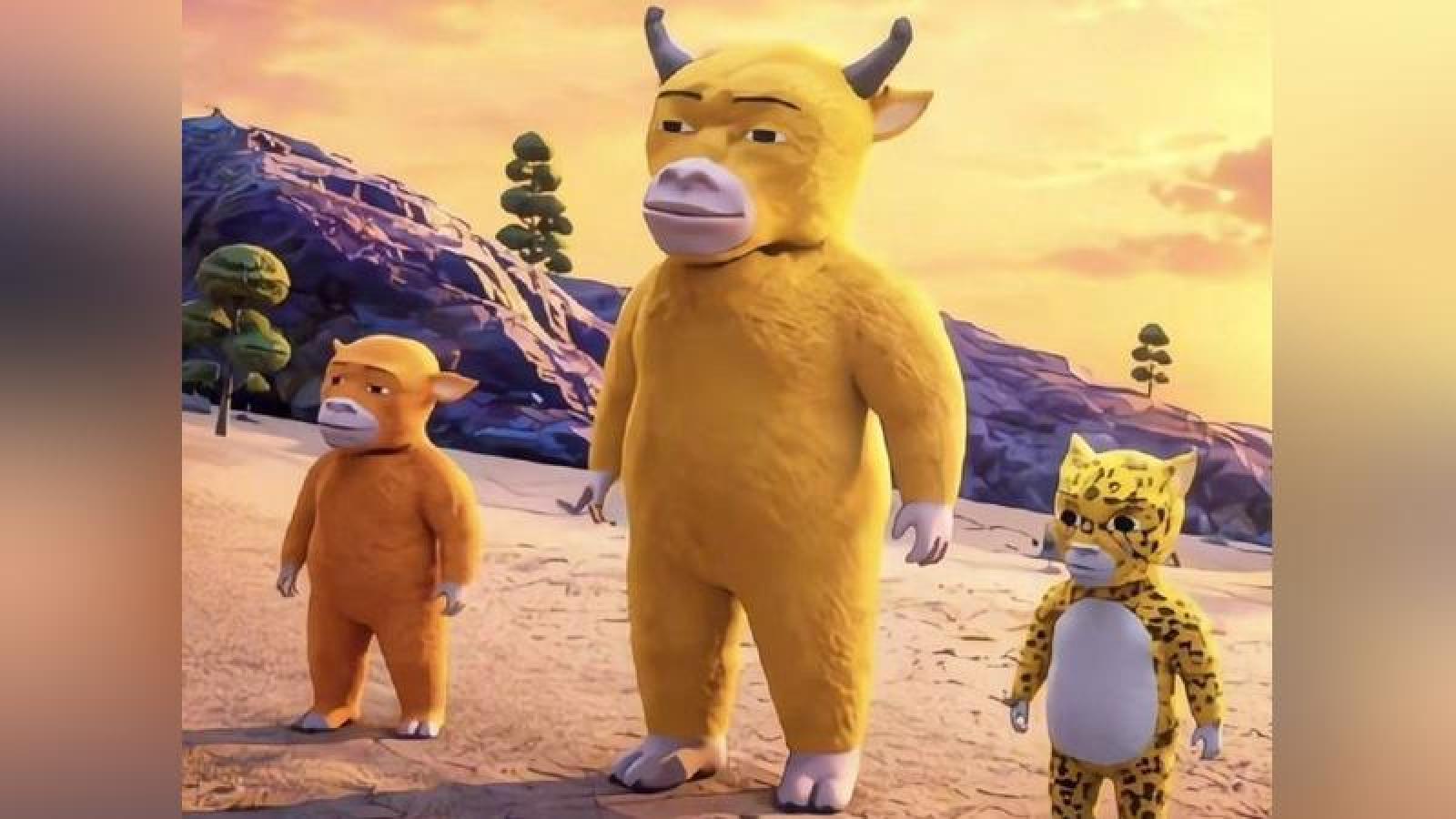
In China's 2026 summer film market, an unusually low-budget animated film titled 'Niu Lai' premiered on August 5. The film initially had almost no market buzz—just nine days before release, its cumulative box office totaled only over 7,000 RMB, with only hundreds of viewers. Its sole promotional material was a beautifully styled ink-wash Chinese-style poster, creating a stark contrast with the film’s crude, distorted 3D models, stiff and laggy animations, and frequent clipping issues. Audiences described it as having '4399 online game quality' (a reference to a popular Chinese online gaming site that accompanied many post-95 youths through childhood), 'a beginner’s 3D homework,' or 'worse than an AI training project.' The most immediate impression of the film is its glaring gap in production quality compared to mainstream Chinese animated films in recent years. Footage circulating on Chinese social media shows widespread criticism of the character modeling, animation, scenes, and lighting effects, with some even saying it 'doesn’t look like a 2026 animation.' 'Niu Lai' was screened in select Chinese theaters, where its unexpected popularity led staff to hand-draw posters—photos from Chinese social media, compiled by Tian Chang. The 'Two-Person Crew' and the 'Dragon Mark' Paradox The film tells the story of a young ox named 'Niu Lai' growing up in dreams and learning responsibility, but was mocked as 'a group of upright cows delivering street-side motivational speeches' and 'incomprehensible.' Initially, Douban’s review section was flooded with one-star ratings, but quickly shifted to ironic five-star praise: 'Pioneering Chinese animation,' 'Best film in theaters this year.' The core creative team behind 'Niu Lai' consists solely of director Xin Yumeng and her mother, Sun Lifang. Xin handled directing, modeling, animation, editing, voice acting, and producing; her mother wrote the script, provided voice acting, and personally sang the ending theme. The production company, Dalian Jingyuan Culture & Film Media Co., Ltd., has a registered capital of only 100,000 RMB. Originally an interior decoration engineering firm, it rebranded into the film and television industry in 2021. Annual reports show only one employee with social insurance. With no external investment, it’s been described as a 'family workshop' or 'amateur troupe.' How, then, did such a film pass censorship and enter theaters? China’s film censorship—commonly known as the 'Dragon Mark'—focuses on 'content orientation': avoiding political, pornographic, or violent red lines. Technical review only checks for broken frames or audio-video sync issues, ensuring screening safety, but does not assess artistic quality or production sophistication. The script was filed in 2021 and passed both content and technical reviews in 2024, following standard procedures. Distributors even advised the director not to release it, but she insisted, 'I worked so hard to make it,' and they eventually helped arrange screenings. This reveals a gap between censorship standards and market expectations: as long as it’s not 'non-compliant,' even the lowest-quality work can legally enter theaters. In China’s film industry, obtaining the Dragon Mark used to be extremely difficult. But 'Niu Lai’s' release revealed to many viewers that getting approval isn’t that hard after all. Overseas Chinese-language social media dubbed it 'It’s no longer bad money driving out good—it’s ghost currency driving out bad money.' Director Xin Yumeng later publicly responded to the controversy. She admitted the five-year project, completed step by step with her mother, had many flaws, but welcomed criticism and viewed the creation as an ordinary person’s pursuit of a dream. As public interest grew, discussions on Chinese social media intensified: Was it attempting to claim local film subsidies? Was it money laundering? Some analyses suggest the scale is too small and timelines don’t match for profitable exploitation, but the debate has expanded from the film itself to broader industry mechanisms and market failure. Online screenshots claim the film’s production company was originally a decoration firm that, unable to collect final payments from government projects, adopted this strategy to receive compensation via film subsidies. According to these claims, journalists verified on the Liaoning provincial government website and official Chinese media reports that policies do exist to subsidize low-to-medium-budget films. However, as of now, Liaoning authorities have not publicly responded. Liaoning Provincial Government policy on rewarding small-to-medium-budget films / Screenshot from official website On August 16, multiple theaters in Dalian, the film’s place of origin, pulled the film, with staff stating, 'The film is so bad, why should we show it?' and 'Made by Dalian people—we’re afraid it’ll damage Dalian’s image.' Soon after, social media reported nationwide cancellation of new screenings. Director Xin Yumeng then posted: 'The theatrical phase of 'Niu Lai' has officially ended. This was a complete creative practice. We’ve received love and criticism, and we’ve taken every voice seriously.' In terms of box office trends, 'Niu Lai' experienced a dramatic reversal. Initially ignored, its revenue surged after August 14 as online discussions exploded. Public reports indicate that by August 16, cumulative box office had surpassed 5 million RMB—a highly unusual case in China’s film market. Systemic Gaps Behind China’s Film Censorship According to current Chinese film review standards, 'Niu Lai' did not violate any red lines. However, Article 18 of the 'Film Industry Promotion Law of the People’s Republic of China' states: 'Film reviews shall involve no fewer than five experts who provide evaluation opinions, which shall serve as important basis for review decisions.' Some mainland media questioned: 'Who exactly are these five experts?' The 'Niu Lai' phenomenon is not isolated. It highlights multiple tensions in China’s film industry: a censorship system prioritizing 'safety' over 'quality,' the disconnect between micro-teams and industrialized standards, the dominance of 'black fame' traffic logic in the social media era, and audiences’ resonance with 'absurd authenticity' under real-life pressures. When 'so bad it’s good' becomes a selling point, market competition and purification mechanisms may further fail. The director’s persistence and her mother’s support, while a personal dream fulfilled, have reignited debate over how low the barrier is for 'ordinary people to enter theaters.'
FACT BOX
- Source: PR Times
- Category: News