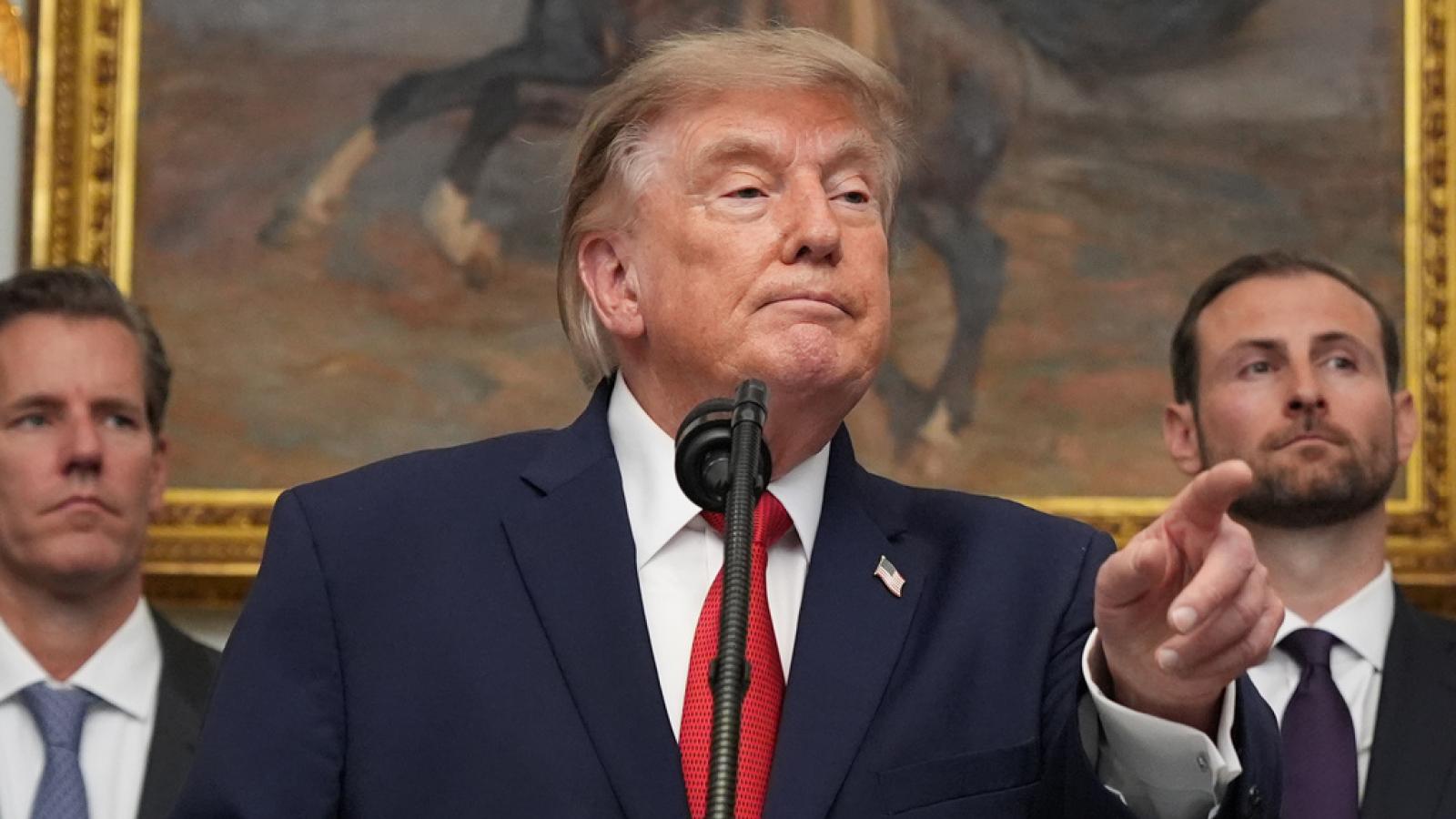
Former U.S. President Donald Trump has announced plans to impose what he calls an 'economic D-Day' on Iran, expanding sanctions against the country. While Trump did not immediately specify the exact punitive measures Washington would take, he warned that nations continuing to support Iran would face severe economic consequences—clearly shifting focus toward China, which purchases the vast majority of Tehran's oil. Observers note that after weeks of military strikes and blockades failed to force Iran's submission, Trump appears increasingly frustrated and is now seeking a new target.
Trump stated via social media that this would be an 'unprecedented' economic war and full isolation campaign. Any country allowing its financial institutions, businesses, airports, or government entities to provide assistance to Iran would face extremely severe economic sanctions or penalties. He also attempted to rally allies who have not yet supported U.S. military actions against Iran, urging them to join in bringing down the regime.
In reality, even before Trump's warning, U.S. Treasury Secretary Scott Bessent had already signaled that Washington was preparing to activate a new round of economic sanctions tools. This strategic shift is highly transparent: facing challenges such as ammunition shortages, rising military costs, and overextended forces, the U.S. aims to exit a military campaign that, despite eliminating most of Iran's top leadership and severely damaging its military, has failed to force Tehran's surrender.
Looking back over the past 30 to 40 years, since the Islamic Revolution, Iran has continuously faced economic and military sanctions. International media are therefore skeptical about what new economic punishments Washington could possibly impose that Tehran hasn't already adapted to. Iran has long been accustomed to navigating sanctions, surviving even under Trump's first-term 'maximum pressure' policy through gray-market mechanisms such as hawala networks, cash transfers, currency swap agreements, flag-of-convenience shipping, shell companies, and oil smuggling.
If the new sanctions directly target Iran's oil sales, this could trigger a new round of direct confrontation between the U.S. and China. With Chinese President Xi Jinping scheduled to visit the U.S. in September, will Trump risk provoking Beijing by imposing such measures?
Brett Erickson, Managing Director of risk management consultancy Obsidian Risk Advisors, pointed out that Trump's social media post draws a red line clearly aimed at one country: China, Iran's most critical economic lifeline to date.
Meanwhile, the United Arab Emirates (UAE) recently announced it would sever economic ties with Iran, citing escalating threats to regional and international peace and security—providing some support to Trump's pressure campaign. The UAE has been Iran's largest trading partner in recent years, and Tehran has heavily relied on this bilateral relationship to access foreign goods and hard currency.
Trump's ultimate goal is to force Iran into a new round of negotiations to end the conflict, demanding Tehran abandon its nuclear program and relinquish control over the Strait of Hormuz. The two sides signed a memorandum in June, but it collapsed shortly after amid repeated retaliatory attacks.
In response to Washington's threats, Iran has taken a clear stance: demanding compensation for economic damages incurred during the conflict and asserting the right to charge transit fees through the Strait of Hormuz. As regional tensions rise again, international crude oil prices have risen for four consecutive days, with October WTI futures holding above $84 per barrel and Brent crude nearing $92 per barrel.
On April 29, 2026, a gas station in Portland, Oregon, displayed gasoline prices at $110.04 per gallon. For Trump, resolving this crisis is a race against time. He faces persistently high domestic gasoline prices, growing public opposition, and the looming November midterm elections, where Republicans fear losing control of both chambers of Congress due to the war and fuel costs.
Within Iran, war and U.S. blockades have severely restricted oil exports, leading to an 80% inflation rate and nearly 30% currency depreciation. Economists warn that if the sanctions and conflict persist, the crisis could plunge Iran—home to 90 million people—into one of the worst economic collapses in its history.
FACT BOX
- Source: PR Times
- Category: News
- Organizations: Hapag-Lloyd / Obsidian Risk Advisors