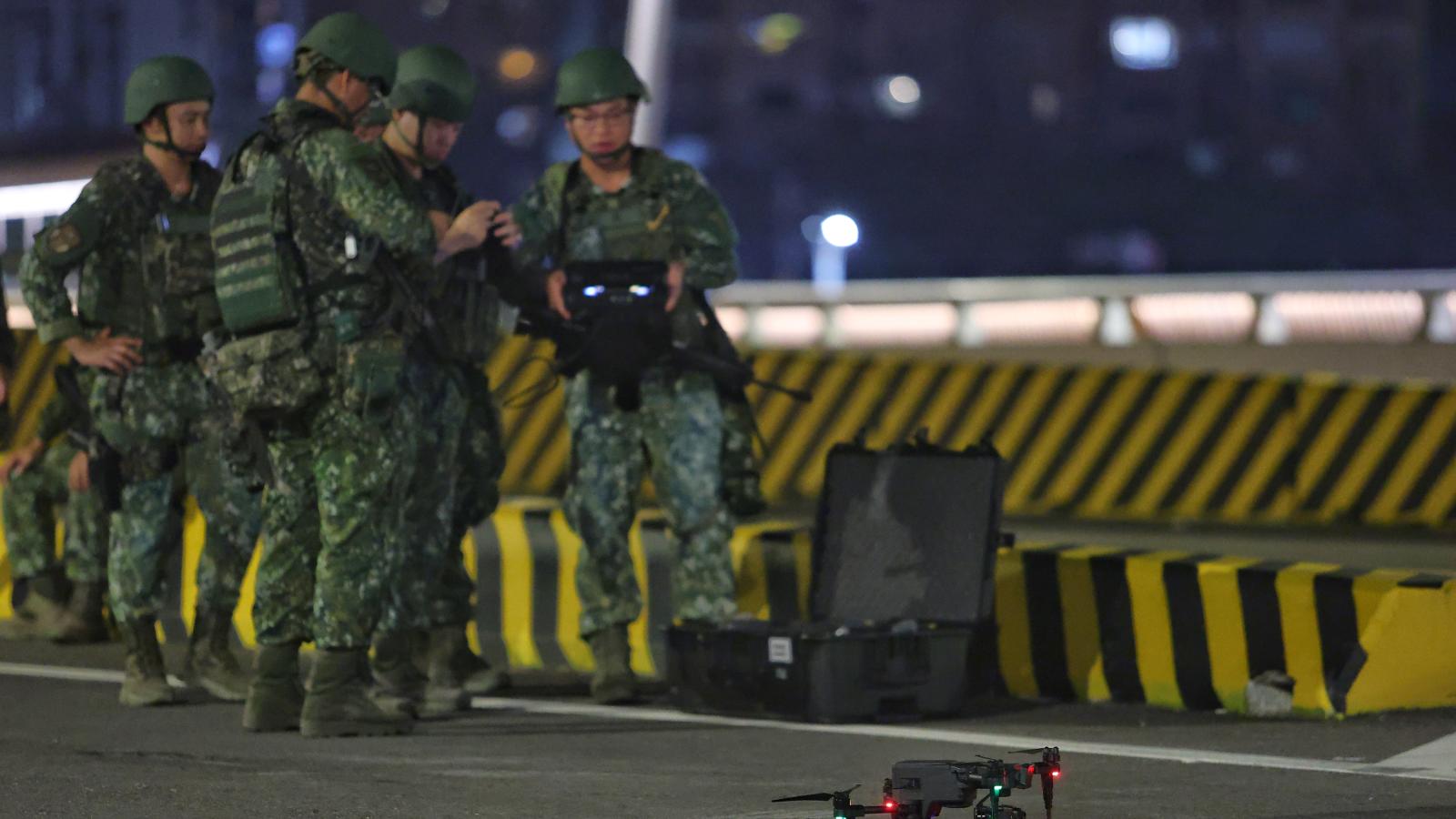
Cross-party negotiations in Taiwan's Legislative Yuan will soon address regulations concerning unmanned vehicles critical to national defense development. Amid urgent U.S. pressure for Taiwan to accelerate unmanned systems development, the Lai Qingde administration's draft of the 'Special Act for Procurement of Indigenous Unmanned Defense Vehicles' has yet to pass. The military is growing increasingly anxious—despite battlefield prowess, it is being stymied in the legislature. Why are the U.S. and Taiwan's military so urgently pushing for unmanned vehicle development?
The New York Times reported that inspired by battlefield experiences in Ukraine, Taiwan is accelerating the development of drones, unmanned attack vessels, and anti-drone capabilities, aiming to implement the U.S.-termed 'hellscape' defense strategy in the Taiwan Strait. Yet, Taiwan's ambitions are stalled in the Legislative Yuan. If Taiwan fails to build its unmanned defense network within the next few years, will it become a drone-dominated hellscape—or will it simply collapse under enemy assault and become hell?
Drones have played a pivotal role in the Russia-Ukraine war, and Taiwan, influenced by Ukraine's battlefield lessons, is actively developing unmanned systems. The image shows Kyiv after a drone attack. (Photo credit: AP)
Unmanned systems have become a national-level strategic priority for China's military, and Taiwan's military cannot afford delays in combat capability formation over the next six years. A defense official stated that while a complete combat force includes various weapon systems beyond unmanned vehicles, the current threat environment is so severe that Taiwan remains vulnerable every single day without operational unmanned capabilities. A national security official explained that the quantities and timelines for procuring three types of indigenous drones under the special act have been carefully assessed and are tied to a strict capability development schedule. Originally, when drone funding was cut from a $1.25 trillion special budget, the estimated timeline for combat readiness was six years. Now, every month of delay pushes that timeline further back.
Defense officials noted that China has already designated unmanned systems as a national strategic industry and is the world's largest exporter of both military and civilian drones. As China's military technology advances, it directly translates into increased military threats against Taiwan. Therefore, Taiwan must immediately develop and invest in drones to prevent the military gap across the strait from widening. Moreover, China's gray-zone incursions—increasing in frequency and intensity, including weekly joint combat readiness patrols, coastal infiltration by small boats, and cyberattacks—highlight a growing national security threat as China transitions from training to exercises and potentially to actual combat.
A senior national security official stated that Taiwan's initial estimate for unmanned system development was a six-year timeline to achieve combat capability. The image shows a surveillance drone used by Taiwan's military. (Photo credit: Liu Wei-hung)
Key to Anti-Landing Defense: Ministry of Defense's Procurement of Three Unmanned Vehicle Types
Defense officials emphasized that the enemy will likely approach rapidly by sea, and unmanned vehicles enable commanders to detect threats earlier and make faster decisions. Unmanned aerial vehicles can be integrated with existing standoff weapons. Taiwan has successfully acquired the Hsiung Feng multi-launch rocket missile system, along with the Hsiung Feng missile and anti-ship missile systems—long-range, precision, and highly effective strike weapons. However, without the ability to detect and identify targets early, these weapons cannot achieve their full strike potential.
Officials added that in anti-landing defense operations, unmanned vehicles can conduct saturation attacks against enemy forces during amphibious landings—what the U.S. often calls the 'hellscape scenario.'
The defense ministry's proposed $21 billion special budget for indigenous unmanned vehicle procurement aims to acquire three types of unmanned systems. This includes 1,446 coastal surveillance drones to help ground-based anti-ship missile units monitor enemy movements; 28,888 coastal attack drones across four variants; and 1,320 suicide drones. These will integrate with existing defensive and strike units' firepower to launch saturation attacks against any enemy landing vehicles, deterring invasion attempts.
The $21 billion unmanned vehicle special budget includes over a thousand suicide drones. (Photo credit: Liu Wei-hung)
Urgency of Capability Development: Special Budget Avoids 'Exclusion'
Why must unmanned vehicle procurement rely on a special budget? Defense officials explained that special budgets offer stable, concentrated funding, preventing competition from other budget items and allowing focused investment in urgent combat capabilities. The scale of a special budget also encourages industry investment. In contrast, annual budgets are unstable, making future planning uncertain and discouraging private sector investment.
Officials stressed that unmanned systems are high-consumption assets in warfare. Only with a robust domestic supply chain can Taiwan reduce foreign dependence and demonstrate its self-defense resolve internationally.
With special budget funding, a vast industrial chain—including airframes, payloads, communications, electro-optics, batteries, and battery maintenance—can be developed. Indigenous defense development will foster core technologies domestically, gradually forming a non-red supply chain and creating dual benefits for national defense and the economy.
Defense officials advocate that the 'Special Act for Procurement of Indigenous Unmanned Defense Vehicles' should be led by the Ministry of Defense, as it is best positioned to assess military threats and urgent capability needs. Different legislative purposes, planning approaches, and resource allocations will ensure faster deployment of unmanned systems to enhance overall defense readiness.
At one point, the ruling and opposition parties were deadlocked over the special act. (Photo credit: CNA)
Taiwan Faces Greater Urgency: Return to Annual Budget Could Undermine Defense Strategy
What would happen if the procurement ultimately reverts to the annual budget? Defense officials warned this would pose significant challenges, as the quantities and timelines for the three unmanned vehicle types have been precisely calculated. Any shortfall in funding would delay unmanned combat capability and strain the overall defense strategy.
National security officials noted that the EU and South Korea have taken similar measures—Taiwan is not unique. However, Taiwan faces a more urgent threat environment. Special budgets are designed for specific, large-scale initiatives. Completing this priority must come first. If delayed by annual budget fluctuations, public and private stakeholders may question why they should invest—creating a domino effect that undermines capability development.
More exclusive Wind Media insights: · Behind the Scenes: Even the U.S. Military Wouldn't Dare—But Taiwan Did? Han Kuang Exercise Features a 'Magical' Military Script · Behind the Scenes: Koo Hsien-hung and Mei Chia-shu Are Serious—Han Kuang Exercise War Plans Suddenly Changed, Commanders Shocked by Orders · Face to Face: Can Taiwan Wait? Koo Hsien-hung Worries Legislative Gridlock Over Drone Budget Is Crippling Military Readiness
FACT BOX
- Source: PR Times
- Category: News