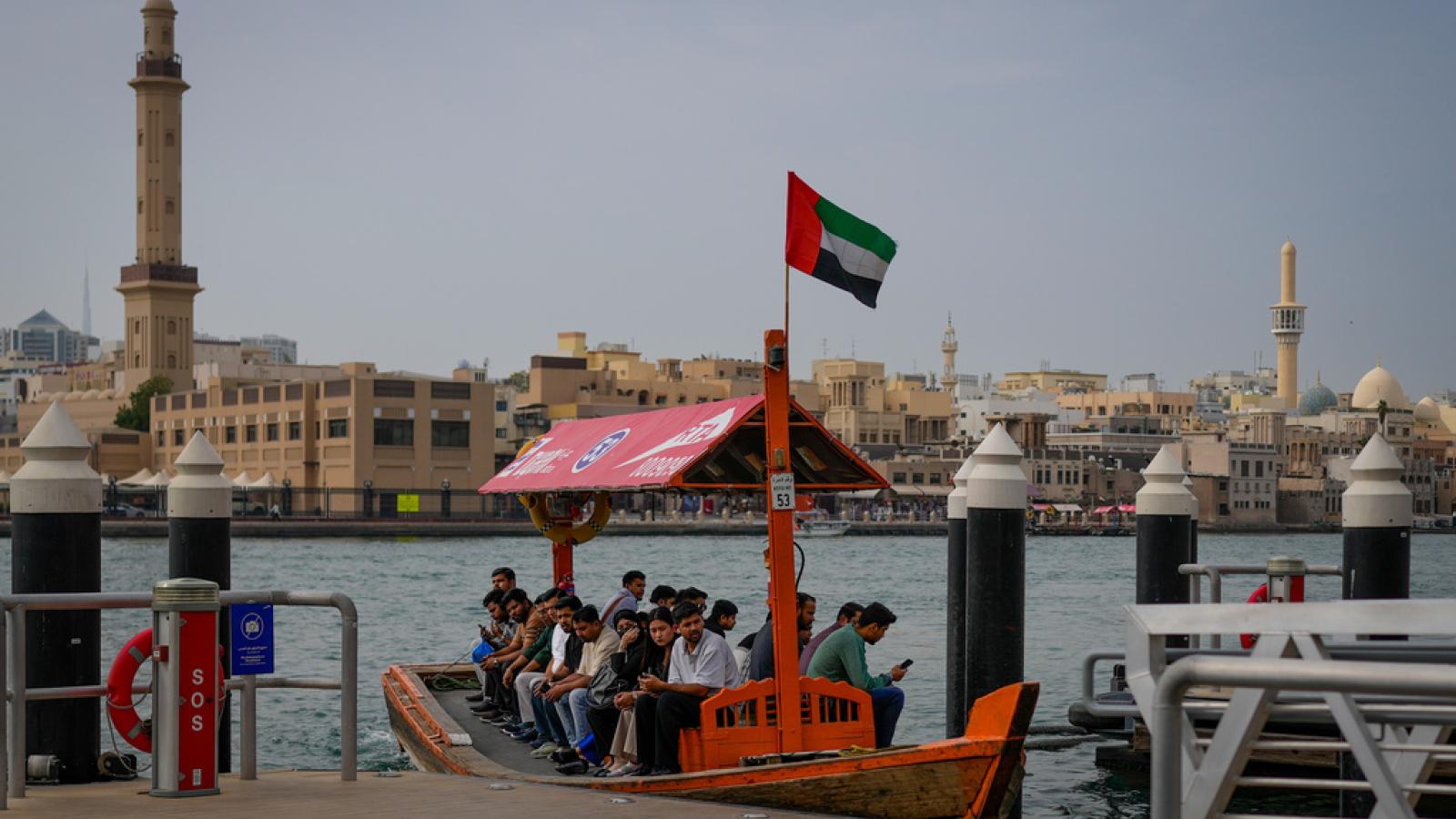
The United Arab Emirates (UAE) announced on the 20th that it would temporarily suspend all trade and financial transactions with Iran after detecting a new round of missile attacks from Iran. This measure is viewed as a strong retaliatory response by Abu Dhabi to Tehran’s military actions and could severely impact the long-standing, large-scale economic exchanges between the two countries.
At the same time, Iran’s Ministry of Foreign Affairs denied launching the missile attack, suggesting instead that the incident might have been a "false flag operation" orchestrated by hostile forces.
The UAE Ministry of Defense stated that its air defense systems detected "two ballistic missiles launched from Iran toward the UAE direction" on the 20th. One missile landed outside UAE territorial waters, while the other fell within them. This marks the first time in the past three months that Iran has been accused of launching a missile strike against the UAE.
Following this, the UAE Ministry of Foreign Affairs announced that, given the escalating regional tensions threatening "regional and international peace and security," the UAE would halt all trade and financial transactions with Iran.
This decision has drawn significant attention because, despite strained political and security relations due to regional conflicts in recent years, UAE and Iran have maintained close economic ties, with annual bilateral trade reaching approximately $28 billion. In particular, Dubai has long served as a crucial transshipment and financial hub connecting Iran to global markets. Amid U.S. sanctions on Iran, the UAE has remained a vital channel for Iran to sustain foreign trade.
Both the UAE and Iran are members of BRICS (Brazil, Russia, India, China, South Africa). Originally formed around these core nations, BRICS has expanded its membership in recent years and is increasingly seen as a multilateral organization led by China, distinct from the U.S.-led global economic and security framework.
UAE and China Are Iran’s Two Economic 'Lifelines'
Although the UAE government officially supports U.S. sanctions on Iran and occasionally penalizes businesses and individuals violating those measures, the informal trade network through Dubai has long been regarded as a critical conduit for Iran to access international goods and maintain foreign exchange transactions. For years, the U.S. government has urged the UAE to further crack down on activities within its borders that help Iran circumvent sanctions.
Miad Maleki, a senior researcher at the Foundation for Defense of Democracies (FDD), stated on the 20th that the UAE and China are Iran’s two economic 'lifelines.' He argued that if the UAE’s newly announced trade ban is fully implemented, it could sever a supply and trade route that the U.S. Navy has long been unable to directly reach but which is critically important to Iran’s economy.
Maleki pointed out that over the past five years, the UAE has been Iran’s largest source of imports. About 80% of Iran’s import-related foreign exchange transactions are linked to the UAE, including around 40% of essential consumer goods such as soybeans and industrial machinery.
He further noted that a significant portion of goods statistically recorded as 'imported from the UAE' are not actually produced in the UAE but are transshipped through Dubai. From this perspective, Dubai has effectively become a key 'window' for Iran to connect with the global economic system.
For example, Iran acquires goods through Dubai such as gasoline from India, auto parts manufactured in China, and soybeans exported from Brazil. These items are not produced in the UAE but first enter Dubai before being rerouted to Iran via its mature logistics, financial, and trade networks.
Dubai’s Role Is Hard to Replace; Iran Softens Its Stance
Regarding whether China could replace Dubai and fill the trade gap created by the UAE’s suspension, Maleki believes there is no real alternative in the short term.
He emphasized that Dubai’s geographical proximity to Iran, combined with its massive logistics infrastructure and extensive commercial networks accessible to Iranians abroad, makes it irreplaceable in Iran’s external trade system. In contrast, maritime routes between China and Iran are much longer, and the current crisis has already driven up shipping costs. Even if China were willing to take over some of the cargo previously routed through Dubai, absorbing the additional transportation costs would be extremely difficult.
The Iranian government also appears to recognize that the situation may be deteriorating further. Earlier on the 20th, Iran’s military had issued strong statements regarding the missile attack on the UAE, warning other Persian Gulf nations that assisting or providing facilities to U.S. forces could result in similar military strikes.
However, Iran’s Ministry of Foreign Affairs later adopted a completely different stance. Spokesperson Esmaeil Baqaei denied that Iran carried out the attack and dismissed related reports as baseless.
According to Iran’s official Islamic Republic News Agency (IRNA), Baqaei expressed regret over what he called "baseless accusations" against Iran, stating that such claims violate principles of good neighborliness and could undermine ongoing efforts among regional states to build mutual trust and prevent further instability.
Baqaei urged all regional parties not to make "baseless accusations" against Iran. He attributed the current regional tensions to what Iran describes as "destructive activities" persistently conducted by the United States and Israel, saying these actions have negatively impacted regional peace and security.
Iranian authorities also mentioned that the Middle East has witnessed multiple incidents in the past labeled as "false flag operations," implying that the missile incident targeting the UAE might not have been launched by Iran.
UAE Rejects Claims of Assisting Iran in Evading Sanctions
While Iran denies the attack, the UAE has also rejected allegations that it has long assisted Iran in circumventing U.S. sanctions.
Anwar Gargash, advisor to the UAE president, stated on the 20th that "misinformation" has been spread about the UAE by certain platforms and that the UAE government remains focused on responding to the regional situation and preparing for future developments.
Gargash specifically denied rumors that the UAE has canceled work permits for Iranian nationals or provided financial facilitation to Iran. He described these claims as false information part of a media campaign targeting the UAE.
Following the UAE’s announcement of suspending trade with Iran, high-level communications between the U.S. and UAE have also attracted attention. UAE media reported that U.S. President Donald Trump spoke by phone with UAE President Sheikh Mohamed bin Zayed Al Nahyan on the 19th, while Secretary of State Marco Rubio held talks with UAE National Security Advisor Sheikh Tahnoon bin Zayed Al Nahyan.
Rubio Emphasizes Maintaining 'Freedom of Navigation in the Strait of Hormuz'
The U.S. State Department said Rubio stressed the importance of maintaining 'freedom of navigation in the Strait of Hormuz' during the call and discussed how the U.S. and UAE could coordinate actions to hold Iran and its supported 'terrorist proxy organizations' accountable for their continued attacks.
The Strait of Hormuz is one of the world’s most critical energy transport waterways, through which vast amounts of Middle Eastern crude oil and natural gas must pass to reach international markets. Therefore, the military conflict and trade disruption between Iran and the UAE not only affect bilateral relations but could also further impact Persian Gulf shipping, energy supplies, and Iran’s ability to maintain imports and foreign currency circulation under U.S. sanctions.
FACT BOX
- Source: PR Times
- Category: News