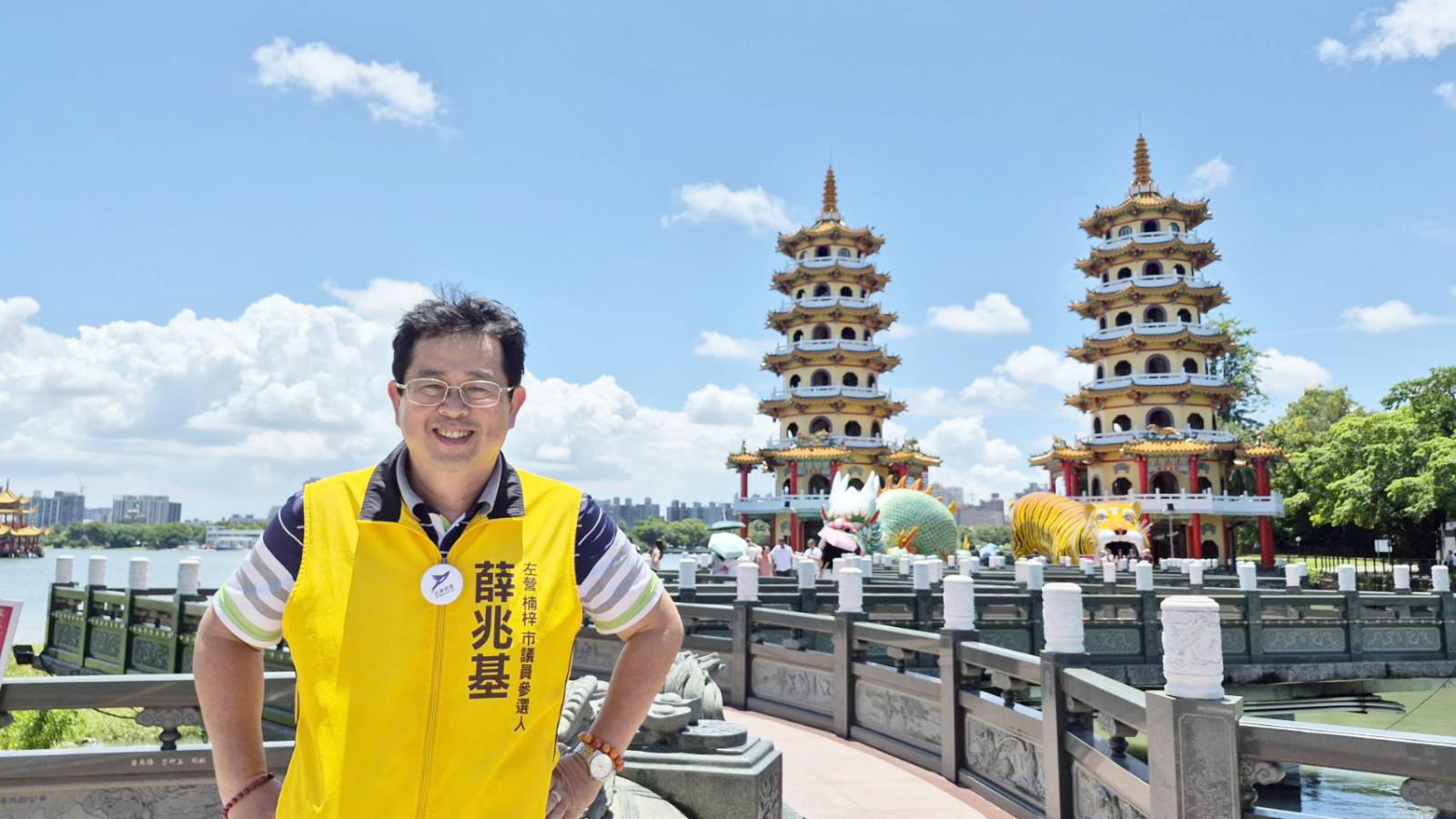
"Lotus Pond is my hometown; making it better is my responsibility!" Hsueh Chao-chi, a candidate for the Zuoying and Nanzih city council who has lived and worked in Zuoying for over 50 years, today (20th) unveiled the "Lotus Pond Ten Perfections Plan." Targeting transportation, tourism, culture, environment, and local economy, he proposed 10 action items aimed at reconnecting surrounding attractions and industries so that tourists don’t just "visit," but are encouraged to stay and spend—turning foot traffic into real local economic gains.
From Transportation and Tourism to Cultural Economy: 10 Actions to Shape Lotus Pond’s Next-Generation Development Blueprint
Hsueh emphasized that Lotus Pond already boasts rich resources such as the Dragon and Tiger Towers, Chun-chiu Pavilion, Confucius Temple, Zuoying Old City, Turtle Mountain, and waterfront areas. The area has never lacked scenic spots; what’s truly needed is a breakthrough in integrating these existing assets to extend visitor stay times and allow nearby residents and businesses to share in the benefits of tourism development.
"Lotus Pond has scenery and people, but still hasn’t managed to keep them here," Hsueh pointed out. In the past, the area often suffered from "visitors without value creation"—tourists would take photos, walk around briefly, and leave, offering limited tangible impact to surrounding businesses. Therefore, he introduced the "Ten Perfections Plan," aiming to restructure the tourism model around three core questions: How do they get here? How do they enjoy their time? And how can we keep them longer?
The 10 actions proposed by Hsueh include night tourism, lotus boat water transport, renovation of Ha-luo Market, parking improvements, upgrading cultural events like Wan-nien Festival, AI-powered smart guides, Lotus Pond Literary Camp, enhanced accommodation options, waterfront environmental upgrades, and international exchange programs—all designed to comprehensively strengthen the area across transportation, tourism, culture, and local industry.
On transportation, Hsueh advocates improving parking and traffic around Lotus Pond by evaluating multi-level parking structures and intelligent parking systems. He also proposes introducing "lotus boats" as water-based transit to connect key lakeside attractions, transforming the waterfront from mere scenery into an actual travel route.
For tourism, he believes Lotus Pond must move beyond daytime sightseeing by developing nighttime lighting, performances, markets, and boat tours to extend visitor stays. Simultaneously, improving the environment and circulation at Ha-luo Market and enhancing lodging and dining options will create a more complete tourist experience.
"Let visitors stay one more night, eat one more meal, explore a few more places—only then can foot traffic turn into local revenue," Hsueh stated. Tourism development shouldn’t just chase visitor numbers but focus on converting presence into spending, ensuring local businesses truly benefit.
Culture is another cornerstone of Hsueh’s plan. He proposes integrating festivals like Wan-nien, temples, Zuoying Old City, local history, and literary activities, while introducing AI-powered, multilingual smart guides to help domestic and international tourists deeply understand the historical narratives behind Lotus Pond. He also promotes international cultural exchanges to strengthen Zuoying’s global connections.
Regarding the waterfront environment, Hsueh calls for continuous improvement of Nanhai Ditch’s water quality, drainage, and surrounding conditions—balancing ecology, flood control, and residents’ quality of life—so that Lotus Pond becomes not just a tourist destination, but an integral part of daily community life.
Reflecting on his over 50 years in Zuoying, Hsueh said he has personally witnessed Lotus Pond’s evolution across half a century, forming a deep emotional bond with the land. "Visitors may see scenery, but someone who’s lived here for 50 years sees the decades Lotus Pond has shared with the community."
He stressed that the next phase of Lotus Pond’s development should fully integrate transportation, foot traffic, culture, consumption, and local value creation—evolving from isolated scenic spots into a cohesive urban tourism lifestyle zone.
"I’ve watched Lotus Pond for 50 years. What I want to do is lay out the right direction for the next generation," Hsueh emphasized. His vision is a future where residents are drawn to the area, tourists choose to stay, and local shops genuinely thrive—where Lotus Pond’s beauty isn’t just a city showcase, but a powerful engine driving Zuoying’s regional development and economic growth.
FACT BOX
- Source: PR Times
- Category: キャンペーン