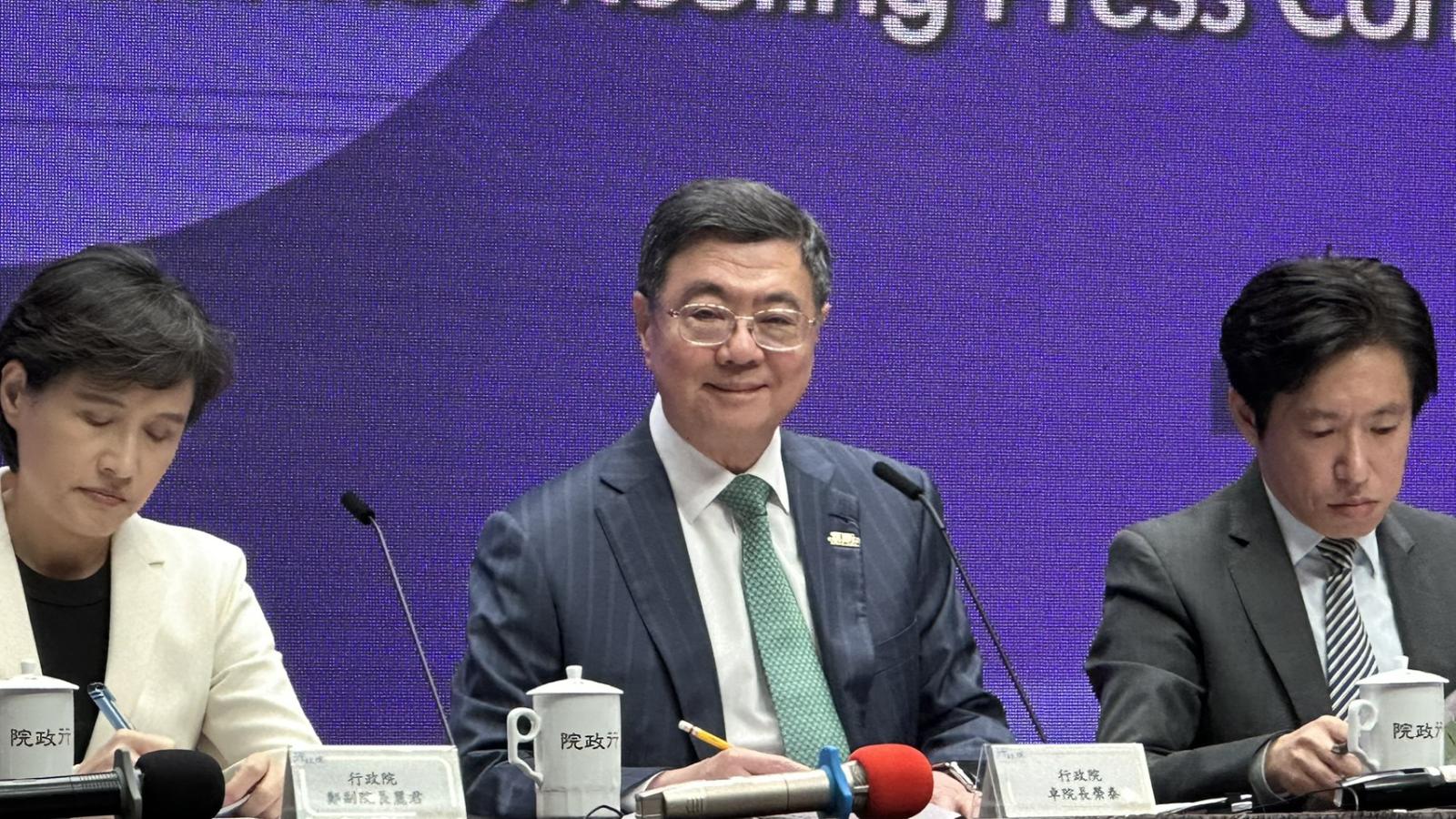
The Executive Yuan recently announced it would not co-sign bills such as the 'Taiwan Future Account,' prompting Legislative Yuan President Han Kuo-yu to criticize, 'Executive power, no matter how strong, must not exceed the Constitution.' In response, Executive Yuan Premier Cho Jung-tai stated on the 20th that if unconstitutional bills are passed by the Legislative Yuan and the president has no veto power, 'the nation could very likely become an opposition dictatorship.'
However, Cho emphasized that the Executive Yuan and Legislative Yuan must still coordinate under the constitutional framework on critical national welfare issues. After the budget is submitted to the Legislative Yuan, Cho said he and Executive Yuan Secretary-General Chang Tun-han would schedule a visit to meet with Han Kuo-yu.
Cho explained that under Article 37 of the Constitution, the president's promulgation of laws requires the co-signature of the premier. Taiwan is neither a presidential system nor a cabinet system but what is known as a 'dual leadership system,' where the president appoints the premier without needing approval from the Legislative Yuan. When the president and premier belong to the same party, there is no issue of checks and balances, Cho argued. In contrast, if unconstitutional bills are passed by the legislature and the president has no veto power, the country could fall into 'opposition dictatorship.'
Cho stated, 'If such a situation arises, the president is legally required to promulgate the law, but this requires the co-signature of the premier. The premier must have the courage, responsibility, and duty to act.' He added, 'I am not a grand justice; I am simply following the interpretation of the Constitution.' If a bill undermines national fiscal discipline, should the government be helpless? If a bill seriously threatens national security, should the nation's gates be left wide open?
Cho questioned whether the constitutional order should be allowed to be destroyed by a bill that violates constitutional principles. If a bill passes the Legislative Yuan without democratic deliberation or voting, what is the meaning of democracy? The premier, he said, has a responsibility to ensure mutual respect under the constitutional system—each branch must fulfill its role. The Legislative Yuan should not draft budgets or embed budget items into laws. If the legislature passes laws that include budgets and then sends them to the Executive Yuan for compilation before returning them to the legislature for review, what is the point of such a review? There is no such constitutional design in the world.
Cho argued that the Legislative Yuan must not use laws to compel the Executive Yuan to compile or increase budgets. Even if such cases occur, the Executive Yuan's opinion must first be consulted. However, the legislature has never fulfilled this obligation and instead uses passed laws to force the Executive Yuan to compile budgets.
Cho reiterated that the Executive Yuan and Legislative Yuan must still coordinate under the constitutional system on important national welfare issues. After the budget is sent to the Legislative Yuan, he and Chang Tun-han will schedule a visit to Han Kuo-yu, emphasizing, 'In ritual, harmony is most valuable.'
More exclusive reports from Storm Media: · Who is right—Han Kuo-yu or Cho Jung-tai? A simplified guide to the co-signing dispute; one observer highlights two key issues: 'If you're going to ignore it, just ignore it from the start.' · Premier Cho did not attend the Legislative Yuan after the budget passed its third reading; the KMT accused him of 'burning the bridge after crossing,' escalating tensions between ruling and opposition parties. · Cho Jung-tai's salary and special expenses frozen! The Legislative Yuan reveals the 'frozen amount' after third reading; Weng Hsiao-ling says, 'It's already lenient not to delete it entirely.'
FACT BOX
- Source: PR Times
- Category: News