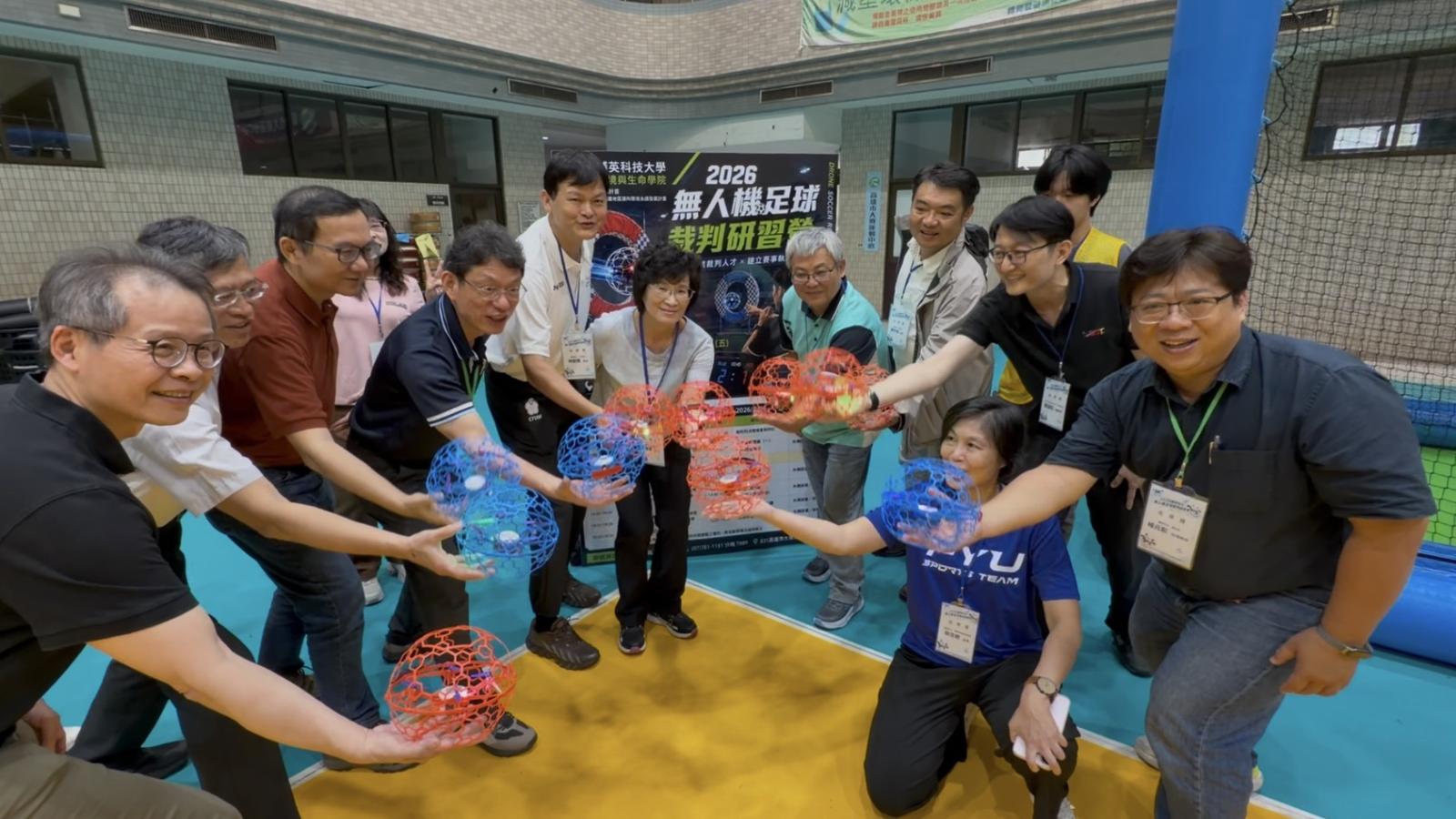
The integration of drones and AI technology has sparked a global trend. 'Drone soccer,' which combines flight control, STEAM education, and team tactics, is rapidly entering campuses. As government and private sectors actively promote the sport, competition events are increasing steadily, but a shortage of qualified referees is becoming a visible challenge.
In response, the University Social Responsibility (USR) project of the College of Environment and Life Sciences at Fuying University of Science and Technology has organized the '2026 Fuying HLS Drone Soccer Referee Workshop.' The event attracted enthusiastic enrollment from deans, professors, administrative staff, and students, creating a rare 'intergenerational co-learning' environment to cultivate referee talent and address the human resource gap in this emerging technological sport.
Dr. Ya-Ching Lin, Vice President of Fuying University, noted that the workshop, limited to 30 participants, received overwhelming applications. Attendees ranged from teenagers to educators in their fifties, including college deans, full and associate professors, and administrative leaders—forming a unique 'intergenerational co-learning' scene that reflects the growing attention drone soccer is receiving on campus.
Lin emphasized that drone technology applications have long surpassed recreational remote flying. Drones are now widely used in disaster response, agriculture, environmental monitoring, logistics, imaging, and defense. In recent years, a 'aerial soccer' craze has swept campuses, and drone soccer has become a vital gateway for students to engage with flight technology and interdisciplinary learning by merging science, sports, and education.
She added that southern Taiwan is gradually forming a technology industry corridor, and Fuying University's proximity to multiple industrial parks allows it to leverage this advantage. By training referee talent, students can gain early exposure to flight operations and technological applications, further cultivating drone pilots, engineering technicians, and interdisciplinary professionals needed in the drone industry. Campus promotion should not only focus on 'having players,' but also ensure 'having teachers, referees, and talent.'
Dual-Track Training: Comprehensive Curriculum from Rule Interpretation to Practical Drills
Dr. Ching-Ho Lin, Dean of the College of Environment and Life Sciences, explained that the workshop was co-developed with industry resources, partnering the college's USR project with Ansos Technology Co. The curriculum was designed according to official drone soccer competition standards, balancing theory, hands-on operation, and实战 (practical drills).
Course content includes an overview of sports development and rules, competition regulations and foul judgment, practical drone operation experience, referee enforcement drills, group simulation matches, scenario-based case discussions,实战 exercises, and a final referee certification exam. Participants who complete all sessions and pass both written and practical evaluations will receive a 'Drone Soccer Referee Training Certificate,' qualifying them to officiate campus and related competitions.
Dr. Lin also enrolled and was selected for the two-day workshop, quoting, 'Learning has no limits; one must remain humble before technology.' As drone soccer integrates aviation technology, digital control, team competition, and real-time decision-making, he believes educators must personally experience and learn to design curricula that meet actual educational needs.
Aerial Offense and Defense Test Judgment: Referees as Indispensable Key Roles
Dr. Lin pointed out that one major difference between drone soccer and traditional ball sports is that collisions, blocking, and offensive-defensive maneuvers are permitted during matches. Attackers must pilot drones at high speed through the opponent's goal to score, while teammates provide blocking, cover, and defense. This not only tests flying skills but also demands high levels of tactical planning, team coordination, and on-the-spot reactions.
Therefore, drone soccer referees do more than just 'watch for goals.' They must simultaneously assess collisions, boundary violations, fouls, offensive and defensive actions, and scoring validity. Referees must be well-versed in competition rules, flight conditions, and field management, making accurate judgments quickly during fast-paced matches. As such, qualified referees are a critical factor in ensuring the smooth operation of events.
Dr. Lin noted that this year alone, including the Ministry of Education's inaugural 'Presidential Cup Drone Soccer Competition' and various city-level events, at least 12 competitions are scheduled. With the rapid increase in events, the supply of referee talent faces significant challenges.
He emphasized that while drone soccer may appear to be an emerging sport on the surface, it actually connects technology, education, industry, and talent development. Fuying University aims to lead by example through this referee training initiative—alleviating the shortage of referees while enabling younger generations to engage with drone technology through sports. By sparking interest, the program hopes to guide students toward academic and career paths in technology, cultivating interdisciplinary talent for the future tech industry.
FACT BOX
- Source: PR Times
- Category: Event
- Dates in source: 2026