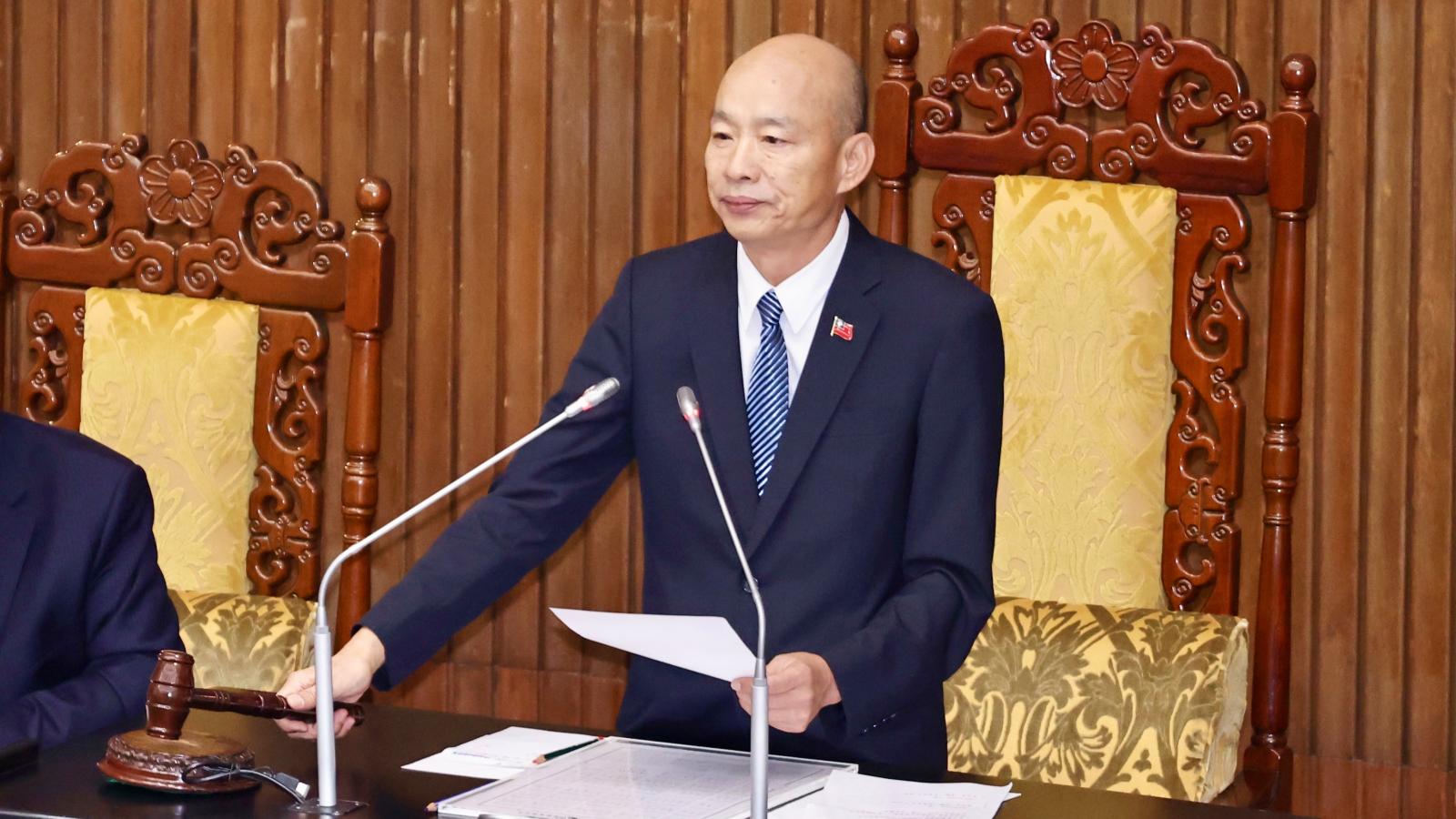
Taiwan's Legislative Yuan convened its final session of the current term today (27th). After nearly two hours of waiting in the chamber, lawmakers began processing revised motions on the unmanned vehicle bill proposed by the three major parties at around 1:00 PM. Following statements from party representatives, a voting marathon officially commenced at 1:30 PM and concluded with the bill's third reading at 4:08 PM. Notably, although opposition parties failed to reach full consensus, the final version passed according to the Kuomintang (KMT) caucus's revised motion—the largest bloc in the legislature—while incorporating elements from other parties' proposals.
Yesterday afternoon, Legislative Speaker Han Kuo-yu convened a cross-party negotiation on 13 draft versions of the unmanned vehicle bill submitted by the Executive Yuan, political parties, and individual legislators. However, no consensus was reached on key issues such as the overseeing authority, whether to use annual or special budgets, and spending caps. As a result, Han decided to advance today’s session. This morning, Han reconvened party leaders for agenda coordination. After nearly two hours of discussion, it was agreed that today’s session would focus solely on the unmanned vehicle bill, along with amendments to the Industrial Innovation Act and the Soil and Water Conservation Act. Opposition parties’ proposed revisions to the Referendum Act for a 'single ballot, multiple proposals' system were postponed to the next session.
Around 1:00 PM, after procedural staff consolidated the revised motions from the three party caucuses and other negotiation reports, the session resumed. The presiding officer briefly shifted from Han Kuo-yu to Vice Speaker Chiang Chi-chen. Following broad discussions by representatives—Democratic Progressive Party (DPP) caucus director Chang Jui-hsiung, KMT deputy caucus secretary Hsu Chiao-hsin, and Taiwan People's Party (TPP) Economic Committee convener Hung Yu-hsiang—the voting marathon began. Han, Chiang, and DPP legislator Yang Yao from Penghu abstained from voting.
During voting, although the KMT and TPP versions were nearly identical, differences emerged on Article 2 (overseeing authority), Article 4 (spending cap), and Article 24 (effective date). Notably, during the vote on the TPP’s Article 2, while KMT leadership refrained from voting, rank-and-file KMT legislators appeared unaware of the differences and initially voted in favor. Only after KMT caucus leader Fu Kun-chi ordered a reversal did members attempt to retract their votes, but 23 KMT legislators hesitated, resulting in 31 votes in favor and 50 opposed.
Did the KMT heed Defense Minister Koo Ji-feng’s advice? The final KMT version integrated drafts from the DPP, KMT, and TPP. During yesterday’s caucus negotiation, Defense Minister Koo cited the KMT’s draft to express the Ministry of National Defense’s desire to amend three provisions: shifting oversight of defense-related procurement from the Ministry of Economic Affairs (MOEA) to the Ministry of National Defense (MND); adjusting the annual budget cap—KMT proposed NT$40 billion per year, but next year’s military drone budget alone is already NT$31.1 billion, indicating the cap is insufficient.
The KMT’s revised motion today appears to have incorporated Koo’s recommendations. Adjustments were made to the overseeing authority and spending cap. Moreover, the bill’s title was changed to the TPP’s version: 'Strengthening National Defense Autonomy and Unmanned Vehicle Industry Development Act.' Provisions from KMT legislator Lai Shih-pao’s draft, the TPP’s proposal, and even parts of DPP legislator Wang Ting-yu’s draft were included.
The final bill mandates a six-year, NT$240 billion government budget (NT$40 billion annually) through the annual budget process, with flexibility to increase funding if needed. The MOEA is the primary authority, but defense-related procurement, R&D subsidies, critical technology imports, cybersecurity reviews, and test zone designations will be jointly managed by the MOEA and MND.
A 'National Unmanned Vehicle Industry Development Strategy Special Committee' will be established, chaired by the Vice Premier, with 15–19 members including heads of MOEA, MND, MOTC, NCC, Public Construction Commission, and Digital Development Ministry, plus experts nominated by legislative caucuses (fewer than half the total).
The bill mandates a 'distributed resilience' principle for unmanned defense systems, avoiding centralized deployment. Public agencies using unmanned vehicles must ensure peacetime-to-war conversion capabilities and comply with procurement guidelines that explicitly ban participation by firms from China, Hong Kong, and Macau, and prohibit teams with personnel from these regions. The goal is to achieve a 'fully trusted supply chain' (non-red supply chain) by 2027.
For any single unmanned vehicle procurement exceeding NT$1 billion, the MND or relevant agency must submit a written report to the legislature within 30 days of contract award. For defense procurement, the MND must prioritize domestically manufactured, low-cost, high-performance unmanned vehicles, especially attack and surveillance types suited for amphibious landing phases—specifically, coastal surveillance drones, coastal attack drones, and small suicide drones, as designated by the Executive Yuan.
The bill includes penalties: recipients using unverified, high-risk, or China-linked components, software, or services will have incentives revoked, funds reclaimed, and face fines of 1–3 times the amount received. Submitting false documents incurs fines of NT$1–5 million; obstructing inspections results in NT$500,000–3 million fines, with repeat offenses subject to continuous penalties.
The overseeing authority must, within one year of enactment, propose the first-phase unmanned vehicle development blueprint and plans for integrating unmanned systems into airspace, waters, and land management, including test zones and corridors. A trusted supply chain certification system must be established within six months. Except for Article 4 (budget), which takes effect immediately upon promulgation, the rest of the bill, including implementation rules, will take effect six months after promulgation.
FACT BOX
- Source: PR Times
- Category: News