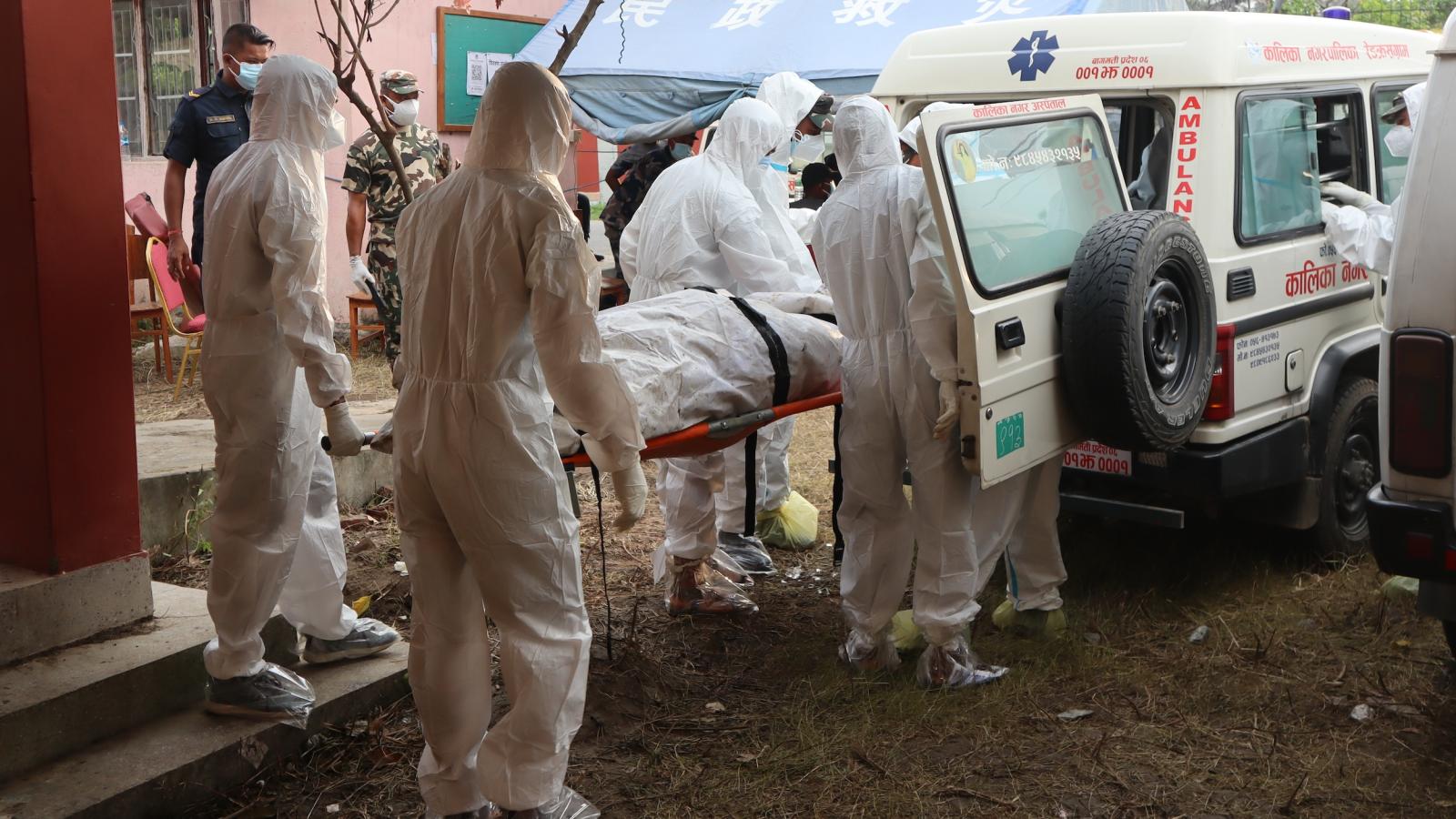
A devastating flash flood triggered by a glacial collapse on the Nepal-China border has resulted in over 800 deaths and more than 3,000 people missing. The raging floodwaters carried victims from the disaster zone all the way to plains nearly 200 kilometers away, and with bodies soaked in water for several days, decomposition accelerated rapidly. As a result, the Nepalese government has urgently excavated hundreds of burial pits in Devghat Forest, Chitwan, to conduct large-scale earth burials for unidentified victims.
The flash flood erupted last Wednesday in the Rasuwa Valley in northern Nepal, severely damaging the Himalayan mountain region. According to Reuters, the forest trail in Devghat, once a popular morning walking spot for locals, has now become a temporary burial ground for severely decomposed bodies due to public health concerns. Ganesh Aryal, Chief District Officer of Chitwan, said: "We had no choice but to take this measure. The rapid decomposition of bodies poses a significant risk to public health. That is our greatest concern."
Bharatpur Hospital in the region is overwhelmed with too many bodies; the stench of decay is already strong at the hospital's entrance, 200 meters from the temporary morgue. The hospital morgue, originally designed to hold 50 bodies, now has about 125 bodies laid on the floor. After days of immersion in floodwaters, most bodies are severely decomposed. Approximately 50 police officers and medical staff on-site are mostly wearing standard surgical masks while working.
An old bungalow next to the expo center has been converted into a temporary morgue, with body bags stacked on double-tiered beds. To slow decomposition caused by high temperatures, dry ice is piled at the entrance, and air conditioning and industrial cooling units run 24 hours a day. Outside, Red Cross and police service booths are set up, and incense is lit in an attempt to suppress the odor, though with limited effect.
"Bodies are decomposing extremely fast," said Police Officer Anil Thapa, who oversees the morgue operations. "More than half of the recovered bodies are unrecognizable; many have lost facial features entirely." Facing the brutal conditions, Thapa's uniform is soaked with sweat: "As soon as I come in to work here, I can't even imagine food. Forget eating—I can't even drink water."
On August 30, 2026, Nepalese authorities buried 96 unidentified bodies in the forest, and over 100 more victims were buried on Sunday (30th). Search teams continue to recover bodies from riverbeds and debris piles, with about 100 rescuers, officers, and officials on-site busy documenting the deceased, photographing remains, assisting families with identification, and preparing burial operations.
Reuters reports that to ensure future identification of buried victims, Nepalese authorities have established a detailed burial record system: each grave is marked with a number both above and below ground, with precise GPS coordinates recorded. DNA samples are collected from unidentified victims before burial. If families later confirm identities through official reports or genetic matching, graves can be precisely exhumed. India has already dispatched a forensic team to assist with DNA analysis, and the Nepalese government is currently coordinating cooperation with Chinese teams.
The Chitwan Expo Centre, located hundreds of meters from the hospital, has become a central gathering point for families of the missing. Over 200 family members have gathered from across the country, many waiting outside the hall with backpacks, hoping for the release of identification photos. Some families arrived the previous day but have yet to be allowed inside. Reuters notes that despite the morgue being full, bodies continued to arrive during reporting, highlighting the scale of the disaster and the immense pressure on personnel handling the deceased.
FACT BOX
- Source: PR Times
- Category: News