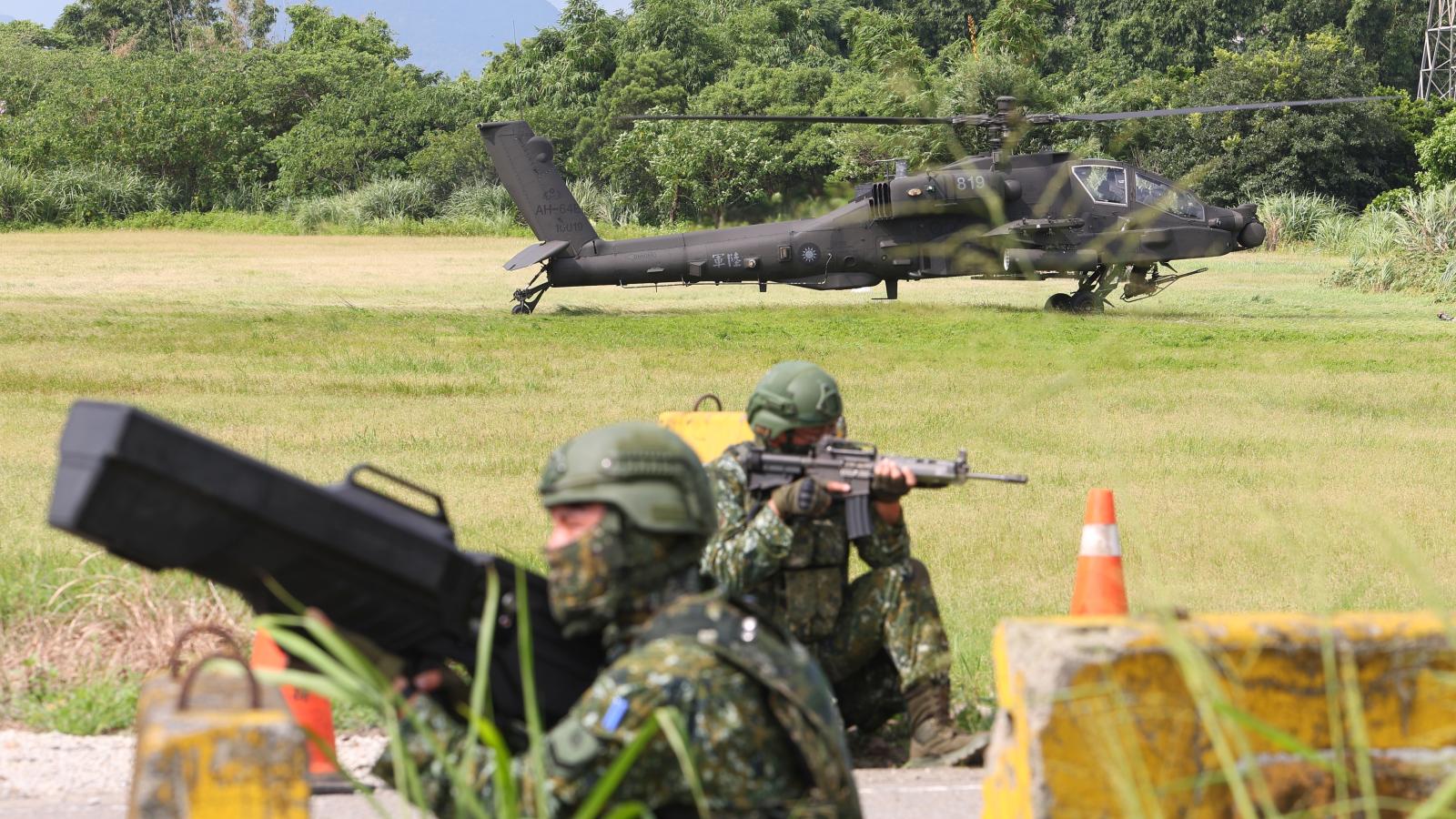
On the 31st, Taiwan's Ministry of National Defense submitted the 2027 budget, the five-year force development and policy implementation report, and the report on China's military power to the Legislative Yuan. The Ministry stated that it will continue to strengthen the joint command, control, communications, computers, intelligence, surveillance, and reconnaissance (C5ISR) system and AI-assisted decision support systems. These will be integrated with various long-range precision weapons and asymmetric warfare equipment to construct a high-tech kill chain, fully implementing the goal of 'multi-domain denial and layered weakening.'
44 Procurement Priorities Listed! Indigenous 'Qianggong' Missiles and Submarine Rescue Ship Included
Regarding the five-year force development priorities, the Ministry of National Defense outlined two main points. First, indigenous procurement. The Ministry listed 29 key items, stating that it will procure new wheeled combat vehicles and wheeled tanks. These vehicles, with high mobility, firepower, and armor protection, will assist combat units in delaying and weakening enemy forces to ensure mission success.
The Ministry also mentioned the construction of a submarine rescue ship to establish a complete submarine rescue capability, ensuring self-rescue capacity and enhancing peacetime underwater battlefield environmental management. Additionally, a next-generation oil and ammunition replenishment ship will be constructed to meet the fleet's needs for mobile deployment and replenishment at sea, ensuring maritime traffic lines and sustained combat effectiveness. The construction of follow-on fast minelayer vessels will be expanded to weaken enemy amphibious threats and create favorable conditions for defensive operations. The procurement of new and upgraded combat vessels will enhance air defense and anti-submarine capabilities to meet maritime operational requirements.
Furthermore, the Ministry stated it will acquire the 'Qianggong' mid-tier anti-tactical ballistic missile and other air defense missiles to build a 'Shield of Taiwan'—a layered, efficient air defense network—to protect critical infrastructure, military targets, and civilian safety.
Second, military procurement from the U.S. The Ministry listed 15 key items. It stated that it will procure the M109A7 precision artillery to provide real-time fire support to all combat units. It will acquire various mobile early-warning radars for flexible deployment to obtain real-time frontline intelligence, ensuring full-spectrum intelligence awareness throughout operations. It will procure new weapons-loading vehicles to replace outdated equipment, supporting rapid armament of various aircraft and enhancing overall combat effectiveness. It will acquire soft-kill and hard-kill counter-drone systems to complement air defense systems, building the 'Shield of Taiwan' to effectively counter threats from enemy tactical ballistic missiles, cruise missiles, fighter jets, and drones. It will procure U.S.-Taiwan co-developed and jointly produced equipment to acquire emerging technologies and strengthen operational resilience and asymmetric capabilities.
Force Structure Transformation! Establishment of Army Unmanned Systems Command and Navy Coastal Operations Command
Regarding the five-year force structure adjustment, the Ministry of National Defense stated that, considering regional security conditions, responding to enemy threats, and anticipating future combat forms, through defense resource allocation, weapons procurement timelines, and adjustments to the conscription system, it has successively completed the establishment of the Army Unmanned Systems Training Command, Navy Coastal Operations Command, Marine Corps Drone Company, Firepower Company, and Air Force MQ-9B drone unit. These adjustments aim to build modern, professional, high-quality forces and maximize the effectiveness of military organizational structures.
The Ministry emphasized continuously enhancing overall combat effectiveness, strengthening asymmetric capabilities and defensive resilience, refining the organizational structure, establishment planning, equipment allocation, and training methods of main combat, defensive, and reserve forces. Guided by the principle of 'technology replacing manpower, firepower replacing traditional forces,' and integrating emerging technologies such as unmanned systems and AI-assisted decision-making, the goal is to reduce manpower burden.
For main combat forces, in line with the phased acquisition of new equipment, the Ministry will simultaneously review the retirement of outdated equipment that no longer meets future battlefield needs and adjust unit composition and personnel. For defensive and reserve forces, based on actual operational scenarios in each combat zone, reserve mobilization management, combat capability restoration constraints, and operational requirements, the Ministry will review equipment allocation and adjust organizational structures to enhance unit mobility and strike capability, building a ready defensive combat force.
Regarding future planning, in terms of military investment, the Ministry stated that to counter China's gray-zone provocations and hybrid threats from joint military operations, the military will continue to introduce innovative technologies. Through multiple channels—including indigenous development, off-the-shelf procurement, and U.S. military purchases—it will acquire key combat capability equipment. In addition to tracking enemy movements through existing land-based and airborne surveillance and reconnaissance systems, the military will continue to strengthen the joint C5ISR and AI-assisted decision support systems. Combined with various long-range precision weapons and asymmetric warfare equipment, it will build a high-tech kill chain to fully implement the goal of 'multi-domain denial and layered weakening.' This will effectively deny, delay, and disrupt the PLA's transit and landing operations at every stage, forcing them to pay a high cost and consume significant time, thereby forming a deterrent capability.
FACT BOX
- Source: PR Times
- Category: News