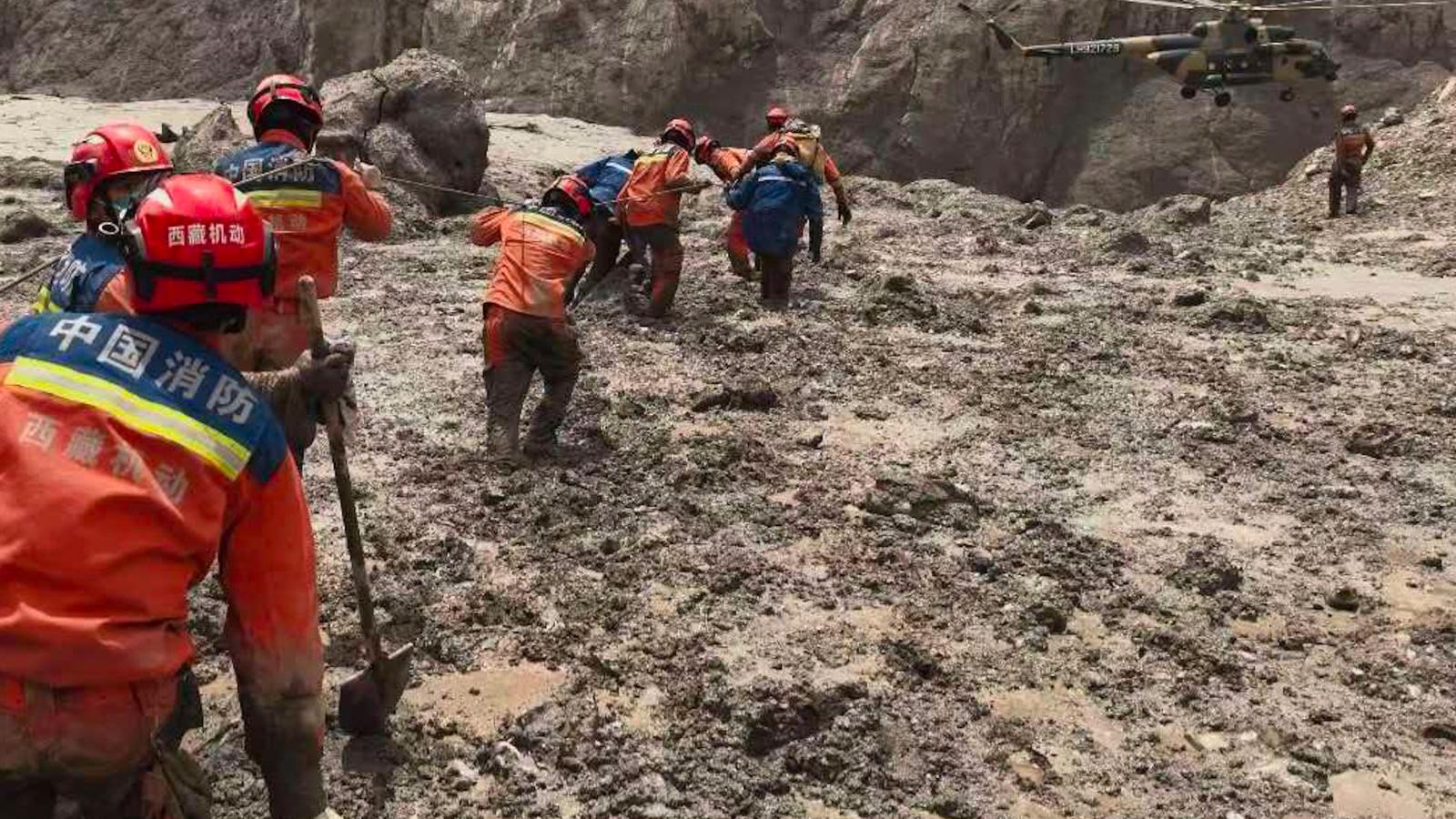
The Political Bureau of the Chinese Communist Party convened a meeting on August 28 to specifically study and deploy emergency rescue operations for the landslide disaster in Gyirong County, Shigatse City, Tibet Autonomous Region. Party leader Xi Jinping personally presided over the meeting, which began with all participants standing in silence to mourn the deceased. The level and formality of this meeting are exceptionally rare in China’s recent records of natural disaster response—typically, major disasters are coordinated at the State Council or specialized department level, making direct Politburo involvement uncommon.
On the morning of August 26, 2026, a massive landslide occurred on the Nepalese side, affecting the China-Nepal border area near Gyirong Port in Tibet. Official Chinese reports indicate significant casualties and missing persons at Gyirong Port. As of August 27, the number of missing persons reported by China reached 558, including a large number of foreign nationals.
Gyirong Port is a crucial passage on the China-Nepal border and a key node for Tibet’s external transportation, trade, and personnel exchanges. Consequently, the disaster involves domestic rescue operations, search efforts for foreign nationals, cross-border coordination with Nepal, and risks of secondary disasters in high-altitude regions.
The Politburo’s directives differ significantly from typical disaster response orders. The meeting emphasized the challenges of high-altitude, cold environments, steep valleys, and volatile weather, along with the presence of numerous glaciers, glacial lakes, and geological hazards in surrounding areas. It called for 'scientifically formulating search and rescue plans and making every effort to locate missing persons from both China and abroad.' It also stressed enhanced monitoring and early warnings, close attention to landslide-dammed lakes and mountain stability, and strict prevention of secondary disasters. The meeting further required proper安置 of affected residents and emergency aid to Nepal’s disaster zones, promoting international rescue cooperation.
Tibet is a highly sensitive border and ethnic region for the Chinese Communist Party. Any large-scale casualties or disappearances—especially involving foreigners—can be magnified into a test of governance capacity and social stability. In recent years, Western countries, human rights organizations, and exiled Tibetan communities have continuously monitored religious freedom, cultural preservation, and border control in Tibet. Any mishandling of the disaster could become a point of external criticism.
The Politburo’s specific emphasis on 'searching for missing persons from home and abroad' and 'providing emergency aid to Nepal' clearly goes beyond rescue efficiency, touching on cross-border image management and neighbor relations stability.
The meeting concluded by stressing the 'coordination of development and security,' 'adherence to extreme thinking and bottom-line thinking,' and 'enhancing the political sense of responsibility of never being at ease.' While such language is common in high-level CCP documents, its appearance in a Politburo meeting focused on a single port’s landslide indicates that Beijing views this disaster as a comprehensive event potentially affecting 'security and stability,' not merely a natural disaster.
'Tibet stability' and 'border security' are, in fact, part of the same governance logic. On January 7 of the previous year, a 6.8-magnitude earthquake struck Dingri County, Shigatse City, Tibet, causing significant casualties. Two days later, on January 9, the Standing Committee of the CCP Politburo held a special meeting to study and deploy earthquake relief efforts in Dingri. That meeting not only demanded continued rescue, medical treatment, resettlement, and post-disaster reconstruction but also specifically required 'maintaining social stability,' 'timely identification and resolution of conflicts,' and 'authoritative information release.' It also called for improving seismic resistance of buildings and infrastructure in key areas and enhancing earthquake disaster response capabilities.
Beijing’s approach to the Dingri earthquake was never just about 'disaster relief.' It simultaneously required social stability management, information control, and post-disaster governance. In this Gyirong landslide, Beijing has again integrated early warning systems, remote-area rescue capacity, border disaster management, and cross-border cooperation into central-level deployment.
Tibet, located on the Qinghai-Tibet Plateau, has a high average elevation, complex terrain, and sparse population, with transportation and infrastructure in some areas far inferior to eastern China. As of the morning of August 27, 260 of the 558 missing persons officially reported by China were foreign nationals. Any delay in rescue, information gaps, or further casualties could quickly turn into diplomatic and international public opinion pressure.
From early warning systems to military-civilian rescue operations, from port infrastructure to glacier and glacial lake monitoring, from local emergency capacity to China-Nepal cross-border cooperation—these are all likely to become new focal points in Beijing’s governance of Tibet in the coming phase.
FACT BOX
- Source: PR Times
- Category: News