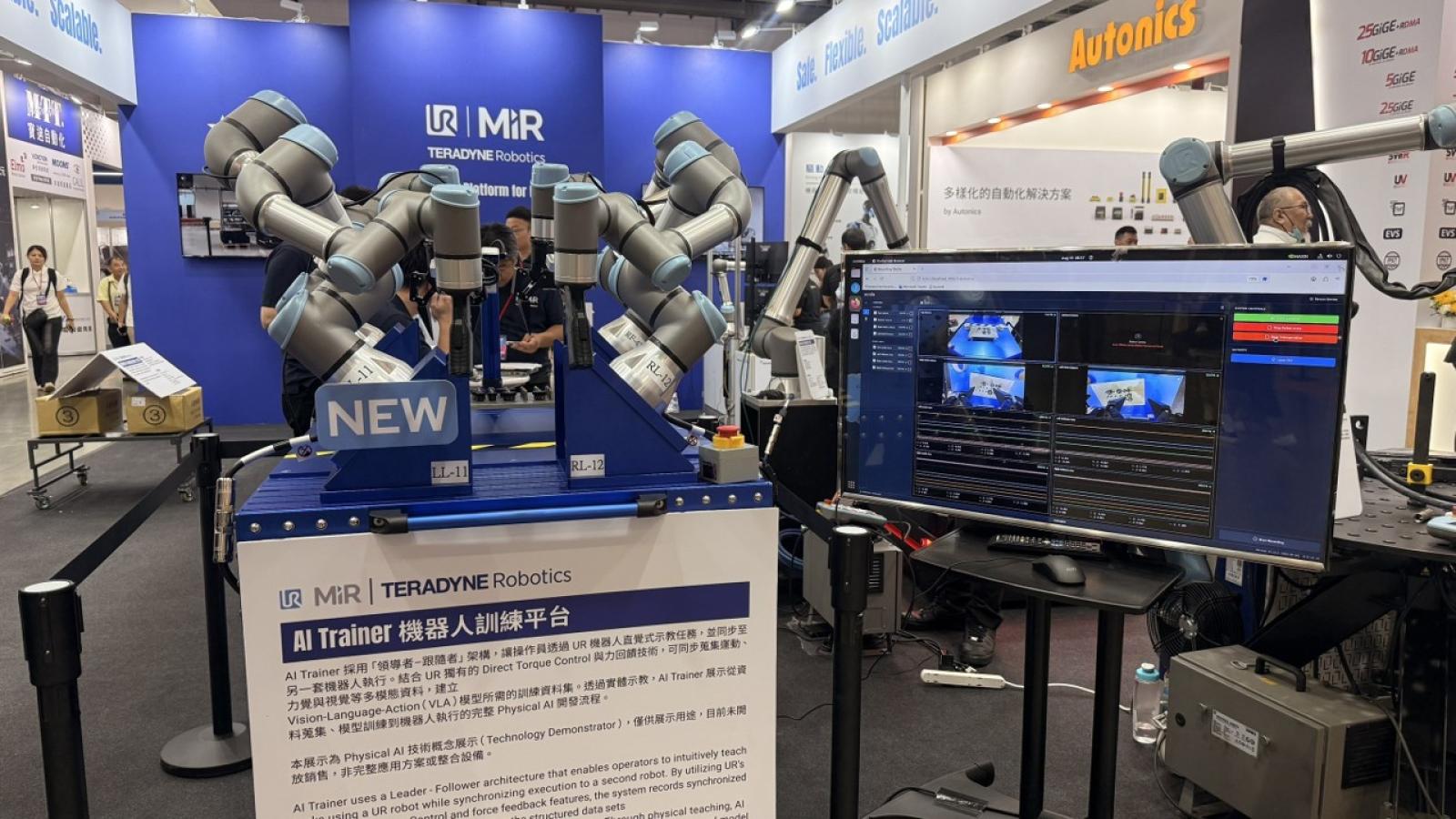
With the rapid advancement of AI technology, the manufacturing industry is transitioning from traditional automation to the era of Physical AI (embodied AI), which possesses sensing, judgment, and adaptive capabilities. Universal Robots (UR; Universal Robots) and Mobile Industrial Robots (MiR), under the global leader in advanced robotics solutions Teradyne Robotics, will showcase multiple innovative smart manufacturing applications at the 2026 Taipei International Industrial Automation Show under the theme of Physical AI. Among them, the AI Trainer and Dual Arm on AMR make their debut in Taiwan, alongside smart logistics and smart welding applications, demonstrating how AI moves from the lab to the factory floor, helping enterprises build more flexible and intelligent human-robot collaboration models.
Physical AI brings new flexibility to manufacturing. Facing challenges such as small-batch, high-mix production, frequent line changes, and labor shortages, traditional automation systems often rely on fixed programs and established processes. Any change in product specifications or production line configuration requires significant time for adjustment and reconfiguration. The development of Physical AI enables robots to integrate sensing, judgment, and execution capabilities, allowing them to understand environmental changes and adjust actions in real time—no longer merely repeating predefined instructions. This is precisely why Teradyne Robotics has chosen Physical AI as the theme for this year’s exhibition, showcasing the trend of smart manufacturing evolving from fixed automation to autonomy.
“The competitiveness of future manufacturing will depend not only on the degree of automation but also on whether equipment can quickly adapt to change. Physical AI is transforming robots from fixed executors into intelligent work partners capable of learning, judging, and coordinating,” said Seth Meng, President of Greater China and South Korea at Teradyne Robotics.
At this exhibition, UR and MiR are showcasing multiple innovative applications that demonstrate how Physical AI can be implemented in actual manufacturing processes. Among them, the AI Trainer, making its first appearance in Taiwan, uses imitation learning to create training data through human demonstrations. This allows robots to collect motion, force, and visual data, accelerating the development and training of Physical AI models, helping enterprises shorten the time from R&D to deployment and lower the barrier to AI application development.
Another highlight is the debut of the Dual Arm on AMR (dual-arm mobile collaborative platform), integrating UR’s dual-arm collaborative robot with MiR’s Autonomous Mobile Robot (AMR). It can autonomously move between different workstations to perform assembly, loading, and unloading tasks. Compared to traditional fixed workstations, this solution offers greater flexibility in responding to production line changes and multi-station demands, helping enterprises reduce changeover costs and reliance on manpower—especially suitable for electronics manufacturing, semiconductor equipment assembly, and small-batch, high-mix production environments.
In the smart welding demonstration area, fixed and mobile welding applications simulate scenarios such as semiconductor equipment enclosures, server heat exchangers, and large metal structures, showcasing how collaborative robots enhance welding quality, consistency, and operational efficiency.
For smart logistics applications, the MiR250 equipped with a rack-handling solution autonomously performs in-factory material delivery and rack transportation, reducing the need for manual handling, improving logistics efficiency and operational safety, and helping enterprises optimize internal logistics processes.
Additionally, UR is collaborating with Inventec and LeapX this year to showcase a Physical AI-based human-robot collaboration safety solution. By integrating edge AI computing, 3D vision, and collaborative robots, the system enables real-time environmental perception and visual analysis, allowing robots to adjust their behavior based on surrounding personnel and environmental changes—enhancing collaboration safety while maintaining production efficiency.
From Automation to Autonomy: Building the Next-Generation Smart Factory
For enterprises, Physical AI addresses not just immediate capacity issues but also structural challenges in the era of small-batch, high-mix, and high-frequency line changes. As product cycles continue to shorten and customization demands rapidly increase, fixed-line automation models can no longer meet market fluctuations. Physical AI equips production lines with self-adjusting capabilities, enabling enterprises to quickly reconfigure in response to market changes. The vision of the next-generation smart factory will evolve from single-device automation to an integrated manufacturing system capable of autonomous perception, autonomous decision-making, and autonomous collaboration.
“We aim to help enterprises build more flexible, intelligent, and competitive manufacturing models through the integration of collaborative robots, AMRs, and Physical AI technology. This will be a key enabler for smart manufacturing to advance to its next stage,” said Seth Meng, President of Greater China and South Korea at Teradyne Robotics, sharing the strategic significance of Physical AI for Taiwan’s manufacturing industry at the exhibition.
FACT BOX
- Source: PR Times
- Category: Event
- Dates in source: 2026
- Products / services: AI Trainer / Dual Arm on AMR