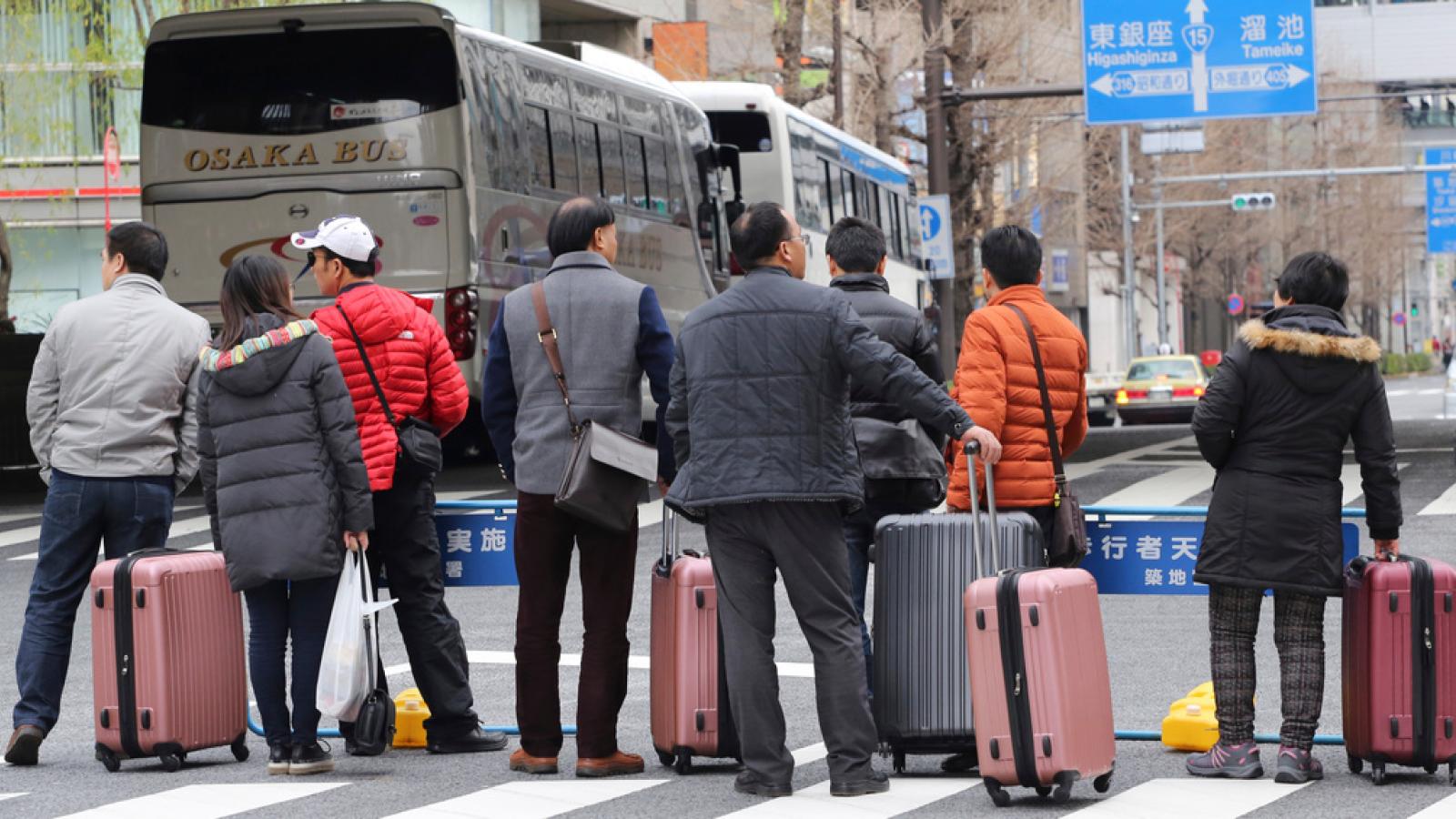
Japanese Prime Minister Sanae Takagi's statement at the end of last year that 'Taiwan is an issue' triggered a strong diplomatic backlash from the Chinese government, which urged Chinese citizens to 'exercise self-restraint' in traveling to Japan. However, in March 2026—about six months later—Japanese media pointed out that Japan's overall number of tourists had not decreased but actually increased. The latest reports show that foreign visitors to Japan in July 2026 reached a record high, and the impact of the sharp decline in Chinese tourists on Japan's tourism industry has been 'almost negligible.' Instead, China's new outbound regulations are 'equivalent to self-destruction.'
The Japanese media outlet 'Diamond online' reported on China's recent announcement of the 'State Council Regulations on Exit and Entry Management.' Under these rules, individuals working in advanced industries may be banned from leaving the country if authorities deem them problematic. This restriction applies not only to Communist Party members and public officials but also extends to employees of private enterprises.
In fact, since 2024, Chinese citizens working in public institutions—such as teachers, civil servants, and bank employees—or state-owned enterprises have been required by their employers to submit their passports. The number of people unable to travel overseas freely has been increasing. In the second quarter of 2026, the number of Chinese traveling overseas was about 3% lower than originally expected, totaling approximately 179 million people. As outbound controls tighten further, this number is likely to decline even more.
Chinese media frequently assert that 'without Chinese tourists, Japan's economy cannot survive.' For example, one report claimed that 'Japan's balance of payments in May 2026 turned into a deficit of 10.3 billion yen in service income due to a sharp drop in inbound tourists.' However, foreign tourist spending in Japan from January to March 2026 reached 2.3378 trillion yen, a 2.5% increase year-on-year. From April to June, it reached 2.5096 trillion yen, up 0.2% from the previous year.
The report frankly states that even though spending by Chinese tourists has decreased, the overall spending has grown due to increased consumption by tourists from other countries.
Additionally, the cumulative number of foreign visitors to Japan from January to July 2026 was 24.5272 million, a 1.7% decrease year-on-year. This decline is not only due to fewer Chinese tourists but may also be influenced by worsening tensions in Iran and reduced flight availability. In fact, the number of visitors in July 2026 alone increased by 0.1% compared to the same month last year, setting a new record for July and indicating a steady recovery trend overall.
After confirming these facts, the report states that 'China's media claims are not only contradictory but can even be considered wrong.' Tourism spending in Japan has not declined, and 'a decrease in Chinese tourists' does not equate to 'a blow to Japan's overall inbound tourism market.'
On the contrary, the report analyzes that China itself is also suffering a certain degree of economic loss due to the self-restraint on travel to Japan. Although there are no official statistics, rough estimates suggest that Chinese travelers often use Chinese travel agencies—including online travel agencies (OTAs)—to book trips and hotels in Japan.
Assuming an average hotel stay of 6.8 nights at 20,000 yen per night, with a 1% commission paid to Chinese travel agencies, and considering that the number of Chinese visitors to Japan in Q2 2026 decreased by 971,000 (a 52.5% year-on-year drop), the estimated loss for Chinese travel agencies is about 1.32 billion yen. If this trend continues for a full year, the economic loss could reach approximately 5.28 billion yen.
In terms of flight operations, Chinese airlines hold a high market share on China-Japan routes. However, due to the national-level travel self-restraint, airlines have reduced flight supply. The number of flights operated by Chinese airlines to Japan dropped from 9,813 in early November last year to 7,432 in December—a 24.3% decrease. The number of available seats fell from 1.85 million to 1.42 million, a 23.2% reduction. Assuming an average ticket price of 50,000 yen per seat and an 80% load factor, the potential monthly loss in passenger revenue could reach up to 17.2 billion yen. If this situation persists for a year, the economic loss could amount to about 2.06 trillion yen.
Moreover, transaction fees generated when Chinese tourists pay via UnionPay or Alipay in Japan also represent income for China, and this revenue is now disappearing. Additionally, businesses run by Chinese residents in Japan—such as restaurants and illegal taxis catering to fellow Chinese—and funds remitted back to China are also likely decreasing.
Therefore, the report concludes that China, which initiated the 'self-restraint on travel to Japan,' is likely suffering a significant degree of economic loss.
Okinawa, a popular destination for Chinese tourists, was predicted to see a drop of about 200,000 mainland Chinese visitors and a reduction of about 9.2 billion yen in tourism spending after the self-restraint began. However, on-site visits to Naha's International Street and Makishi Public Market reveal that while many souvenir shops display Chinese signage, a closer look shows they use 'Traditional Chinese characters'—used in Taiwan and Hong Kong—rather than the 'Simplified Chinese characters' used in mainland China.
When asked, shop staff said, 'Visitors from mainland China have indeed decreased, but we've always had many customers from Taiwan and Hong Kong, and their numbers have recently increased further.' Store revenues have not declined and are instead maintaining strong performance.
Okinawa diving operators also reported, 'Foreign bookings have actually increased. Chinese divers usually prefer Chinese instructors, but now European, American, and Korean divers are booking with Japanese instructors like me who live in Okinawa.'
In terms of nationalities visiting Okinawa, the largest group is from Taiwan, followed by South Korea. With increasing visitors from Thailand, Singapore, and other countries, Okinawa's tourism revenue surpassed 1 trillion yen for the first time in 2025. Thanks to the rise in visitors from South Korea, Taiwan, Europe, the U.S., and other regions, the decline in Chinese tourists has already been offset.
The report concludes that China will further strengthen outbound restrictions starting September 15, making it even more difficult for Chinese citizens to travel to Japan and likely expanding economic losses. China's 'self-harm' situation is expected to continue for some time.
FACT BOX
- Source: PR Times
- Category: News
- Organizations: Diamond online