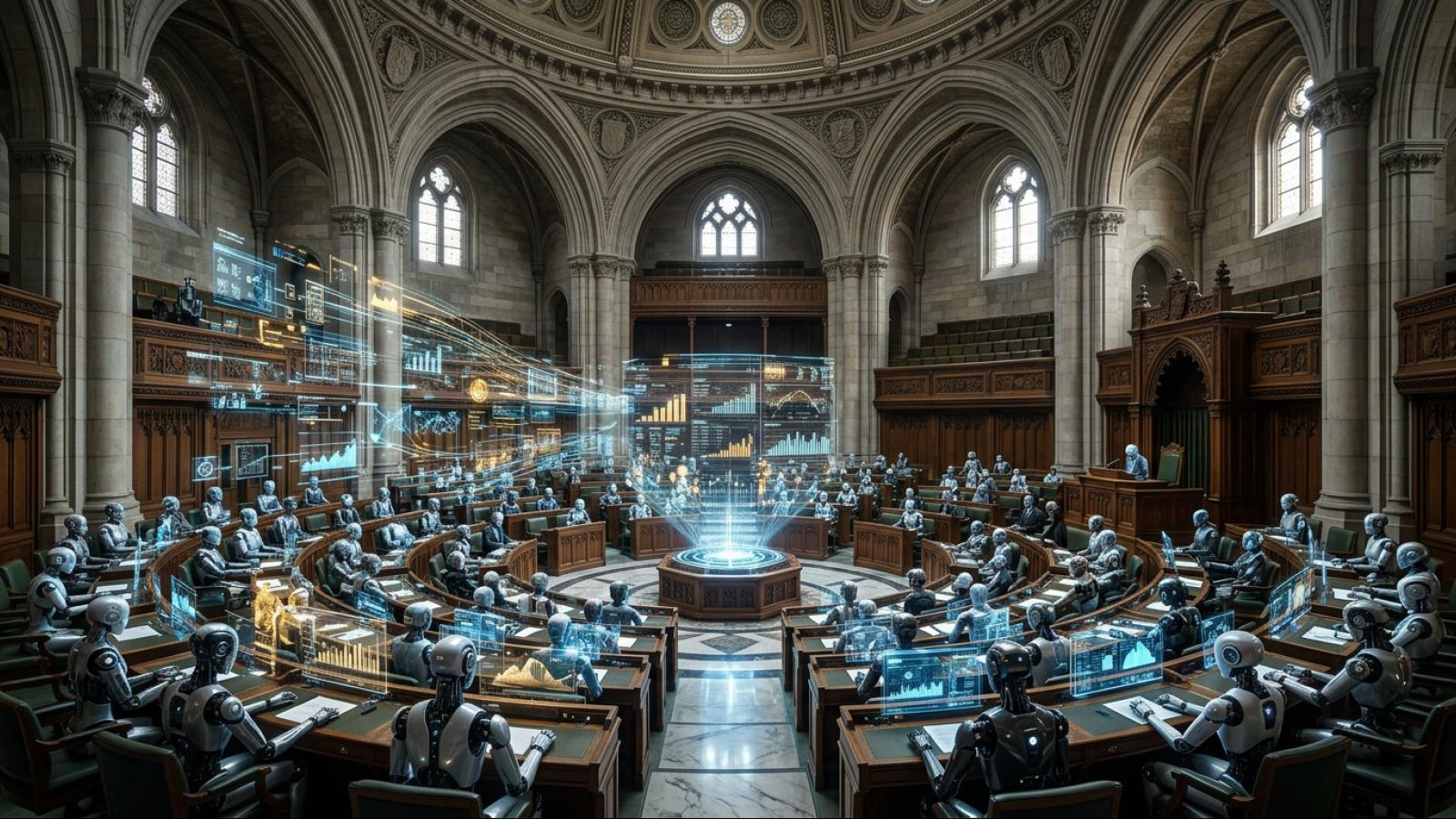
In parliamentary democracies, tens of millions of people vote every few years to elect a few hundred representatives, who then decide the nation’s laws, taxation, war, and peace for the coming years. We’ve grown accustomed to this and regard it as natural. But this system is built upon a very real constraint: it’s impossible to ask everyone about every single matter. Thus, various compromises arise.
When modern representative democracy was established, there was no internet, no real-time polling, and certainly no artificial intelligence. A government could not possibly know the opinion of an ordinary voter on agricultural subsidies, defense budgets, or foreign policy. Therefore, we needed 'representatives': we elect someone to parliament, hoping they roughly understand what we want, so they can make decisions on our behalf.
But AI may permanently alter this foundational assumption.
Imagine ten years from now, when every citizen has a personal AI that has lived with them over time. It knows your income, where you live, whether you have children; it knows you care about the environment but oppose higher gasoline prices; you support increased defense spending but don’t want healthcare cuts. You wouldn’t even need to fill out surveys—your AI could already infer your values from years of conversation. So when the government proposes a budget, instead of letting 650 British MPs 'represent' voters’ choices, why not let sixty million personal AIs analyze the proposal and exercise direct democracy? The result could be far more precise than any opinion poll. The government might even discover: 'If we raise income tax by 1% and allocate all funds to the NHS, 54% of citizens accept it; if raised to 2%, support drops to 39%.'
Politics would thus shift from once-every-five-years elections to a massive, ongoing deliberative survey accessible every day.
At this point, a very old question resurfaces: do we still need legislators?
Supporters of keeping representatives typically argue this: democracy has never been merely about summing up everyone’s preferences—otherwise, it becomes the 'tyranny of the majority.' If 51% of people wish to ban a certain religion, AI can accurately inform the government—but the democratic answer should not simply be to ban it. Minority rights, constitutional limits, and legal principles exist precisely to prevent majorities from acting arbitrarily, which is why we need 'representatives' to mediate and balance interests.
Moreover, human political opinions are inherently contradictory. We may simultaneously desire lower taxes, expanded welfare, stronger military, yet oppose increasing government deficits. One crucial function of parliament is not merely reflecting these desires, but forcing politicians into public debate, compromise, and prioritization—ultimately holding someone accountable for decisions.
In other words, the most dangerous aspect of AI might be making politics appear too scientific. If one day the government claims, 'According to the national citizen AI model, 67.3% support this policy,' this sounds more objective than 'passed by Congress.' But who designed the model? How does AI interpret my values? Do my statements from last year represent who I am today? If Amazon, Google, or the government itself controls this system, are we measuring public opinion—or manufacturing it?
Yet this trend is unstoppable. AI may not directly replace parliaments, but it will likely weaken lawmakers’ monopoly on claiming to represent public sentiment. In the future, when a legislator says, 'My constituents told me,' anyone could instantly pull up real-time opinions from hundreds of thousands of voters to verify the claim. Citizens might even authorize their AI to directly express views on certain issues, reserving complex matters for elected officials—creating a hybrid system between direct and representative democracy. At that point, democratic textbooks will need substantial rewriting, and many assumptions we now take for granted may quickly become obsolete.
*The author is an international relations scholar and currently serves as Associate Professor at the Institute of Taiwan-Hong Kong International Studies, National Sun Yat-sen University.
FACT BOX
- Source: PR Times
- Category: Survey