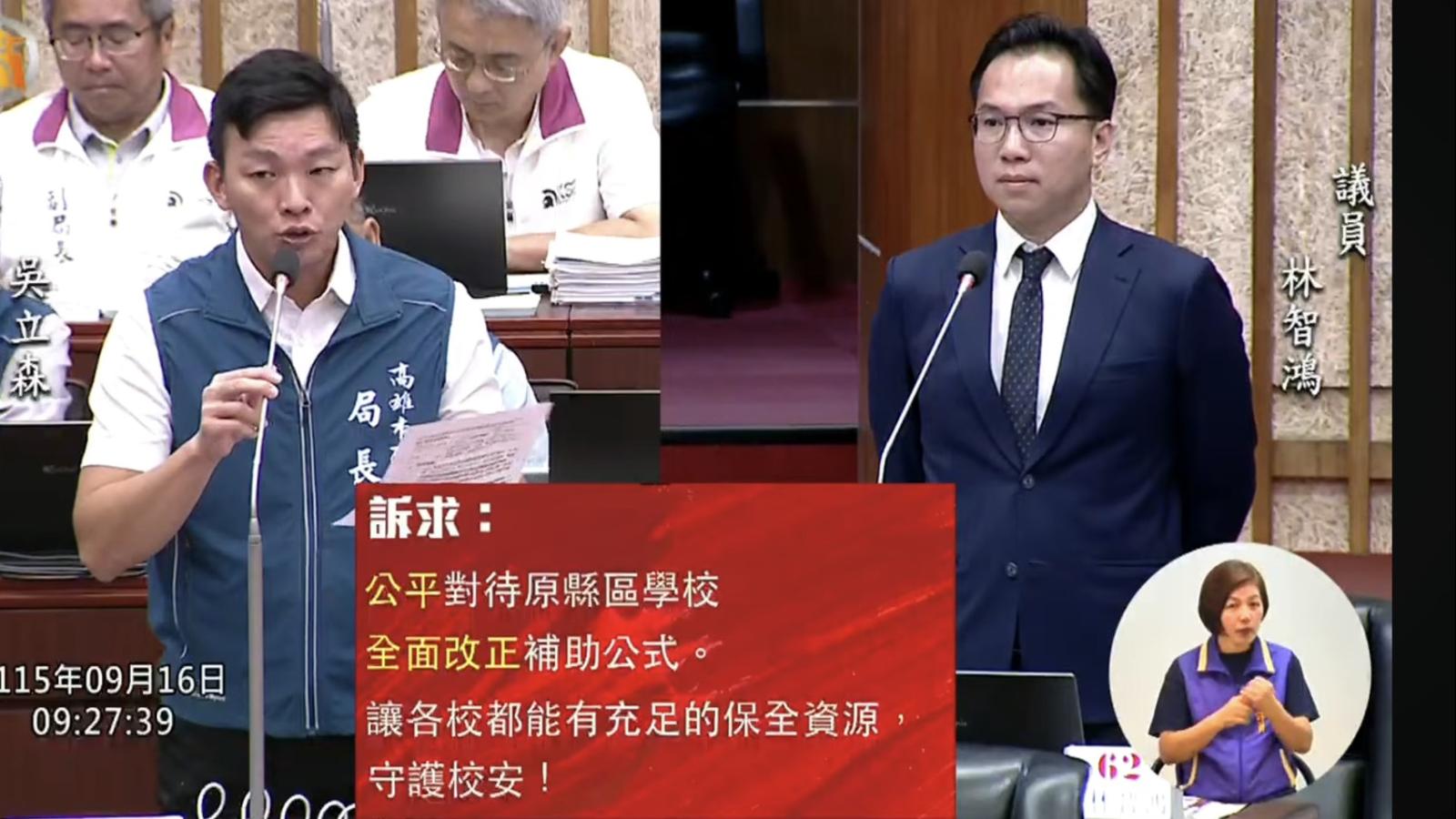
Kaohsiung City Councilor Lin Chi-hung pointed out on the 16th during the education department’s questioning session at the city council that campus safety should not vary based on historical administrative differences between former urban and rural districts. According to data from the Education Bureau, 99 schools in Kaohsiung receive security subsidies exceeding NT$1 million, of which 89 are located in former urban districts and only 10 in former rural districts. Schools in districts such as Sinsing, Zuoying, Cianjhen, and Siaogang receive over NT$1 million in subsidies, yet Fengshan District—where population continues to grow—has no school receiving more than NT$1 million, highlighting a clear gap in current campus security funding allocation.
The current subsidy system fails to adequately reflect student numbers, campus area, security staffing shortages, and actual management burdens. Lin stated that most schools in Fengshan receive security subsidies around NT$720,000, with Zhonglun Elementary receiving only NT$440,000 and Fucheng High School NT$540,000. In contrast, many schools in former urban districts receive over NT$1.07 million. The core issue lies in the current subsidy criteria, which are primarily based on whether schools have guard-technician staffing and whether those staff have retired, rather than on actual needs such as student population, campus size, security gaps, and management load.
He noted that schools in the former Kaohsiung County generally lacked the guard-technician staffing historically present in former urban schools, causing the current subsidy calculation to inadequately reflect their actual campus security needs. In other words, historical staffing differences have become a source of current resource disparities, placing former rural district schools at a systemic disadvantage.
Lin further illustrated this with examples: Lide Junior High in Zuoying District has 163 students and a campus area of 30,916 square meters, yet receives a security subsidy of NT$1.07 million. Daren Junior High in Lingya District has 251 students and 19,256 square meters, also receiving NT$1.07 million. Jiuruh Elementary in Gushan District has 416 students and 17,866 square meters, with the same NT$1.07 million subsidy.
In contrast, multiple schools in Fengshan District, despite having significantly larger student populations and campus sizes, receive only NT$720,000. Fengjia Junior High has 1,221 students and 40,301 square meters; Zhongxiao Elementary has 722 students and 42,398 square meters; and Xinjia Elementary has 1,997 students and 25,800 square meters—all receiving only NT$720,000 in security subsidies.
When calculating per-student security funding, the disparity becomes even more pronounced. Lide Junior High allocates about NT$6,586 per student, Daren about NT$4,277, and Jiuruh about NT$2,581. In contrast, Fengjia allocates only about NT$590 per student, Zhongxiao about NT$997, and Xinjia a mere NT$361.
Lin questioned how schools in the same city—with more students, larger campuses, and heavier security management burdens—receive fewer security resources. He emphasized that the current subsidy formula clearly needs re-examination. This is not merely a budget allocation issue, but one involving whether students in different regions can receive equitable campus safety protection.
Lin stressed that elementary and junior high school students have relatively limited self-defense capabilities, and unlike high schools where some military instructors transition into campus security roles, elementary and junior high schools have more direct needs for security personnel. He noted that Fengshan is a district experiencing continuous population growth and rising demand for school-age education, meaning schools face increasingly diverse safety needs related to student numbers, campus management, and access points. If the subsidy formula continues to rely solely on outdated guard-technician staffing criteria without adjusting to actual school needs, large schools in former rural districts will face long-term resource disparities, and parents will inevitably grow concerned about their children’s campus safety.
Lin called on the Education Bureau to comprehensively review and revise the security subsidy formula. In addition to existing criteria such as guard-technician staffing and retirement status, the formula should incorporate factors such as student numbers, campus area, number of gates and entrances, existing security or guard personnel, nighttime facility usage, shared community spaces, and historical staffing disparities between former urban and rural districts. He urged the establishment of a transparent, publicly accountable subsidy mechanism that can be dynamically adjusted based on actual school needs.
He emphasized, 'Campus safety should not differ between former urban and rural districts. Children’s safety must not be compromised due to historical institutional differences. The city government must acknowledge the disparities created by the current subsidy system and prioritize filling the security resource gaps in large schools in former rural districts. Campus security funding must truly become “even across regions,” so that parents in Fengshan can feel at ease and every child can attend school safely every day.'
FACT BOX
- Source: PR Times
- Category: News