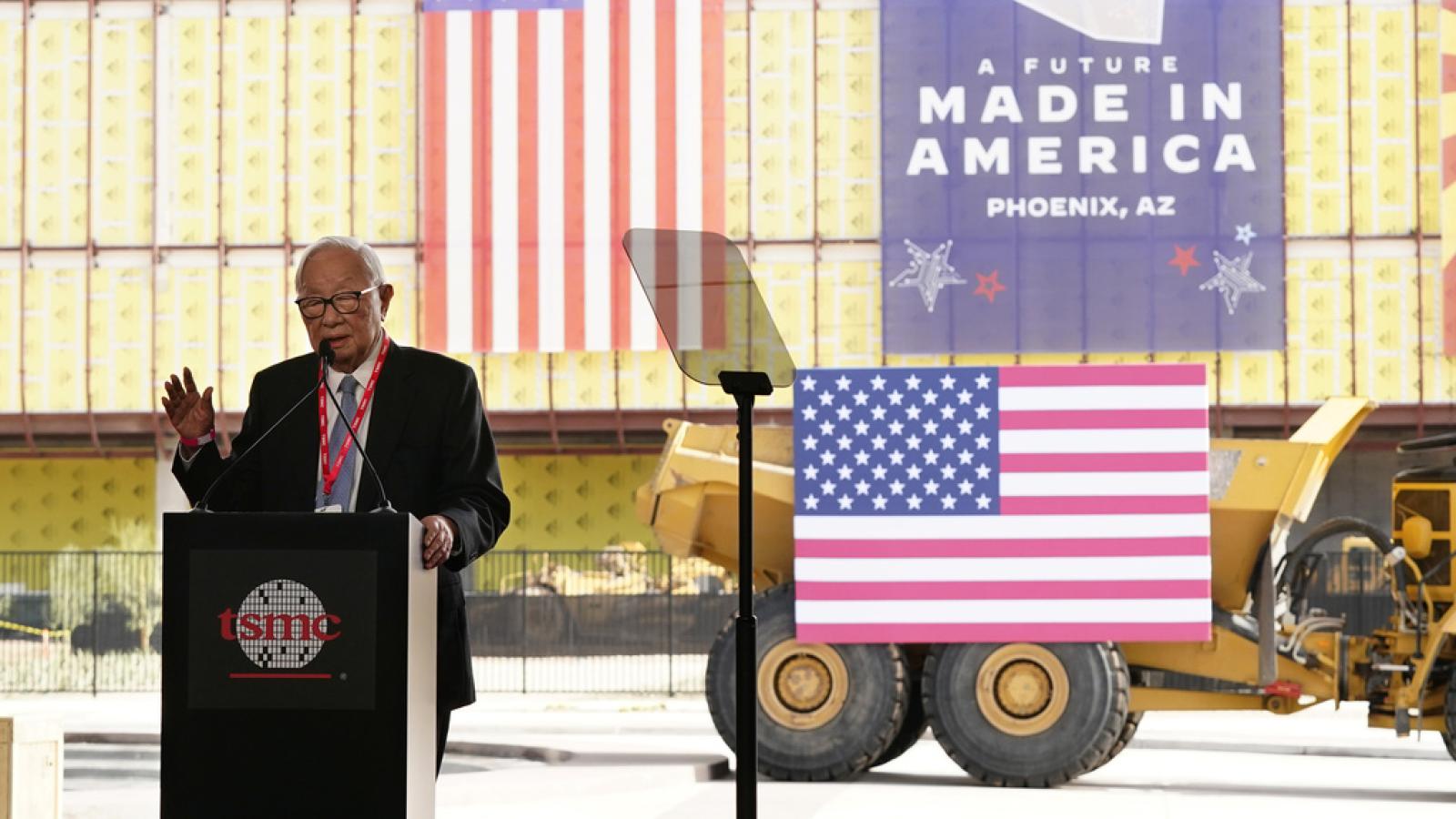
With Taiwanese investment in the United States reaching historic highs, directly boosting the U.S. through advanced semiconductors and high-tech production capacity, the Washington-based think tank Hudson Institute has issued a new report urging the White House to fully recognize the U.S.-Taiwan Investment Agreement signed in January, which has already achieved significant progress. The report also calls on the U.S. Congress to swiftly pass the U.S.-Taiwan Bilateral Tax Agreement (ADTA).
The Hudson Institute simultaneously issued a warning: if the Trump administration chooses to impose punitive tariffs on Taiwan due to the widening U.S.-Taiwan trade deficit, it will severely damage America’s long-term goal of building the world’s largest AI ecosystem.
TSMC’s cumulative investment exceeds $265 billion
In mid-July, the U.S. Department of Commerce announced that Taiwan Semiconductor Manufacturing Company (TSMC) will invest an additional $100 billion (approximately NT$3.17 trillion) in the United States for advanced semiconductor manufacturing. Combined with the $100 billion announced in March 2025 and the $65 billion invested in Arizona since 2020, TSMC’s cumulative foreign direct investment (FDI) in the U.S. has reached at least $265 billion (approximately NT$8.41 trillion).
On March 3, 2025, U.S. President Donald Trump and TSMC Chairman Mark Liu held a press conference in the Roosevelt Room at the White House. (AP)
Beyond TSMC, including investments by Foxconn, GlobalWafers, Quanta, and Wistron, the total amount committed by Taiwanese companies in the U.S. has surpassed $300 billion—exceeding the $250 billion FDI and $250 billion credit guarantee commitment made by Taiwan in the January 2026 U.S.-Taiwan Investment Agreement.
For Washington, Taiwan’s investments not only boost domestic chip manufacturing but also alleviate the shortage of local engineers and ensure continued security of the semiconductor supply chain amid rising geopolitical tensions in East Asia.
Will the U.S. trade deficit with Taiwan become the world’s largest?
However, America’s insatiable demand for artificial intelligence has led to an explosive increase in imports of advanced chips and AI servers from Taiwan. Over the past two years, the total value of AI-related technology products imported by the U.S. from Taiwan has surged over 200%, accounting for 75% of all U.S. imports from Taiwan.
Semiconductors have become an indispensable key industry for Taiwan. (AP)
Data shows that the U.S. goods trade deficit with Taiwan reached approximately $146 billion by the end of 2025. By the end of 2026, the deficit is projected to increase by 57% to 65%, reaching $241 billion (approximately NT$7.65 trillion). Taiwan is highly likely to surpass Mexico and China to become the largest source of U.S. goods trade deficit for the first time.
Although reducing the trade deficit has been a core policy goal of the current Trump administration, the think tank report argues that 50% of U.S. domestic demand growth over the past two years, along with the majority of the S&P 500 index’s gains, has been driven by the AI boom. Without support from Taiwan’s semiconductor industry, the U.S. gross domestic product (GDP) would suffer an annual loss exceeding $2 trillion (about 8%).
President Trump has stated that the AI race is a major test, and for the U.S. to win this international competition, Taiwan is absolutely indispensable.
U.S. Independence 250: Taipei 101 Lights Up in Celebration (2)
To celebrate the 250th anniversary of U.S. independence, several iconic landmarks in Taiwan participated on July 4 in the global “Freedom 250” lighting event. Taipei 101 lit up in the evening, displaying messages such as “U.S.-Taiwan friendship forever,” offering congratulations and blessings. (Photo by Central News Agency reporter Pei Chen, July 4, 2026)
To deepen U.S.-Taiwan economic cooperation and maintain America’s AI competitiveness, the Hudson Institute has made two concrete recommendations:
The U.S. Congress should swiftly pass the U.S.-Taiwan Bilateral Tax Agreement (ADTA): Taiwan is one of the few major economies that has not yet signed a tax treaty with the U.S. to avoid double taxation. As more Taiwanese businesses invest in the U.S., passing the tax agreement will not only reduce the tax burden on U.S. and Taiwanese companies but also allow more capital to be used for operations and expansion rather than tax payments.
Taiwan should accelerate the passage of the Bilateral Reciprocal Trade Agreement (ART) bill: After the U.S. Trade Representative (USTR) completes and updates its Section 301 investigation, Taiwan’s legislature should quickly pass the relevant legislation, open its markets, and fulfill its commitment to purchase $85 billion (approximately NT$2.7 trillion) worth of U.S. energy, power infrastructure, and commercial aircraft by 2030, effectively reducing the bilateral goods trade deficit.
FACT BOX
- Source: PR Times
- Category: Survey