Toyo Construction Co., Ltd. (Head Office: Chiyoda-ku, Tokyo; President and CEO: Ryuyu Nakamura) and JFE Steel Corporation (Head Office: Chiyoda-ku, Tokyo; President: Masayuki Hirose) will commence a demonstration experiment on April 1, 2026, in the Marushima district of Amagasaki Nishinomiya Ashiya Port, Hyogo Prefecture, aimed at regenerating and creating a foundation that contributes to blue carbon ecosystems and biodiversity through the creation of artificial tidal flats. This demonstration experiment will repurpose dredged viscous soil as material for shallow areas*1 and tidal flats, as well as for breakwaters, and will involve technology development contributing to carbon neutrality.
Background of the Demonstration Experiment In recent years, securing disposal sites for dredged viscous soil, which is generated from dredging work for maintaining and expanding port functions, has become difficult, making its effective utilization a challenge.
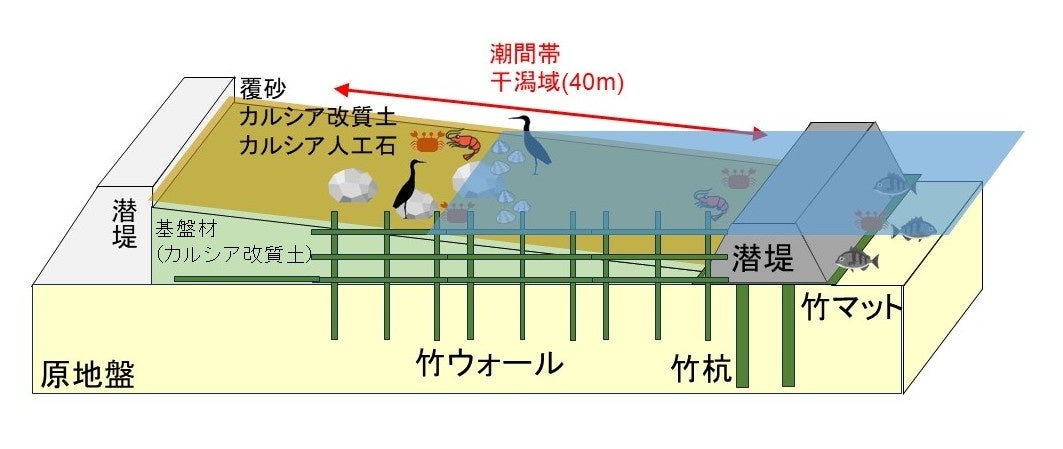
Overview of the Demonstration Experiment Dredged viscous soil is high in moisture and soft, making it difficult to utilize effectively as is. Therefore, strength improvement through dewatering or solidification treatment is necessary. While cement addition is a common method for solidification, this demonstration experiment also aims to confirm the applicability of tidal flat creation using Calcia-modified material*2 to suppress CO2 emissions. Calcia-modified soil will be used for the foundation material of the tidal flats, and Calcia artificial stones*4 will be used for the breakwater material. Calcia-modified soil is attracting attention as a material that is expected to suppress turbidity, improve the strength of dredged soil, and improve the seabed without affecting marine life. Furthermore, for reinforcing the base of the breakwater for tidal flats and for temporary piers for maintenance, materials such as piles and mats made from bamboo, a renewable resource, will be used. The materials used in the creation of tidal flats will be recycled and renewable materials, designed with consideration for the effective utilization of resources.
Future Outlook In this demonstration experiment, in collaboration with nearby universities, we plan to investigate the settlement status of seaweed and seagrass on stone and bamboo materials, and the amount of atmospheric CO2 absorbed and fixed as blue carbon by marine plants. We will also confirm the emergence of tidal flat effects such as biodiversity, and after the effects of the tidal flats become apparent, we are considering their use as a site for environmental education and research. Moving forward, we will proceed with the demonstration experiment and focus on developing technologies that contribute to the realization of a carbon-neutral society, thereby contributing to the realization of a sustainable society.
*1 A shallow water area mainly facing the coast. *2 A material produced as a byproduct of steel manufacturing, consisting of converter-type steelmaking slag with controlled composition and particle size. *3 A material whose physical and chemical properties have been modified by mixing Calcia-modified material with soft dredged soil. *4 A material made by mixing Calcia-modified soil with binders such as blast furnace slag powder to increase strength to the level of stone, and then crushing it after solidification.
[Image] Image of an artificial tidal flat
[Image] Artificial ti
FACT BOX
- Source: PR TIMES
- Category: News