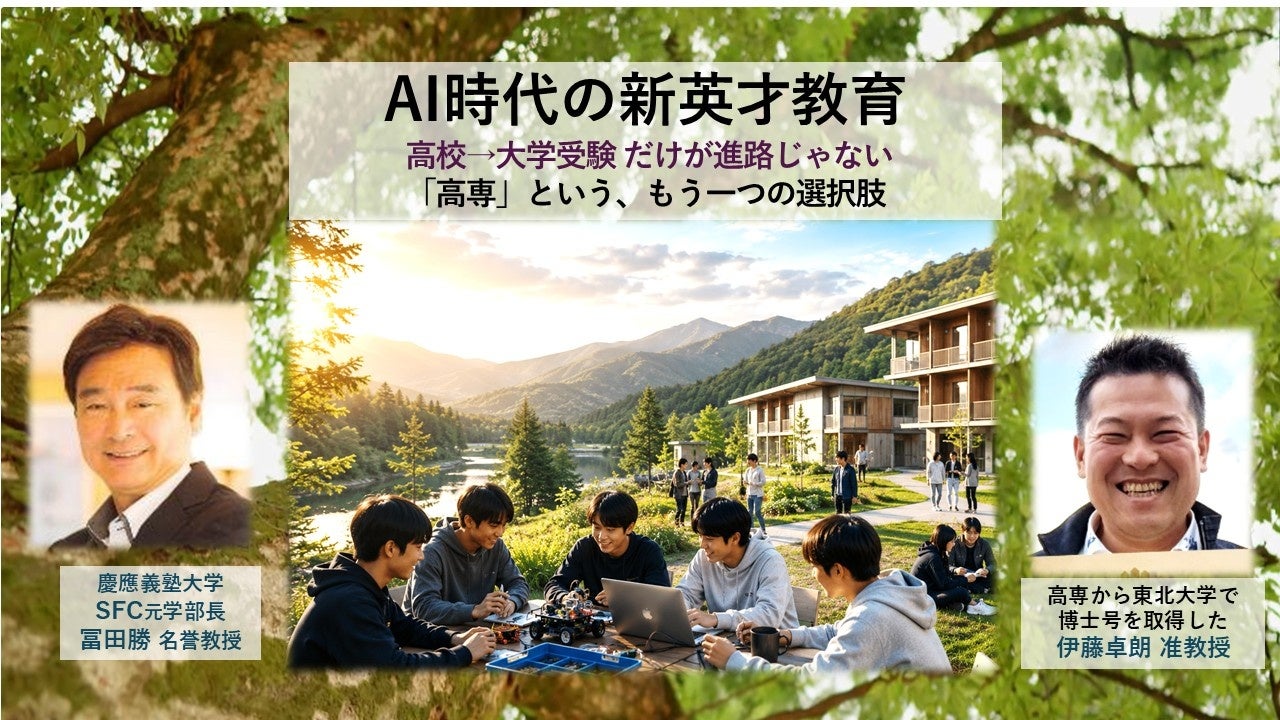
Does the common sense that "going to university from a regular high school" is the norm remain unchanged in the age of AI?
In the rapidly evolving society of AI, what will be required are not people who get good scores on tests, but individuals who can identify challenges on their own, collaborate with peers, and create new value beyond what is written in textbooks. "Kosen" (National Colleges of Technology) are now being re-examined as a system for "New Gifted Education in the Age of AI" to foster such human and technical capabilities.
Kosen is an educational system, comparable to a Japanese-style boarding school, where students become independent through dormitory life, learn what they love with passion alongside peers from all over the country and international students, and cultivate advanced expertise and human capabilities over five years. In fact, many of the world's prestigious boarding schools are located not in urban areas, but amidst rich natural environments.
Kosen graduates nurtured in this way are widely sought after by society. They are highly valued by major manufacturers, IT companies, infrastructure companies, and R&D departments, with recent employment rates at nearly 100%. The job offer to student ratio exceeds 20:1, meaning each student receives more than 20 job offers (National Institute of Technology Organization, Overview, FY2025 Edition).
Simultaneously, Kosen graduates have pathways to transfer to the third year of national universities, and even pursue graduate studies to become researchers, scientists, university faculty, entrepreneurs, or managers.
• What are the differences from regular high schools?
• What is the value of starting dormitory life in a rural area at age 15?
• What abilities are truly needed in the age of AI?
In this discussion, we welcome Mr. Takuro Ito, who advanced from Kosen to graduate school, obtained a Ph.D., and is active as a cutting-edge life scientist. Professor Emeritus Masaru Tomita of Keio University will provide a detailed explanation of "Kosen" as an old yet new educational path option.
Event Overview
Date and Time: July 12, 2026 (Sun) 7:30 PM - 8:45 PM
Format: Zoom Webinar (Live)
Target Audience: Parents, junior high school students, and those interested in education
Capacity: 300 people
Participation Fee: Free
Takuro Ito
Advanced from Kosen to university and graduate school, obtaining a Ph.D. While active at the forefront of life sciences, he also established an NPO to promote the charm of Tsuruoka's traditional culture and regional tourism.
A researcher integrating science and humanities, symbolizing the age of AI, who freely moves between science and culture.
1998 Graduated from the Department of Materials Science, Tsuruoka National College of Technology
2001 Graduated from the Faculty of Agriculture, Hirosaki University (Transferred in 3rd year)
2006 Completed Doctoral Program at the Graduate School of Life Sciences, Tohoku University
2006 Researcher and Project Assistant Professor, Institute for Advanced Biosciences, Keio University
2015 Assistant Program Manager, Japan Science and Technology Agency (JST)
2021 Associate Professor, Tsuruoka National College of Technology
2025 Awarded the Medal with Purple Ribbon by the Minister of Education, Culture, Sports, Science and Technology
Masaru Tomita
Professor Emeritus at Keio University. Born in 1957. After graduating from the Faculty of Science and Technology at Keio University, he studied AI at Carnegie Mellon University in the U.S. and obtained a Ph.D. He returned to Japan in 1990 with the opening of the Shonan Fujisawa Campus at Keio University. He served as Associate Professor, Professor, and Dean of the Faculty of Policy Management. In 2001, he established the Institute for Advanced Biosciences at Keio University (Tsuruoka City, Yamagata Prefecture) and served as its director for 22 years, during which he supported the founding of nine Keio Tsuruoka-based venture companies. Representative Director of Tsuruoka Science Park. Author of "Datsu Yutosei no Susume" (Hayakawa Shobo) and "Game Shonen no Yume" (Kindle), among others.
FACT BOX
- Source: PR TIMES
- Category: 教育