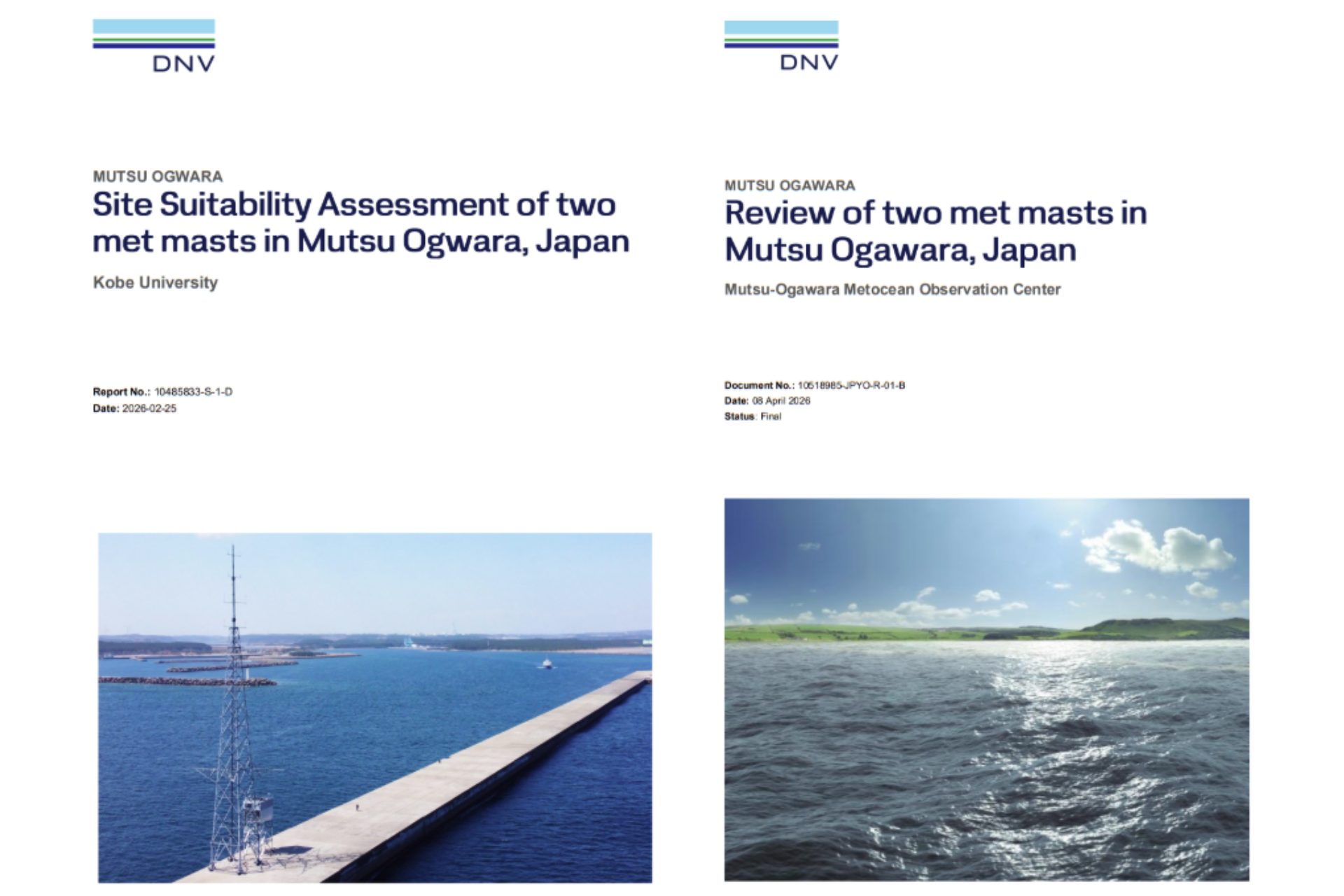
The General Incorporated Association Mutsu-Ogawara Metocean Observation Center (Representative Director: Eiichi Kobayashi, hereinafter "MOC") has signed a technical cooperation agreement (hereinafter "the Agreement") with DNV AS, Japan Branch (hereinafter "DNV") to establish a foundation for receiving technical support from DNV regarding the utilization of the Mutsu-Ogawara Offshore Wind Observation Test Site (hereinafter "the Test Site") operated by MOC.
Purpose of the Agreement
The Agreement aims to establish a foundation for MOC to receive technical support from DNV, an independent consultant, as MOC contributes to the healthy development of the offshore wind power sector through the Test Site. In the future, by obtaining third-party evaluation from DNV on MOC’s operational experience and environment at the Test Site, MOC aims to contribute to the development of technical infrastructure for offshore wind power in Japan and the promotion and advancement of renewable energy.
Under this Agreement, the following items will be discussed to prepare for achieving the above objectives:
1. Technical information regarding the utilization of the Test Site
2. Observation equipment, measurement methods, and verification methods
3. The offshore wind power sector in general
The Agreement does not include the provision of technical support services by DNV. Specific technical support will be implemented through a separate service agreement between MOC and DNV. Prior to this Agreement, DNV has already conducted evaluations of the test site and wind mast specifications, and continued technical support from DNV is expected in the future.
Significance of the Agreement
In offshore wind power generation, acquiring high-precision wind data is essential for project feasibility assessments and wind farm design. However, installing offshore wind masts typically requires extensive local coordination, permitting procedures, and significant costs. In recent years, remote sensing technologies such as scanning lidar (Note 1) and floating lidar systems (Note 2), including Doppler lidar (Note 3), have become the global standard for offshore wind measurement, both domestically and internationally.
However, to apply data obtained from these advanced observation instruments to actual project feasibility assessments, prior accuracy verification under offshore conditions compliant with international standards (e.g., IEC standards) is globally recognized as essential.
The Test Site is Japan’s first public facility capable of conducting such verifications under conditions closely resembling actual offshore environments. MOC, as the operator of Japan’s first verification field, receiving technical support from DNV—a globally recognized independent consultant and third-party organization with extensive expertise—brings high technical credibility to this initiative. DNV possesses extensive international experience in offshore wind measurement and provides comprehensive support, from pre-verification of LiDAR systems to full measurement campaign planning. DNV’s technical support is seen as a crucial step toward elevating the reliability of verification sites and, ultimately, offshore wind observation data in Japan to international standards, thereby facilitating smoother and more reliable future project development.
Major examples of offshore wind farms and wind observation methods
Notes
Note 1) Scanning Lidar: A device that observes wind conditions by emitting a laser beam and receiving backscattered light from airborne particles in the atmosphere. Installed onshore, it can measure offshore wind conditions by directing lasers toward the sea. Scanning lidar rotates its head while emitting lasers to measure wind conditions along the laser path.
Note 2) Floating Lidar System: A device that installs a Doppler lidar on a floating offshore structure to measure wind conditions above the sea surface. (Using scanning lidar or floating lidar systems enables relatively easy wind observation at high altitudes and in deep-water areas offshore, where observation with meteorological masts is difficult.)
Note 3) Doppler Lidar: A type of LiDAR that observes the relative velocity and displacement of a target by detecting frequency shifts caused by the Doppler effect. LiDAR is an acronym for Light Detection and Ranging or Laser Imaging Detection and Ranging, a remote sensing technology using light. Since lidar performs wind observation via remote sensing, calibration against anemometers is essential.
Accuracy verification of floating lidar used in offshore wind observation at the test site
Accuracy verification of scanning lidar used in offshore wind observation at the test site
Overview of the Mutsu-Ogawara Offshore Wind Observation Test Site
Official Website: https://mo-testsite.com/
The Mutsu-Ogawara Offshore Wind Observation Test Site is Japan’s first offshore wind observation facility, established within Mutsu-Ogawara Port in Aomori Prefecture, capable of verifying the accuracy of remote sensing instruments such as Doppler lidar used for wind observation. Since April 2024, it has commenced full-scale operations under a joint management framework between Kobe University and the General Incorporated Association Mutsu-Ogawara Metocean Observation Center (MOC). The site aims to become a public test facility widely accessible to wind power developers, observation service providers, researchers, educational institutions, and local stakeholders by opening observation equipment to general users and providing wind, weather, and oceanographic data.
【Main Activities】
1. Accuracy Verification of Wind Observation Instruments
Doppler lidar and other wind observation instruments for wind power generation can be used for accuracy verification. Issuance of verification reports is also possible.
2. Research & Development and Educational Use
Functions as a research and development platform in fields such as wind, weather, oceanography, environment, and ecosystems, offering joint research with Kobe University and educational opportunities for students.
3. Regional Contribution
Emphasizes collaboration with local communities through marine spatial planning support using observation data and educational initiatives in partnership with academic institutions in Aomori Prefecture.
Corporate Overview
Organization Name: (Non-Profit) General Incorporated Association Mutsu-Ogawara Metocean Observation Center (English: Mutsu-Ogawara Metocean Observation Center; MOC)
Address: • Head Office: 3-25 Toyosu, Hachinohe City, Aomori Prefecture 039-1162 • Branch Office: 5-1-1 Fukayaminamimachi, Higashinada-ku, Kobe City, Hyogo Prefecture 658-0022
Established: March 2024
Representative Director: Eiichi Kobayashi
Directors: Yasuichi Hayashi, Akihiro Honda, Mizuki Konagaya, Hirofumi Tsujimoto, Kazuhiro Kawamoto
Auditor: Fumihiko Iizuka
Constituent Members (Corporate): Reratech Inc., Japan Meteorological Association, Kitanihon Kaikou Kogyo Co., Ltd., Kobe University Innovation Inc.
Main Activities: Management and operation of the "Mutsu-Ogawara Offshore Wind Observation Test Site" in collaboration with National University Corporation Kobe University
Website: https://moc.or.jp/ (MOC), https://mo-testsite.com/ (Test Site)
【Inquiries】
For inquiries, requests, or media inquiries regarding MOC, please contact the following email address.
press[*]moc.or.jp
*Please replace [*] with @ in the above address.
For inquiries regarding the use of the Mutsu-Ogawara Offshore Wind Observation Test Site, please visit the following page.
https://mo-tests
FACT BOX
- Source: PR TIMES
- Category: Partnership
- Organizations: DNV AS, Japan Branch