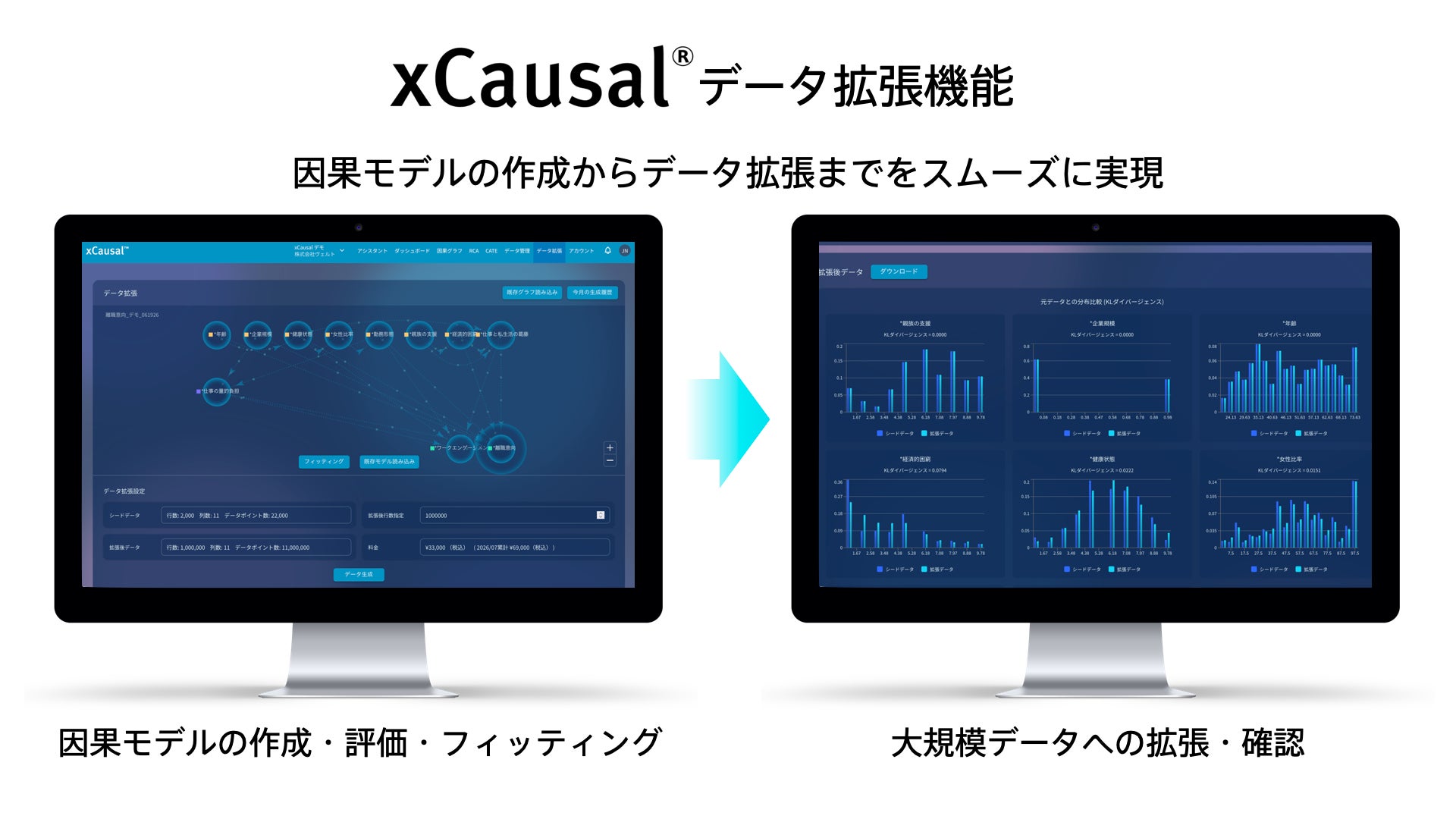
Veldt Inc. (Headquarters: Shibuya-ku, Tokyo; CEO: Hitoshi Nonogami; hereinafter "Veldt") will begin offering the "xCausal® Data Augmentation Feature" on July 13th. This feature, as part of its proprietary Causal AI platform "xCausal®", generates large-scale data required for AI development and statistical analysis from a small amount of seed data. This function applies the principle that a Graphical Causal Model (GCM) can expand a small amount of seed data into a large dataset, provided the GCM accurately captures the reality of the target domain. It can address the needs of fields with "many variables but few cases," such as rare disease research in healthcare, and can be applied to areas where data scarcity is a serious issue, including manufacturing, finance, infrastructure, and mobility. The generated data comes standard with a Fidelity verification function, allowing quantitative confirmation of how faithfully the augmented data reproduces the seed data.
In 2026, Veldt refreshed its mission statement to "We power your business with WHY ~ Redefining trust in the age of AI." This function, which starts with the mechanism of cause and effect – the "why" – is offered as part of an initiative to embody this concept.
xCausal® Data Augmentation Feature Screen
Background: The Structural Challenge of "Data Shortage" Across All Industries
The problem of quantitative data scarcity in AI and statistical analysis is widespread. Events most critical for decision-making, such as product defects, fraudulent transactions, equipment failures, disasters, and rare diseases, occur infrequently. This leads to biased and imbalanced data, causing predictive models to miss important cases across various domains. Meanwhile, recently popularized generative AI synthetic data methods require large amounts of training data for high-accuracy models, making them difficult to use in situations with limited data. When generated from small amounts of data, they tend to merely replicate the original data, and the generation process becomes a black box, raising the adoption hurdle in fields requiring accountability like healthcare and finance.
Utilizing Causal Models (GCM) as "Data Generation Mechanisms"
General data augmentation methods like GANs and VAEs approach the problem by referencing a large amount of data and mimicking its appearance (distribution). They do not capture the reasons why certain values occur. Consequently, accuracy decreases with less reference data, and the generation process becomes difficult to explain externally. In contrast, GCMs prepare a blueprint of how data is generated through a chain of causes and effects. For example, by incorporating causal relationships like "when a certain condition changes, the next state changes, resulting in a change in quality," they can generate large amounts of coherent data even from a small amount of seed data. Furthermore, they can explain "why" each individual value occurs. The difference from imitative approaches is the ability to generate plausible data according to the blueprint, even for conditions not actually observed.
Image of the process of generating and verifying data from causal mechanisms
Features of This Function
1. Augmentation Based on Causal Structure, Not Mimicking Correlation
Data is augmented starting from the following data generation mechanism. While general methods mimic observed correlations (interpolation), this function generates data based on causal structure, enabling it to function even with small seed data and explain "why the data was generated" through its causal structure. It can generate data for interventions and counterfactual scenarios that have not actually occurred but are possible, making it useful for preparing for rare events and for stress testing.
1 Variables with no parents (root nodes) sample values from their respective distributions.
2 Variables with parents (child nodes) have their values determined by calculating them using functions or machine learning models with parent values as input, plus noise (i.e., a functional mechanism). Expressed as an equation: "Child = f(Parent) + Noise."
3 This process is repeated sequentially from upstream (parents) to downstream (children) to create one data record (one row).
By repeating this process for the required number of records, data can be expanded to a large scale while maintaining the same causal relationships as the seed data.
2. Fidelity Verification Function
The extent to which the augmented "synthetic augmented data" reproduces the seed data can be quantitatively confirmed from the following two perspectives:
・ Similarity of each variable's distribution: Univariate distributions are compared with the seed data.
・ Comparison of correlation between variables: The correlation and dependency relationships between variables are compared to see if they are maintained.
For higher accuracy verification, we offer a practical utility test using predictive models as a professional service. Identical predictive models are built and compared using the seed data and augmented data, respectively, to verify the quality of the augmented data from the perspective of its usability "as a substitute for real data."
* The concept of "synthetic augmented data" and fidelity evaluation in this function refers to the definition and evaluation methods for synthetic data presented by the UK's Office for National Statistics (ONS).
3. Reliability and Usability of the Causal AI Platform "xCausal®"
The value of this function is realized on the foundation of the Causal AI platform "xCausal®." xCausal® is a SaaS-type causal AI platform that is intuitive to use without coding, balancing reliability and ease of use. It enables the rapid creation of highly reliable models using theoretically proven causal inference based on Structural Causal Models (SCM) and functions like robustness evaluation.
4. Professional Services - Causal Model Creation Support, Utility Verification, etc.
Veldt provides comprehensive professional services, from supporting the construction of the underlying causal models (GCM) for this function to verifying the practical utility of the augmented data. For causal model creation, we assist in identifying necessary variables and data, such as covariates, and support model construction. For utility verification, we build and compare identical predictive models using seed data and augmented data to assess the quality of the augmented data from the standpoint of whether it can be used in place of real data.
Prerequisites and Target Audience
This function operates effectively under the premise that the underlying causal model (GCM) and mechanisms are valid from an expert perspective.
・ Usage Prerequisites: If the prerequisite causal model differs from the actual reality, incorrect data may be generated. The output quality of this function depends on the validity of the input GCM, so please use it with the prerequisite of domain expert verification and confirmation of the causal structure.
・ Target Data: Tabular numerical data is targeted.
・ Balance Between Data: The quality of augmentation is also influenced by the balance between variables in the seed data.
Please note that highly biased data will result in augmented data that reflects that bias.
Contribution to AI-Ready Data
In recent years, the importance of "AI-Ready Data" – data prepared for immediate use in AI learning and inference – has rapidly increased in domestic and international policies. AI-Ready Data refers not only to large quantities but also to high-quality data that ensures accuracy, consistency, and completeness, and that machines can interpret its meaning. Large amounts of such high-quality data are necessary for AI to improve accuracy by suppressing hallucinations and bias. Japan's first "Basic Plan for Artificial Intelligence" (subtitle: "Japan's Revival through Trustworthy AI"), decided by the Cabinet in December 23, 2025, emphasizes the development and expansion of high-quality data, which is Japan's strength, and ensuring the explainability and transparency of AI [1]. Furthermore, the "Basic Policy on the Future of Data Utilization Systems," decided by the Council for Digital Administrative Reform on June 13, 2025, takes as its basic perspective the creation of a virtuous cycle of data and AI to realize an "AI-Powered Society" [2]. The "xCausal Data Augmentation Feature" addresses the challenge of "scaling while maintaining quality" by expanding small amounts of high-quality seed data into large datasets based on causal structure. Moreover, the Fidelity verification function allows for quantitative confirmation that accuracy and consistency are maintained even after augmentation, contributing to the development of AI-Ready Data that balances both quantity and quality. This initiative supports the virtuous cycle of data and AI advocated by the government in areas where AI utilization has been hindered by data scarcity.
【Sources】
[1] Cabinet Office, "Basic Plan for Artificial Intelligence"
[2] Council for Digital Administrative Reform, "Basic Policy on the Future of Data Utilization Systems"
Deployment Areas and Main Use Cases
We plan to offer this service in a wide range of fields where data scarcity and imbalance are issues, including healthcare/drug discovery, finance/insurance, physical AI/mobility, manufacturing, social infrastructure/disaster prevention, and cybersecurity. For example, the following use cases are envisioned:
・ Pharmaceuticals: Generation of External Control Arms
Constructing a pseudo-control group for clinical trials by generating counterfactual data from a few patient data points.
・ Finance: Testing Resilience Against New AML (Anti-Money Laundering) Tactics
Resolving blind spots in detection models by generating previously unobserved fraud patterns from causal graphs.
・ Physical AI: Generation of Physically Consistent Edge Cases
Safely mass-producing physically correct accident data from minimal measurement data through augmentation that enforces physical laws.
Comment from Professor Shogo Watanabe, Graduate School of Health Sciences, Okayama University
While AI analysis is advancing in medical decision-making in the cardiovascular field, ensuring reliability in determining "which treatment intervention is optimal" has been a major challenge with traditional correlation-based predictions alone. The causal inference technology provided by Veldt allows for the construction of causal mechanism models from complex clinical data, enabling the simulation of optimal treatment effects even from limited real-world data. This approach greatly enhances the interpretability of medical AI and is strongly expected to become an important model case for the advancement of personalized medicine in cardiovascular diseases.
What is the Causal AI Platform "xCausal®"?
Service Site: https://xcausal.com/
xCausal® (Cross-Causal) is a SaaS-type Causal AI platform for business users, usable without coding, even for those who are not data scientists. It is equipped with intelligence technology that pursues reliability and ease of use, offering a full stack of functions including prior knowledge setting, causal discovery, causal inference, robustness evaluation, root cause analysis (RCA), and CATE (Conditional Average Treatment Effect), which is a key feature of Causal AI. It also features an assistant function that allows users to improve models and utilize various Causal AI capabilities through an AI agent by entering prompts via an interactive UI. Veldt also provides accompanying professional services such as custom support and analysis outsourcing.
About Veldt Inc.
Veldt Inc. is a data science company that accelerates social problem-solving and goodwill innovation through the power of understanding "why." As a leading company in Causal AI, we offer the Causal AI platform "xCausal® (Cross-Causal)" for elucidating causal relationships, and custom solutions such as "Causal AI Assistant" that AI-enable specialized knowledge and advanced decision-making processes of organizations. By providing "trustworthy AI" with interpretability and explainability, which tend to be black boxes, Veldt creates a positive spiral in society.
CEO Hitoshi Nonogami
Headquarters: 5-18-10 Jingumae, Shibuya-ku, Tokyo 2-D
Established: August 1, 2012
URL: https://veldt.jp
FACT BOX
- Source: PR TIMES
- Category: 製品リリース